

The “GM 4465P Water Vapor Humidity Test” standard, published by General Motors (GM), is an engineering testing standard developed to evaluate the resistance of coated materials and components to prolonged exposure in high-humidity, saturated water mist environments. This standard is widely used to verify automotive paints, coatings, coated parts, adhesives, and other protective coatings that must withstand moisture throughout the vehicle's lifespan.
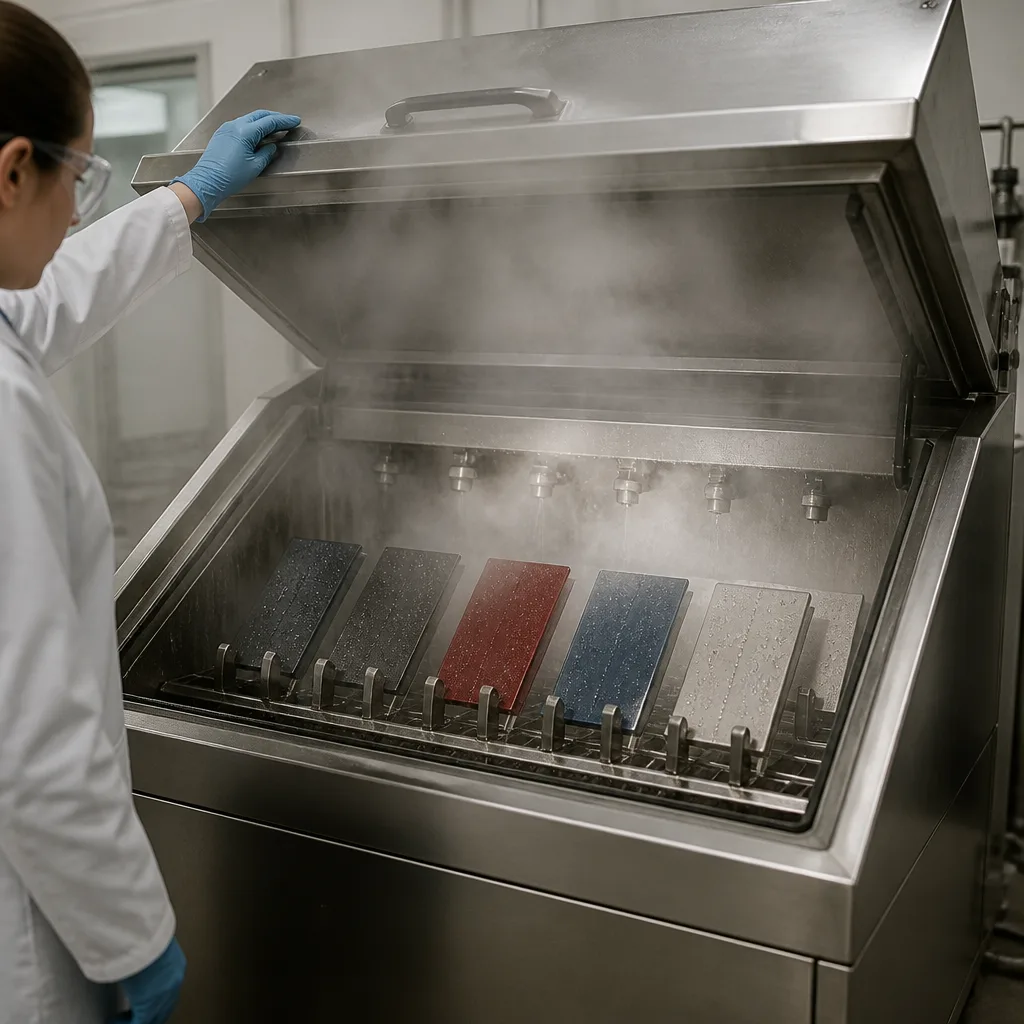
This standard is primarily based on the “ASTM D1735 Standard practice for testing the water resistance of coatings using a water mist device” standard, but the GM 4465P standard includes additional General Motors-specific requirements, improvements, and acceptance criteria for automotive applications.
The primary purpose of the GM 4465P standard is to determine how well protective coatings resist degradation caused by continuous exposure to hot, saturated moisture. This standard evaluates whether coatings can:
Because vehicles are exposed to rain, condensation, humidity, and temperature fluctuations throughout their lifespan, moisture resistance is one of the most critical durability characteristics of automotive coatings.
Water vapor is one of the most significant environmental factors affecting the durability, performance, and reliability of automobiles. Although invisible, atmospheric moisture can penetrate materials, condense on vehicle components, and initiate degradation processes that shorten a vehicle's service life. Therefore, automotive manufacturers invest considerable effort in designing materials and verifying components that can withstand prolonged exposure to humid environments.
Moisture testing standards such as GM 4465P, ASTM D1735, ISO 6270, and various manufacturer-specific specifications have been developed to evaluate how materials withstand accelerated moisture exposure before being used in manufacturing processes.
The GM 4465P standard applies to numerous automotive materials, including:
The described test method can also be used after other environmental exposures to determine cumulative resistance.
In principle, the test method exposes test samples to a continuously saturated water mist atmosphere within a humidity chamber. Unlike the salt spray test, the GM 4465P standard uses pure water mist instead of an abrasive salt solution. This environment accelerates moisture absorption into the coating systems while neutralizing the effects of chlorides.
The test primarily assesses the following:
While the exact requirements vary depending on the material properties, typical conditions include:
These conditions provide accelerated exposure to moisture compared to natural environmental conditions.
Following exposure, inspectors evaluate the sample for defects such as those listed below:
Acceptance criteria are generally defined by GM material specifications or engineering drawings.
The GM 4465P standard is essentially based on the ASTM D1735 standard, but GM has introduced additional requirements specifically tailored for automotive products. The GM version generally specifies the following:
Therefore, the GM 4465P standard should be viewed not as a completely separate test method, but as General Motors' adaptation of the ASTM D1735 standard.
The GM 4465P standard has been used to characterize the following:
It has also been used as a reference in other GM engineering specifications for corrosion-resistant coatings and environmental durability verification.
The main advantages of this standard are:
However, despite its immense value, the GM 4465P standard does not evaluate every environmental factor. For example, it does not simulate the following:
Consequently, the GM 4465P standard is typically used in conjunction with other GM environmental and corrosion tests during full product validation.
The GM 4465P standard is now classified as an inactive standard. As GM unified its engineering specifications globally, many older standards have been replaced by newer GMW (General Motors Worldwide) standards for humidity and environmental durability testing. However, laboratories still use the GM 4465P standard for legacy programs or customer-specific requirements.
Moisture is a leading cause of coating degradation and corrosion in vehicles. Even coatings that perform well in dry conditions can degrade after prolonged exposure to moisture. The GM 4465P standard provides engineers with a controlled and accelerated method to identify these weaknesses before production. This standard contributes to:
Although largely superseded by newer GM Worldwide specifications, the GM 4465P standard has played a significant role in defining moisture resistance requirements for automotive coatings and remains a recognized reference for legacy General Motors programs.
For many years, our organization, with its competent and experienced staff, has been understanding the needs of its clients, providing the advanced testing services they require, and assisting them in the establishment, implementation, and improvement of management systems. Within this framework, we also provide testing services compliant with the GM 4465P standard.
To get an appointment, to get more detailed information or to request an evaluation, you can ask us to fill in our form and reach you.

