

External surface sealing systems are essential components of modern vehicles as they protect vehicle cavities and components from water, dust, dirt, moisture, corrosive contaminants, and environmental impacts. General Motors uses environmental cycle testing to evaluate whether external surface sealing materials can maintain their protective function throughout simulated service conditions.
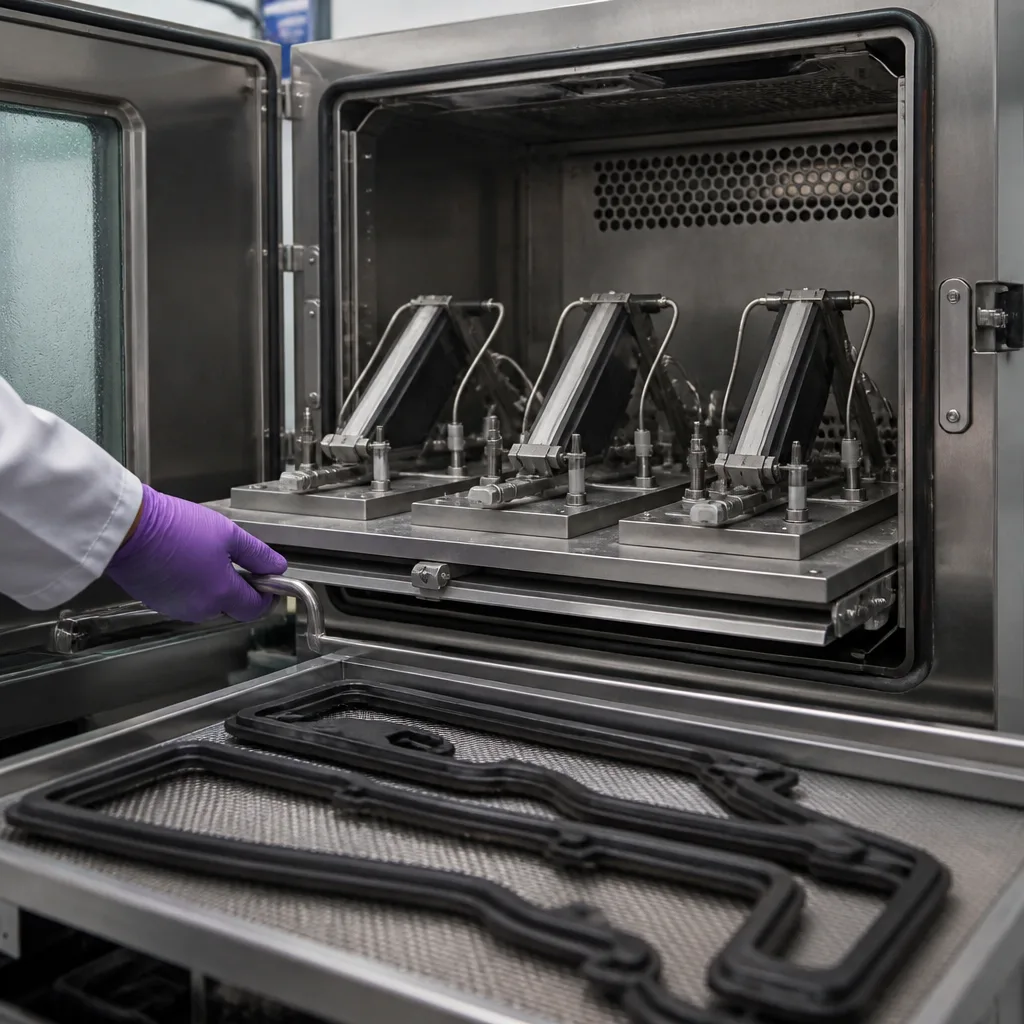
Developed by General Motors Worldwide (GMW), “GMW Cycle Testing - External Surface Sealants” is defined as climate testing followed by corrosion testing in accordance with the SAE J1389 standard by advanced testing laboratories and includes applications such as closed-cell, in-situ foam, and thermoplastic sealants.
The primary purpose of external seal cycle testing is to determine whether a sealing material or sealing system can withstand repeated environmental stresses without losing its required performance. During vehicle servicing, external seals may be subjected to:
Therefore, the test provides a laboratory simulation of environmental exposure, rather than relying solely on a simple initial material examination.
The outdoor loop approach can be applied to various sealing technologies:
These three categories are outlined in the GMW external cycle test description. The test is essentially an environmental durability assessment. A representative sealing material or component is subjected to defined environmental conditions in a controlled array of laboratories. A typical assessment concept consists of: initial inspection, climate exposure/cycle testing, corrosion exposure, final inspection, and performance evaluation.
Precise temperatures, humidity levels, exposure times, number of cycles, sample configuration, and acceptance criteria are specified in the relevant GMW specification or referenced test table.
Climate exposure aims to reproduce the environmental stresses that an external sealing system might be subjected to during vehicle operation. Temperature and humidity variations can cause:
A sealant that performs well under laboratory conditions may exhibit significantly different behavior after undergoing environmental cycling.
Following climate exposure, testing may include a corrosion exposure phase according to the SAE J1389 standard. This part is important because external seals are often located close to metallic vehicle structures. A seal that allows moisture or contaminants to reach the metal interface can contribute to corrosion-related problems.
The combined assessment of climate and corrosion represents the actual vehicle exposure, going beyond simply evaluating the sealant after a basic temperature test. Depending on the applicable GMW material or component specification, the assessment may include the following observations:
External seals are a relatively small component of a vehicle, but their failure can have significant consequences. A compromised seal can allow water or contaminants to enter areas that need protection. Possible consequences include:
Therefore, environmental cycle testing is a crucial part of validating external sealing materials and systems.
External cycling should not be considered as an isolated material test. GMW specifications may combine external cycling with other requirements such as material properties, adhesion, compression behavior, dimensional stability, or resistance to specific environmental factors. For example, the GMW 17408 standard is defined as a specification for flexible foam rubber and rubber-like materials used for air, dust, noise, and water insulation, and is listed in laboratory listings as “External cycling test.” This highlights an important point: applicable test conditions and acceptance criteria depend on the specific GMW specification and insulation application.
In general, the testing process follows these steps:
In conclusion, GMW cycle testing is an environmental durability approach used to evaluate whether automotive exterior sealing materials can withstand combined climatic and corrosion-related stresses. The main objective is to determine whether the sealing system can maintain its physical integrity and protective function after environmental aging.
For many years, our organization, with its competent and experienced team, has been understanding the needs of its clients, providing the advanced testing services they require, and assisting in the establishment, implementation, and improvement of management systems. Within this framework, GMW cycle testing services are also provided to businesses.
To get an appointment, to get more detailed information or to request an evaluation, you can ask us to fill in our form and reach you.

