

The “PSA D24 5011 Method for dry abrasion resistance of paint coatings with abrasive materials” standard, developed by the French car manufacturer PSA Group (now part of Stellantis), describes a test method for measuring the resistance of gloss coatings to dry scratches on plastic or metal brackets. This method is particularly applicable to gloss varnishes, but also to gloss topcoats.
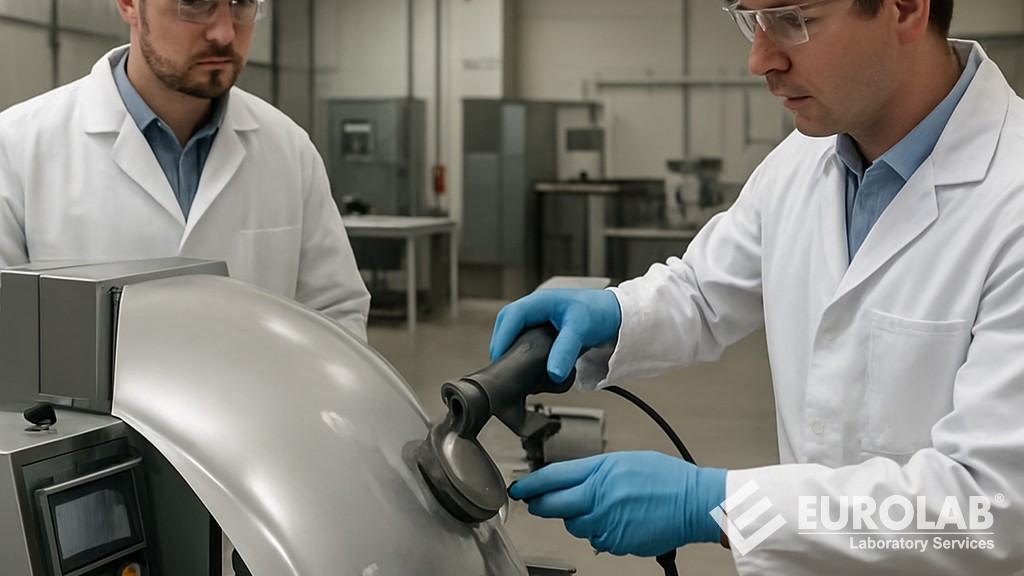
The test consists of exposing the paint coating to be evaluated to the effect of an abrasive material band fixed to a moving bracket. This abrasive material band is fixed to a bracket of known mass. The back-and-forth movement of the bracket is provided by a mechanical arm connected to a motor. The resulting surface defect is optical dullness caused by the accumulation of scratches. This deterioration is assessed by measuring the loss of gloss.
Test samples should be 100 mm x 150 mm in size, within the minimum limits, made of plate or plastic material, and covering the paint range to be tested. These test samples can be taken from vehicles (samples must be smooth) or performed for testing (for brackets other than plates, ensure that the bracket required for testing is representative: material, texture). This sampling procedure should be carried out according to the MXP_TAC07_0592 method for external vehicle parts. At least 2 test tubes are required for each test.
Tests are conducted in test chambers with temperatures of 23 degrees plus/minus 2 degrees and 50 percent plus/minus 5 percent relative humidity.
In the high-risk automotive manufacturing world, where vehicles are subjected to years of wear, tear, and environmental impacts, rigorous testing standards are essential. One such standard, PSA D24 5011, plays a critical role in ensuring the longevity and performance of paint coatings on vehicles. This specification includes a precise method for evaluating how resistant automotive paints are to scratching and dulling caused by dry friction. Developed and improved over the years, this standard helps engineers and quality control teams simulate real-world wear, such as wiping dust off a dashboard or rubbing against interior surfaces. As electric vehicles and advanced materials become more widespread, PSA D24 5011 and similar standards are vital for maintaining consumer confidence in vehicle aesthetics and durability.
Automotive paints are more than just color and gloss; they are complex, multi-layered systems designed to provide a visually appealing finish while protecting metal surfaces from corrosion. However, everyday use subjects these coatings to mechanical stresses: a passenger's arm rubbing against a door panel or a stain being wiped away with a cloth. Low abrasion resistance can lead to visible scratches, loss of gloss (dullness), and premature fading, which not only affects aesthetics but also accelerates corrosion if the top coat is punctured.
The PSA D24 5011 standard addresses this issue by focusing on dry wear, distinguishing it from wet or chemical wear tests. It is part of a broader family of standards covering various durability aspects of coatings. For example,
These standards are compatible with international standards such as “ISO 105-X12 Textiles - Color fastness tests - Part X12: Color fastness to abrasion” and “GOST 9733.27 Textiles - Test method for color fastness against color fading”, but PSA has adapted them specifically for automotive applications. In an industry where recalls due to paint defects can be costly, compliance with the PSA D24 5011 standard ensures that vehicles meet stringent original equipment manufacturer requirements.
This standard requires the following setup for reproducible results:
Samples must be conditioned for 24 hours prior to testing at a temperature of 23 degrees Celsius and 50 percent relative humidity to simulate standard laboratory conditions. Essentially, the testing process works as follows:
For many years, our organization, with its competent and experienced staff, has been understanding the needs of its clients, providing the advanced testing services they require, and assisting in the establishment, implementation, and improvement of management systems. Within this framework, we also provide testing services to businesses in accordance with the "PSA D24 5011 Dry abrasion resistance of paint coatings with abrasive materials" standard.
To get an appointment, to get more detailed information or to request an evaluation, you can ask us to fill in our form and reach you.

