

The standard “FORD FLTM BO 151-01 Low temperature impact resistance” developed by Ford Motor Company (FORD) describes a method for determining the low temperature impact resistance of polyurethane foams, foam-reinforced plastics, molded plastics and similar materials.
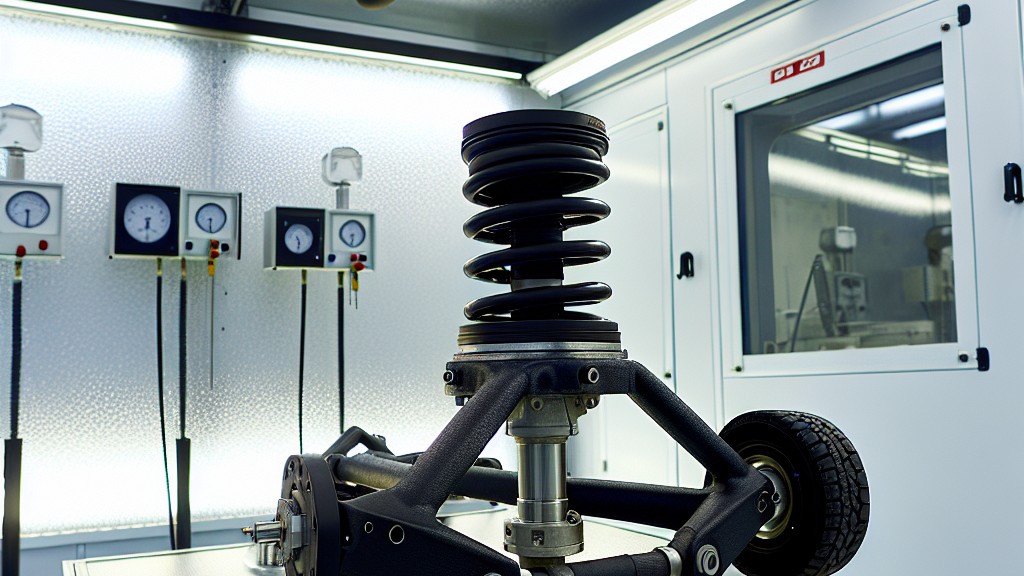
The ball drop test is a standard test method used to evaluate the impact resistance and energy absorption properties of various materials and products. It involves dropping a ball of a specified weight and diameter from a predetermined height onto a test specimen.
The FORD FLTM BO 151-01 standard describes two different drop test methods for determining impact resistance at low temperatures:
In these methods, the impact force generated in contact with the sample is measured to assess the ability of the sample to withstand the stresses associated with impact. Impact tests are widely used in various industries. Some examples include:
The load cells used in ball drop testers are specifically designed to withstand high impact forces and provide reliable and repeatable measurements. By carefully selecting a drop ball test force sensor with appropriate features such as high natural frequency response and sensitivity, engineers can measure drop test forces in a wide variety of applications. Damping of the measuring device and fixture can greatly affect the results in the overall system.
Additionally, the presence of additional mass in the test setup can affect the accuracy of the impact force measurement. Care should be taken to minimize any extraneous mass that could interfere with accurate measurement of applied forces during the ball drop test. However, it is extremely important to create a test setup that minimizes damping effects on the applied force so that the load cell sensor can accurately capture the full impact force.
The temperature coefficient relates the change in resistance to the change in temperature of the material. If the temperature coefficient is high, a greater portion of the resistance changes with the change in temperature. If the temperature coefficient is low, a smaller portion of the resistance changes with the change in temperature.
The resistance of any conductor is its ability to oppose current flowing through it. The greater the resistance value of any conductor, the less current will flow through it for any applied voltage. The temperature coefficient of resistance describes the change in resistance as a function of temperature. It can also be defined as the change in resistance per degree Celsius of temperature change. The electrical resistance of any substance changes with the change in its temperature. It is a measure of the change in electrical resistance of any substance per temperature change.
In fact, if the temperature of a metal increases, the random motion of free electrons and the vibration between atoms within the metal increases, resulting in more collisions. More collisions oppose the smooth flow of electrons through the metal, so the resistance of the metal increases with increasing temperature. Therefore, the temperature coefficient of resistance for metals is considered positive.
According to the general rule, the dependence of resistance on temperature is that in conductors, the resistance increases with increasing temperature, and in insulators, the resistance decreases with increasing temperature.
Our organization has a strong staff that closely follows the developments in the world in the field of science and technology and constantly improves itself. Among the numerous test, measurement, analysis and evaluation studies provided for businesses in various sectors, there are also test services in accordance with the "FORD FLTM BO 151-01 Resistance to low temperature impacts" standard.
To get an appointment, to get more detailed information or to request an evaluation, you can ask us to fill in our form and reach you.

