Flammability Resistance of KIA MS300-08 Interior Materials
Developed by Hyundai-Kia Motors, the oldest motor vehicle manufacturer in Korea, the “KIA MS300-08 Flammability Resistance of Interior Materials” standard is based on the “571.302 Flammability of Interior Materials” standard, developed under federal motor vehicle safety standards. The KIA MS300-08 standard describes the test methods and requirements for the flammability resistance of interior materials used in automobile production.
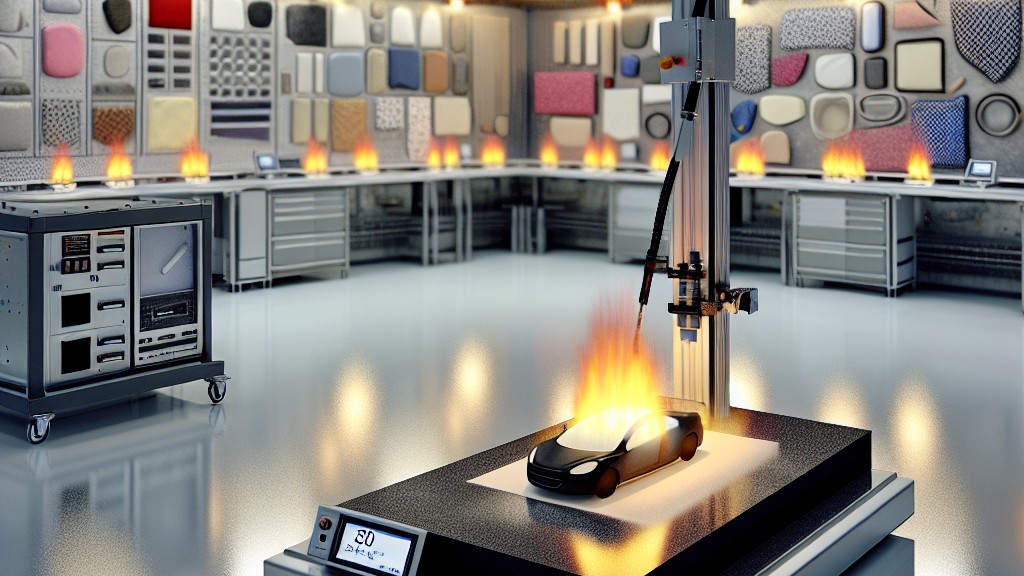
The following components, generally located in the passenger compartment of a vehicle and within 13 mm of the air surface, shall meet the requirements of this standard: seat and seat back, seat belt, head cover, convertible roof, armrest, door cover, door cover seal, door side cover, quarter cover, side cover, pillar cover, rear shelf, headrest, carpet, floor mat, curtain, sun visor, footrest, instrument panel pad and housing, speaker net, parking brake lever cover, gear lever boot, glove box side cover, console box, console side cover and air bag box cover, cushion and wrap. Other materials located in the passenger compartment of a vehicle designed to absorb crash energy and reduce noise (such as ventilation pad, steering wheel centre pad, air bag cushion and knee support) are within the scope of this standard.
The general requirements in this standard are described as follows:
- Materials subjected to flame resistance treatment must have excellent durability and not deteriorate flame resistance due to fatigue during the production process or after loading.
- The products must be free from defects that may affect their performance after flame resistance treatment. They must also conform to the part and material specifications.
- Flame retardant treated parts should not cause quality problems such as stains, fading, cracks, corrosion or unpleasant odors for built-in materials or other parts and materials used in contact.
- In case of flame resistance treatment, retardants prohibited by worldwide regulation should not be used.
This material is tested by the methods defined in the standard and must comply with the conditions specified in the table.
When starting the tests, 5 samples are prepared in accordance with the following methods:
- The specified size is taken whenever possible.
- The width should be 100 mm and the length should be 350 mm.
- The thickness should be the thickness of the finished products, however, if the thickness of the finished products exceeds 12mm, it should be cut smoothly to 12mm thickness.
When it is impossible to take the specified measurement,
- If the sample surface is not a plane, the samples are cut from the areas receiving the least bending. If so, the thickness shall not exceed 12 mm anywhere. However, in materials made of two layers of composite materials of different composition at a depth of 13 mm from the surface, whether bonded or not, the samples shall be prepared according to the following method:
- In case of adhesion to the entire surface, if the two bonded materials are not separated from each other, samples are prepared in a bonded state at a depth of 12 mm from the surface of the parts.
- If the entire surface is not adhered, only the materials on the surface of the passenger compartment air surface are separated and samples are prepared from the separated materials, and samples are cut from the adhered surface to a depth of 12 mm. However, when two different imposed materials adhere again to a depth of 12 mm, the samples are prepared in the same way as the passenger compartment air space.
- When the maximum dimensions achievable in width and length are less than the specified dimensions, the samples are cut to the largest possible dimensions. In this case, the minimum dimensions of the samples are 25 mm wide and 293 mm long.
- When it is not possible to obtain a flat sample due to surface curvature, the samples are cut from the material produced by the same process as the finished products. The thickness of the samples should be the thickness of the flat part of the finished parts.
- When the materials are anisotropic or have different burning rate, five samples are cut respectively.
- When materials contain a hairy or tufted type surface, samples should be placed on a flat surface and combed twice against the hair with a 25-7 tooth comb at 8 mm.
Tests are performed according to the following methods:
- The leading edge of the specimens is placed in the frame opening in a “U” shape. However, the specimen is oriented so that the exposed side faces downward toward the frame.
- The mounted sample is placed in a horizontal position and, in the case of a Bunsen burner being fitted to the test chamber, it is placed in the test chamber in such a way that the centre of its nozzle is 19 mm below the centre of the lower edge of the open end of the sample.
- The gas is adjusted with the control valve until the frame reaches a height of 38 mm.
- In this case, the air valve remains closed.
- The position of the sample in the test chamber shall be in accordance with this standard. The Bunsen burner is installed in the test chamber.
- After the sample is exposed to the flame for 15 seconds, the gas flow is stopped.
- The time required for the flame to travel from line A to line B is measured (38 mm from the U-shaped frame end of the sample). If the flame does not reach line B,
- The time and length until the point at which the flame stops is measured. The burning rate is measured even if a flash occurs. However, surface flash affected by cuts from the manufacture of the test pieces should be excluded.
- When the length of the sample is less than specified, the time required for the flame to travel a pre-measured distance beyond the drawn line A is measured.
- When the flame does not reach line B for up to 5 minutes, it is possible to forcibly stop the test. Then, the distance until the flame is extinguished is measured as the burning time.
- For each test piece, the temperature and gas in the test chamber are brought to normal.
Burning rate is calculated using the formula given in the standard.
Our organization has a strong staff that closely follows the developments in the world in the field of science and technology and constantly improves itself. Among the numerous test, measurement, analysis and evaluation studies provided for businesses in various sectors, there are also testing services in accordance with the "KIA MS300-08 Flammability resistance of interior materials" standard.



