

Developed by General Motors Worldwide (GMW), the “GMW 14093 Impact Resistance of Plastic Components” standard is an engineering standard used to evaluate the ability of plastic components to withstand impact forces under specific conditions.
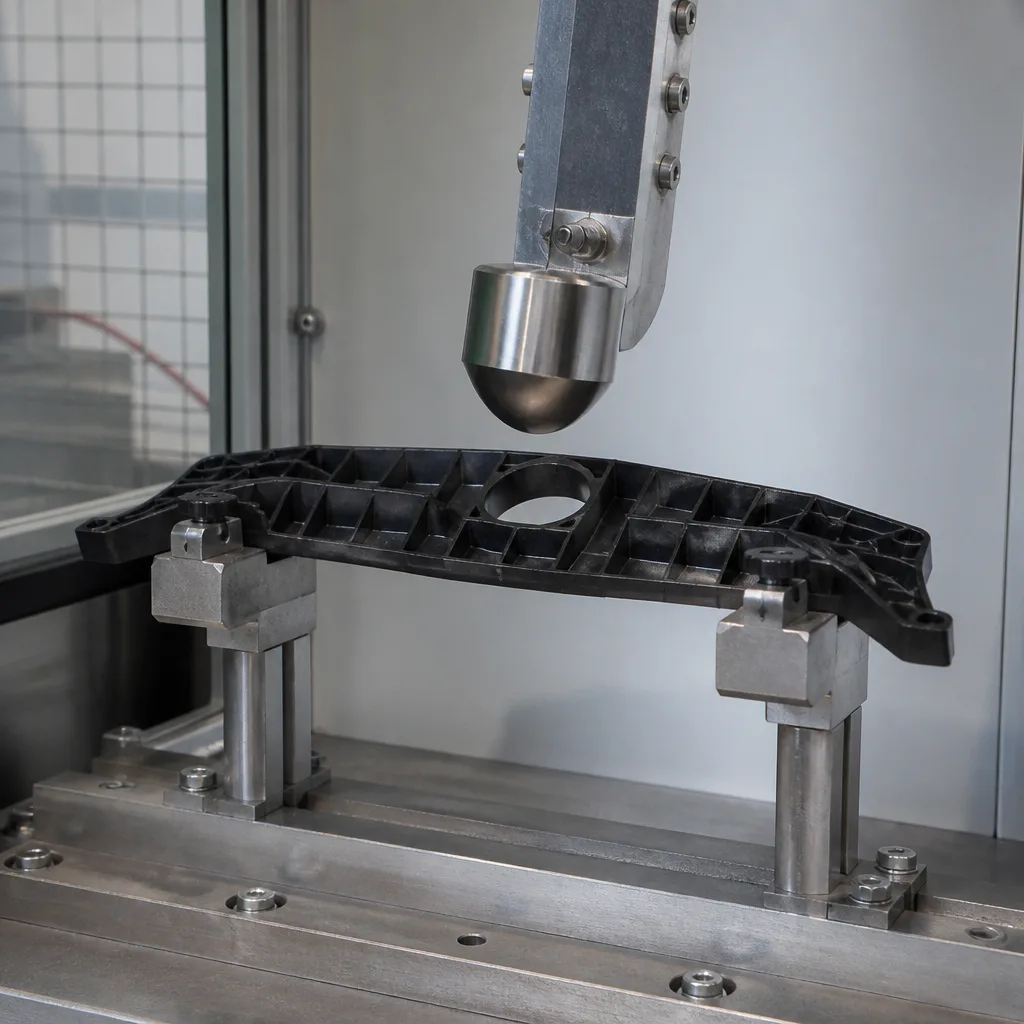
This standard is designed for plastic components that may be subjected to impact stresses during vehicle assembly, operation, maintenance, or daily use. Its primary purpose is to determine whether a plastic component can absorb a specified amount of impact energy without unacceptable cracking, fracture, or other damage.
Plastic components in automobiles can be subjected to sudden mechanical forces. Examples include impacts from tools, luggage, objects carried inside the vehicle, assembly processes, or accidental contact by vehicle passengers.
A plastic material may possess sufficient tensile or bending strength but still perform poorly under a sudden impact. Therefore, impact resistance represents a distinct aspect of material and component performance.
The GMW 14093 standard provides a controlled procedure for determining this impact resistance. The basic principle is to apply a defined impact energy to a test specimen or component and evaluate its response. This standard applies to plastic components likely to be subjected to impact stresses.
Impact resistance describes the ability of a material or component to withstand a rapidly applied mechanical load without catastrophic failure. During an impact, the component must absorb the energy in a very short period of time. Depending on the plastic formulation, temperature, geometry, thickness, aging condition, and manufacturing process, the component can:
The GMW 14093 standard is therefore particularly useful for identifying plastics that become brittle under specific environmental or temperature conditions.
This standard uses impact test arrangements in which a defined amount of energy is applied to the test piece. Various device configurations include:
A key feature of the GMW 14093 standard is that impact testing can be performed under different environmental or temperature conditions. The following coding is defined for different test conditions:
The applicable temperature, conditioning time, aging procedure, and impact requirements can be specified in the relevant engineering drawing or material specification. This is particularly important because many thermoplastics become significantly more brittle at low temperatures.
Impact energy is one of the key parameters in testing. Increasing the mass of the impactor or the drop height increases the energy transmitted to the component. This makes it possible to determine the minimum impact energy requirement for a given component.
A typical engineering requirement is conceptually expressed as: Impact resistance according to GMW 14093 standard, Apparatus A, Code 3, minimum 5 J. This type of definition specifies the test apparatus, environmental conditions, and minimum impact energy requirement.
During the test evaluation, the component is examined for damage following an impact. Depending on the applicable product specification, the evaluation may include:
Acceptance criteria are generally determined by the relevant General Motors component, material, or engineering specification, rather than solely by the impact testing method itself.
GMW 14093 standard is considered important for the following reasons:
For components subjected to significant mechanical shock, a material with better impact resistance can be selected.
Therefore, this standard provides useful information during component development and validation.
GMW 14093 standard is part of General Motors’ broader family of material and component testing requirements. It also replaces the earlier “GMI 60267 Determination of impact resistance of plastic components” standard.
The GMW 14093 standard may be applicable to numerous automotive plastics applications, including:
Actual feasibility depends on the component drawing, material specification, and General Motors engineering requirements.
In conclusion, the importance of the GMW 14093 standard goes beyond simply determining whether a plastic part has fractured. By controlling impact energy, temperature, conditioning, and test configuration, the method helps engineers assess the integrity of plastic components under conditions that may arise during vehicle use.
This standard is particularly valuable for identifying brittle behavior, evaluating low-temperature performance, comparing materials, supporting component design, and improving the durability and reliability of automotive plastic parts.
For many years, our organization, with its competent and experienced staff, has been understanding the needs of its clients, providing the advanced testing services they require, and assisting them in the establishment, implementation, and improvement of management systems. Within this framework, we also provide testing services in accordance with the GMW 14093 standard.
To get an appointment, to get more detailed information or to request an evaluation, you can ask us to fill in our form and reach you.

