

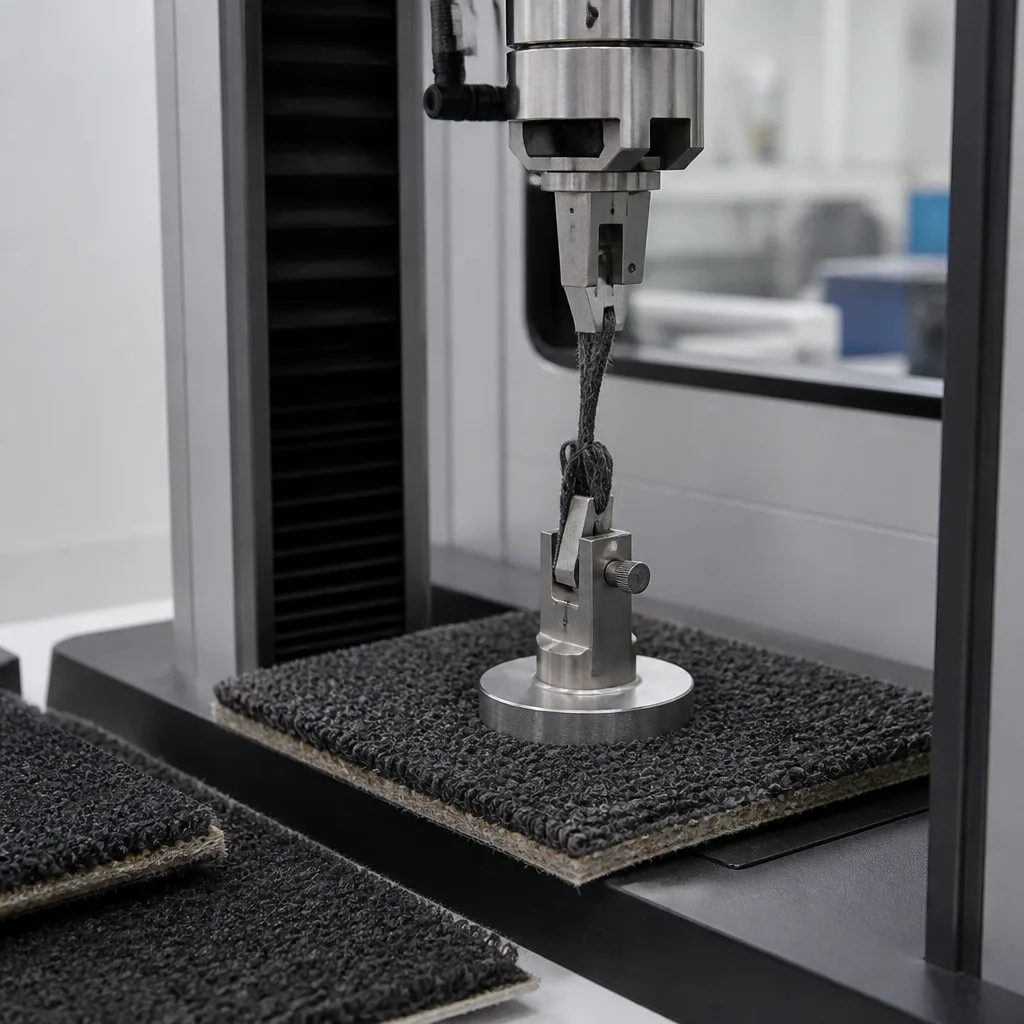
The “GMW 14148 Floor Carpet Loop Pull Strength” standard, developed by General Motors Worldwide (GMW), is a test specification used to evaluate the loop pull strength of automotive floor carpets. The test relates to the ability of carpet loops to remain securely fixed within the carpet structure when subjected to a defined tensile force.
Automotive floor carpets are subjected to repeated mechanical stresses during vehicle use. Shoes, mats, pedals, trunk, cleaning operations, and general foot traffic can pull or deform the carpet fibers.
The GMW 14148 standard provides a controlled method for evaluating whether individual carpet loops are sufficiently securely fixed to the carpet backing. The described method determines how much force is needed to pull a carpet loop from the floor carpet. In a carpet with poor loop retention, the following may develop:
Therefore, loop tensile strength is an important property for automotive carpets.
In shag automotive carpets, the yarn is formed into loops and mechanically secured to a backing material. When a loop is pulled upwards, the following can occur:
The GMW 14148 standard primarily addresses the resistance of the carpet structure to this tensile mechanism. This differs from a general tensile strength test because the aim is not simply to determine the strength of the yarn. This test evaluates the interaction between the carpet yarn, the pile structure, and the backing.
This standard applies to automotive floor carpets and related carpets used especially in areas exposed to pedestrian traffic. Potential applications include:
Precise applicability must always be verified against the current General Motors specification and the engineering drawing or material specification for the relevant vehicle program.
The test principle is relatively simple. A test sample is prepared from the carpet. Then a carpet loop is held with a suitable pulling device. The loop is subjected to a controlled pulling force until the specified failure condition occurs. The test equipment records the force associated with the breaking of the loop. The resulting value provides an indication of the carpet's loop/pile retention capacity.
The precise sample dimensions, conditioning, equipment, tensile speed, number of measurements, and acceptance criteria are specified in the GMW 14148 standard.
GMW 14148 standard is considered important for the following reasons:
This makes the test useful during material development and supplier qualification assessment.
Factors that affect the tensile strength of a carpet include:
In fact, the GMW 14148 standard should not be considered a complete durability assessment for automotive carpets. Instead, it evaluates a specific failure mode: loop rupture. A comprehensive automotive carpet assessment might also take into account the following characteristics:
These tests, taken together, provide a much broader assessment of carpet performance.
For a carpet supplier, compliance with the GMW 14148 standard is important in the following situations:
A supplier should not rely solely on the average test result. Variation between samples can also be important because inconsistent feather retention can indicate instability in the production process.
If a carpet fails a loop pull test, engineers must determine how the failure occurred, rather than simply recording the force value. Possible failure mechanisms include:
Failure mode analysis can help differentiate a yarn-related problem from a carpet making or production process issue.
In short, while the tearing of the fibers might seem like a minor feature, it directly contributes to the perceived durability of the vehicle's interior. A carpet that develops loose or missing fibers can cause the vehicle to look prematurely worn, even if the rest of the interior remains in good condition.
In conclusion, the importance of the GMW 14148 standard lies in its ability to control a specific, yet visually significant, failure mode of automotive carpets. By measuring loop retention rate, the test helps manufacturers and suppliers evaluate carpet construction, maintain production consistency, support material adequacy, and reduce the risk of premature interior deterioration.
For many years, our organization, with its competent and experienced staff, has been understanding the needs of its clients, providing the advanced testing services they require, and assisting them in the establishment, implementation, and improvement of management systems. Within this framework, we also provide testing services in accordance with the GMW 14148 standard.
To get an appointment, to get more detailed information or to request an evaluation, you can ask us to fill in our form and reach you.

