

The standard "DIN 75220 Aging of automotive components in solar simulation units," developed by the German Institute for Standardization (DIN), describes a test method for determining the aging behavior of polymer automotive components in their original mounting positions and assembly methods. This method is applicable to complex assemblies or entire vehicles and is therefore particularly suitable for demonstrating interactions between different materials or multiple components within a component.
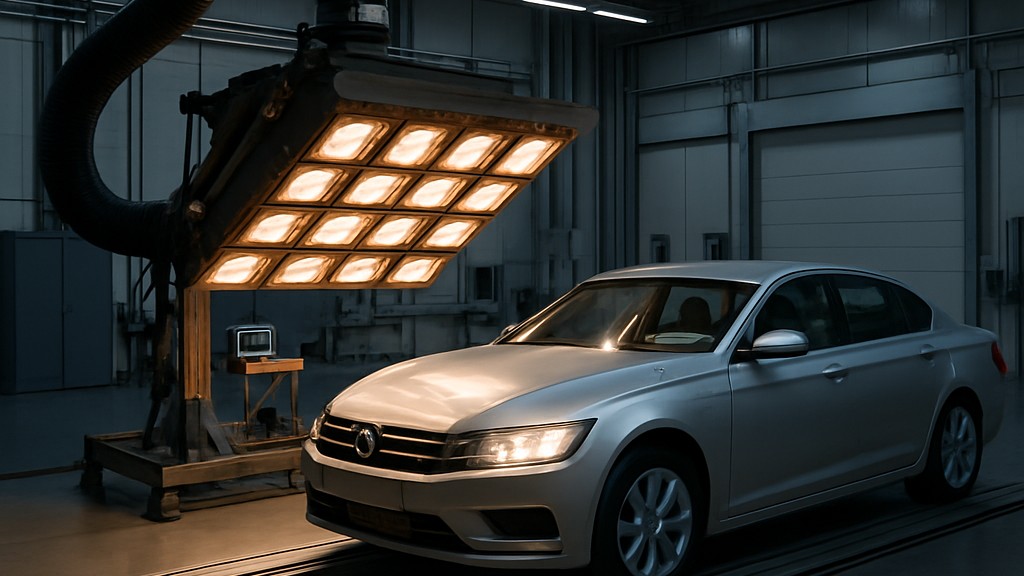
Compared to the DIN 75202 standard, this standard is expanded and evaluates changes in all usage-related properties such as shape, colour, gloss, feel, strength and the consequences of thermal expansion under the influence of artificial spherical radiation, heat/cold and humidity.
The DIN 75220 standard defines a method for testing the climatic resistance of components used in road vehicles. This is particularly important for components exposed to changing environmental conditions, such as temperature changes, humidity, and solar radiation. The aim of this standard is to ensure that components maintain their functionality, safety, and performance in a wide range of climatic conditions. This is a particularly critical issue in the automotive industry, where vehicles operate in diverse environments worldwide.
This standard provides a climate stress test cycle intended to simulate real-world environmental exposure over a short period of time. It is commonly used in the qualification testing of materials and components, including:
By subjecting parts to accelerated aging, manufacturers can identify potential failures before mass production, increase product reliability, and reduce warranty claims.
This standard outlines a cyclic test procedure that includes the following changes:
A typical test cycle lasts 24 hours, and components are exposed to this repeated stress for a specific number of cycles (e.g., 10 to 30 cycles) depending on the desired severity and product requirements.
The main advantages of this test are:
The DIN 75220 standard plays a key role in the automotive qualification process, particularly for exterior and electronic components subject to environmental exposure. Because vehicles are expected to operate reliably across continents—from arctic cold to desert heat—this standard helps ensure that automotive components are climate-resistant, safe, and high-performing throughout their service life.
The DIN 75220 standard is important because it helps ensure that automotive components can withstand real-world environmental stresses throughout a vehicle's lifespan. This standard is considered important for the following reasons:
Ultimately, the DIN 75220 standard is important because it provides a robust, efficient and standardised way to ensure that automotive components are climate-resistant, reliable and safe, no matter where the vehicle is used.
Our organization, which has been supporting businesses across all sectors for years through a wide range of testing, measurement, analysis, and evaluation activities, has a strong team of employees who closely follow global developments in science and technology and are constantly improving themselves. In this context, we also provide testing services in accordance with the DIN 75220 "Aging of automotive components in solar simulation units" standard.
To get an appointment, to get more detailed information or to request an evaluation, you can ask us to fill in our form and reach you.

