Nissan NES M0133 Chemical Resistance Test Methods for Plastic Parts
The standard "Nissan NES M0133 Chemical Resistance Test Methods for Plastic Parts," developed by Nissan Automobiles, describes test methods for the chemical resistance of plastic parts used in automotive components. The purpose of these tests is to determine whether chemicals used in dealerships and during vehicle and component assembly processes cause abnormalities in automotive plastic parts. These abnormalities include dissolution, clouding, staining, discoloration, deformation, cracks, fractures, thinning, softening, hardening, and similar conditions caused by direct contact of the part with the chemicals or by chemicals in adjacent parts. For plastic materials used in automotive components, this standard also includes a method for assessing aging deterioration due to chemical changes resulting from continuous contact with chemicals.
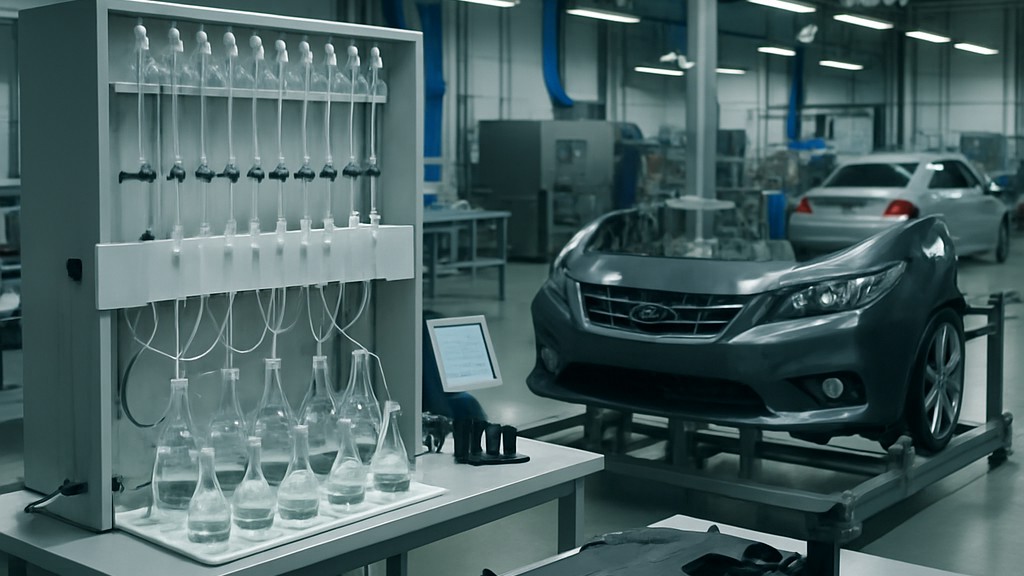
Test methods are divided into six types, as shown in the table provided in the standard, depending on the location and type of exposure of the part. Depending on the location of the part, more than one test method should be applied, if appropriate. The selection of chemicals to be tested should fully consider the environments in which each part will be used (it is not necessary to test all chemicals specified in this standard).
Test methods are classified as follows:
- Method 1 Type 1 Containers or parts used as liquids. Immersion test. Required chemicals, all chemicals used in containers.
- Method 1 Type 2 Parts normally exposed to chemicals. Immersion test. Required chemicals, all chemicals that come into contact with the part.
- Method 2: Internal parts. Wipe test. Required chemicals: artificial perspiration, detergent, insect repellent, suntan lotion, sunscreen, liquid paraffin, and others.
- Method 3: Exterior parts. Drip test. Required chemicals include gasoline, diesel fuel, kerosene, engine oil, acid, polish, windshield washer fluid, detergent, primer, and the like.
- Method 4: Parts inside the engine compartment. Drip test. Chemicals required include gasoline, diesel fuel, engine oil, kerosene, acid, brake fluid, antifreeze, windshield washer fluid, corrosion inhibitor, calcium chloride, and the like.
- Method 5: Interior parts, exterior parts, and parts made of ABS, PMMA, PC, PPE, and PAT materials. Normal application in a real vehicle. Required chemicals include all chemicals used during the parts assembly process, vehicle assembly process, or dealership transport process, such as grease, lubricating oil, metal cutting oil, press machine oil, anticorrosive, silicone oil (including emulsion types), paint protection agent, paint remover, mold release agent, detergent, and artificial perspiration. Required chemicals for parts adjacent to components containing plasticizers include plasticizers (vinyl chloride, rubber materials).
- Method 6: Environmental load entry test method. Separately for parts that come into contact with chemicals or that may come into contact with them. Application or immersion test. Required chemicals, chemicals with parts that come into contact or that may come into contact with them.
The test site conditions were determined as follows:
- Room temperature conditions: The room temperature and humidity of the test location should be maintained in accordance with the “JIS Z 8703 Standard atmospheric conditions for testing” standard, respectively, Class 5 (temperature 20 degrees plus/minus 5 degrees) and Class 20 (relative humidity 65 percent plus/minus 20 percent).
- Standard conditions: The standard temperature and humidity conditions of the test location should be provided in accordance with the “JIS Z 8703 Standard atmospheric conditions for testing” standard, respectively, Class 2 (temperature 20 degrees plus/minus 2 degrees) and Class 10 (relative humidity 65 percent plus/minus 10 percent).
The main equipment used in the tests are:
- Temperature controlled chamber: temperature controlled at plus/minus 2 degrees
- Wide mouth bottle: Made of material that is not affected by chemicals
- Reflux condenser
- Chemical balance: accuracy up to 0,1 mg
- Syringe: Made of material that is not affected by chemicals
- Gauze: Material sold for medical use (density 34,3 g/m2)
- Tensile tester: Units specified in the NES M8020 standard.
The temperature-controlled chamber is used for high-temperature testing and drying of the test specimen. The reflux condenser is used only for high-temperature testing.
The test pieces for Methods 1 to 5 were determined as follows:
- Essentially, the test piece must be made from finished products. It must be free of dust and similar substances that could affect the test results. Unless otherwise specified, the test piece must have been stored for at least 24 hours under actual assembly conditions at the standard temperature specified in this standard. Further details are subject to agreement between the parties involved.
- The finished product is a fully molded part that can be subjected to secondary processing (such as plating, hot stamping) or assembled with other parts. If the shape or size is unsuitable for testing, the test piece can be cut. (Attention should be paid to the cutting area and assembly (installation) conditions. If stress occurs during actual vehicle assembly, an equivalent load should be applied for testing.)
The test piece in Method 6 was determined as follows:
- The test pieces are of the following three types with different shapes and sizes. The thicknesses of test pieces 1, 2 and 3 shown in the table are the preferred values.
- Regarding the production method, thermosetting plastics or flat molded parts should be machine cut, and the cuts should be reported. Thermoplastic parts can be produced with an injection molding machine. However, mechanical strength can vary depending on the molding conditions. Therefore, molding conditions should be carefully adjusted and reported.
- If a test piece is cut around, a pressure effect will occur and normal test values may not be displayed. Therefore, it is necessary to finish the area around a test piece smoothly with fine sandpaper.
- As a rule, five test pieces are used for a condition. When testing a plate material with anisotropy characteristics, five test pieces are used for mutually perpendicular directions of the plate.
The chemical substance and concentration used in the tests should be as specified in the table given in the standard:
- Method 1 Type 1 Room temperature and maximum temperatures (NES M0131 and NES M0132 standards). Exposure time 168 hours. If the chemical is expected to evaporate, a reflux condenser is used.
- Method 1 Type 2 Room temperature and maximum temperatures (NES M0131 and NES M0132 standards). Exposure time 24 hours. 2-3 Wipe back and forth 3 times.
- Method 3: Room temperature and maximum temperatures (NES M0131 and NES M0132 standards). Exposure time 24 hours. Drip volume 0,3 to 0,5 ml.
- Method 4: Room temperature and maximum temperatures (NES M0131 and NES M0132 standards). Exposure time 24 hours. Drip volume 0,3 to 0,5 ml.
- Method 5: Room temperature and 60 degrees Celsius. Exposure time: 168 hours. The chemical application areas and volume should be similar to on-vehicle assembly conditions. Details are subject to agreement between the parties involved. If a real part comes into contact with an adjacent part containing plasticizers or chemicals on the contact surface, the two parts should be assembled under the same conditions as on a real vehicle.
- Method 6 Conditions specified by each evaluation standard for each plastic material.
The gauze used for the wipe test should absorb 2 to 2,5 g of chemical per gram of gauze.
Our organization, which has been supporting businesses across all sectors for years through a wide range of testing, measurement, analysis, and evaluation activities, has a strong team of employees who closely follow global developments in science and technology and are constantly improving themselves. In this context, we also provide testing services in accordance with the Nissan NES M0133 Chemical Resistance Test Methods for Plastic Parts standard.



