

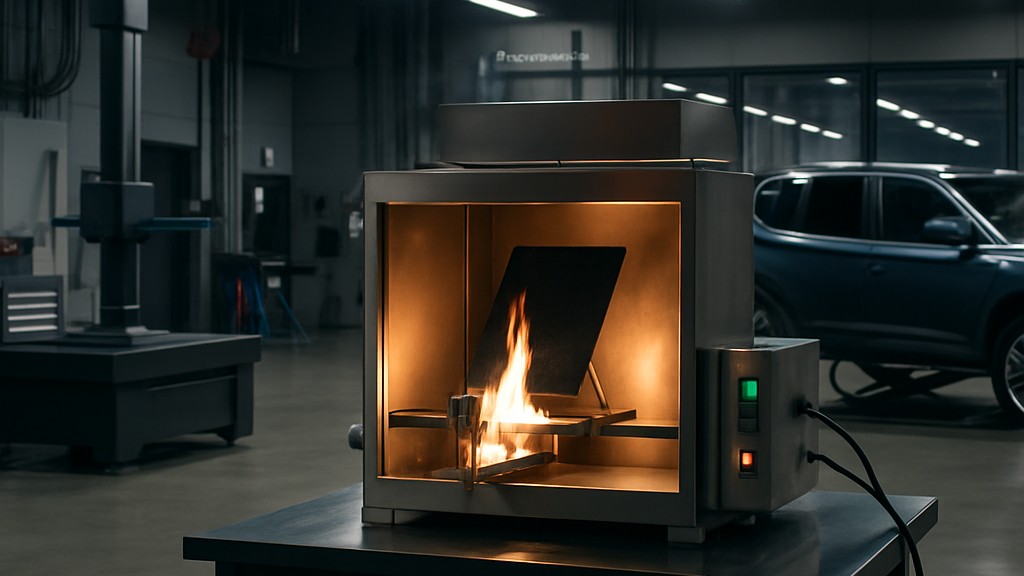
This standard applies to materials found in the passenger compartments of passenger cars, multi-purpose vehicles, trucks, and buses. It assesses the flammability of these materials and sets limits on how quickly they can burn. To comply with FMVSS 302, materials must have a burning rate of no more than 10 cm per minute when subjected to a horizontal burn test.
The FMVSS 302 standard applies to a wide range of materials inside vehicles, including: seats and upholstery, carpets, headliners, door panels, and labels and adhesives used on interior components.
This standard uses the horizontal burn test to evaluate material flammability:
FMVSS 302 compliance isn't just a legal requirement; it also signifies a commitment to safety, quality, and industry leadership. Adhering to this standard ensures that materials meet the highest safety standards, making your business a trusted partner for original equipment manufacturers and a contributor to automotive innovation. By taking proactive measures like selecting the right materials, conducting comprehensive testing, and staying informed about regulatory changes, you can turn compliance into a competitive advantage.
FMVSS 302 applies to passenger cars, trucks, buses, and multi-purpose passenger vehicles. It specifies the fire resistance requirements and flame front propagation rates for materials used in the passenger compartments of motor vehicles. This standard specifies the fire resistance requirements for materials used in the passenger compartments of motor vehicles. The purpose of this standard is to reduce deaths and injuries to motor vehicle occupants, particularly from fires ignited in the vehicle interior from sources such as matches or cigarettes.
Passenger compartment airspace refers to the space within the passenger compartment where regenerable air normally resides. The following components of vehicle passenger compartments must meet the requirements of this standard: seat cushions, seatbacks, seat belts, headliner, sunroofs, armrests, all trim panels, including door, front, rear, and side panels, bulkhead shelves, head restraints, floor coverings, sun visors, curtains, sunshades, wheelhouse covers, engine compartment covers, mattress covers, and all other interior materials, including padding and crash-deployable elements, designed to absorb energy upon occupant contact in the event of a collision.
In addition, any portion of a single or composite material within 13 mm of the passenger compartment air space shall meet the requirements of this standard. Any material that does not adhere to other materials at each point of contact shall meet these requirements when tested separately. Similarly, any material that adheres to other materials at each point of contact shall meet these requirements when tested in composite with other materials.
Before testing, each sample is conditioned for 24 hours at 21 degrees and 50 percent relative humidity, and the test is carried out under these ambient conditions.
The test specimen is placed between two matching U-shaped metal frames, 25 mm wide and 10 mm high. The internal dimensions of the U-shaped frames are 51 mm wide and 330 mm long. A sample, which softens and bends at the flaming end, causing uneven burning, is held horizontally by supports consisting of thin, heat-resistant wires extending at 25 mm intervals across the width of the U-shaped frame beneath the sample. One device that can be used to support such materials is an additional U-shaped frame, wider than the U-frame containing the sample, and tensioned with 10 mils of heat-resistant wires, placed above the lower U-frame.
Each material sample to be tested should be a rectangle, as close as possible to 102 mm wide and 356 mm long. The sample thickness is the thickness of the single or composite material used in the vehicle. However, if the material thickness exceeds 13 mm, the sample is cut from the sample surface closest to the passenger compartment air space to the measured thickness. If a flat sample is not possible due to surface curvature, the sample is cut to a maximum thickness of 13 mm at any point.
The sample is produced by cutting the material in the direction that produces the most adverse test results. The sample is oriented so that the surface closest to the passenger compartment air space is facing down on the test frame.
Material with a hairy or tufted surface is placed on a flat surface and combed twice against the pile with a comb having seven to eight smooth, rounded teeth at 25 mm.
During the test, the specimen is mounted so that both sides and one end are held by the U-shaped frame, with one end flush with the open end of the frame. If the maximum usable width of the specimen does not exceed 51 mm and the edges of the specimen cannot be held in the U-shaped frame, the specimen is placed on wire supports and one end is placed in the closed end of the U-shaped frame.
The mounted sample is placed horizontally in the center of the chamber. After the flame is adjusted, the Bunsen burner and sample are placed so that the center of the burner tip is 19 mm below the midpoint of the lower edge of the open end of the sample. The sample is exposed to the flame for 15 seconds. Timing (regardless of the duration of the burner flame application) is started when the flame of the burning sample reaches a point 38 mm from the open end of the sample. The time it takes for the flame to advance to a point 38 mm from the clamped end of the sample is measured. If the flame does not reach the specified endpoint, the flame is timed to advance to the point where the flame stops.
Burning rate is calculated according to the formula given in the standard.
Our organization, which has been serving for many years and meticulously following global developments in science and technology, employs a team of experienced professionals and a broad infrastructure to conduct testing, measurement, and analysis in a wide range of areas for businesses across all sectors. In this context, we also provide testing services in accordance with the "FMVSS 302 Flammability of Interior Materials" standard.
To get an appointment, to get more detailed information or to request an evaluation, you can ask us to fill in our form and reach you.

