Flexible Material for FORD WSS-M15P46-C Gear Shift Boots and Parking Brake Boots
The standard "FORD WSS-M15P46-C Flexible Material for Shift Boots and Parking Brake Boots," developed by Ford Motor Company (FORD), specifies performance requirements for the interior materials cut and sewn into boots for floor-mounted shift levers and parking brakes. These materials must have good resistance to flex cracking at cold temperatures.
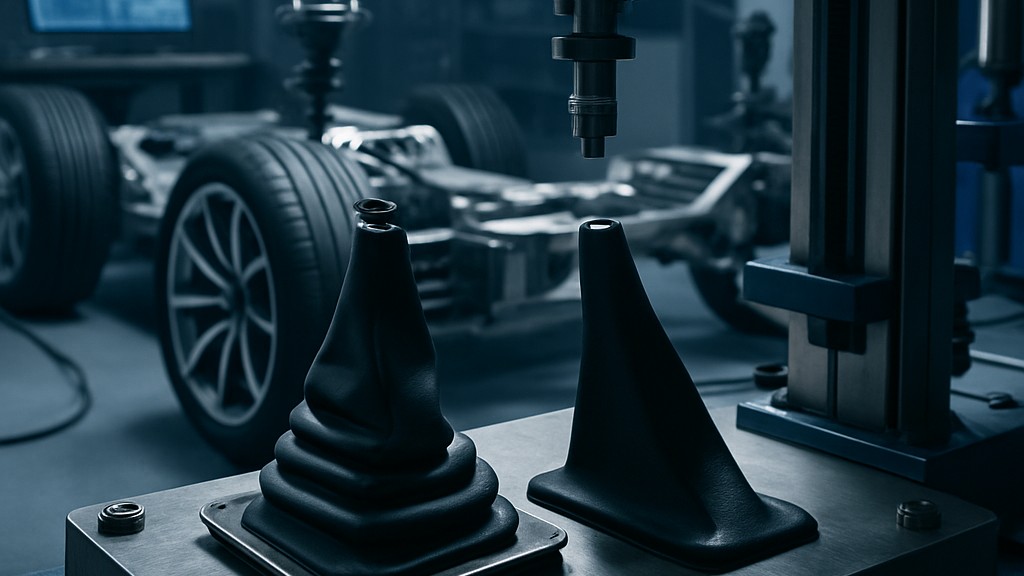
The scope of application of this standard covers interior floor-mounted transmission shift boots and parking brake boots. This standard was originally written for fabrics with a polyurethane coating.
The requirements in this standard are specified as follows:
- Approved sources: This standard is performance-based and does not have approved sources.
- Appearance: Color, texture, visual aesthetics, craftsmanship and finish must be approved by Ford design engineering.
- Finish: A color-matched finish coat must be applied. The material must be fully dyed to prevent undyed fibers from showing through after sewing, and the dye must be a color similar to the surface finish.
- Physical characteristics:
- Thickness (ASTM D 1813): Between 0,7-1,2 mm
- Tensile strength (ASTM D 751 grip method): 250 N min
- Tear strength (Trapezoidal) (ASTM D 751): 44 N min
- Seam strength (FLTM BN 119-01): 250 N min
- Hardness (ASTM D 747, 25 x 50 mm sample): Report value
- Dimensional stability (FLTM BN 105-03, 3 cycles)
- Color specifications: General acceptance criteria are as follows: The material must not exhibit any change in appearance, such as color change, fading, or gloss change, exceeding the required AATCC rating. Additionally, the material must not exhibit any staining, blistering, loss of paint adhesion, flaking, breaking, uncoating, chalking, cracks, splits, depressions, bulges, stickiness, peeling, or delamination.
The finishing features are described as follows:
- Coating adhesion test: Using a knife, draw an "X" approximately 25 mm wide through the base coat of the sample. Acetate fiber tape (25 mm wide or equivalent) is applied to the tape. The tape is rubbed until good contact is achieved. Grasp one end of the tape and pull it quickly and steadily to remove it from the sample surface.
- Crack resistance test (FLTM BN 107-01 standard): Dry and wet degree 5 min, cleaner degree 5 min and commercially available glass cleaner degree 5 min.
- Abrasion resistance test (SAE J948 standard): The abraded area must have a color and appearance consistent with the adjacent unworn area. There must be no signs of wear or other detrimental effects. The abrasion resistance of the production material must be equal to or better than the sample approved by Ford Materials Engineering.
- Abrasion resistance test (SAE J365 standard): There shall be no lifting, peeling, signs of abrasion, or other detrimental effects. The abraded area shall exhibit a color and appearance consistent with the adjacent unworn area. The abrasion resistance of the production material shall be equal to or better than the sample approved by Ford Materials Engineering.
- Cold Bally flex test (FLTM BN 162-01 standard): Three specimens in each direction are tested to the number of cycles specified below. All tested specimens are stored and submitted for evaluation by Ford Materials Engineering.
- Functional testing: The supplier must confirm that the material is suitable for processing in their manufacturing facility. This includes, but is not limited to, cutting and sewing operations.
- Odor test (FLTM BO 131-03 standard): If the sample is 100 percent bonded, it is tested as part of a production assembly composite. If not 100 percent bonded, each component is tested individually.
- Fogging photometric test (SAE J1756 standard): Fog count 70 min. The formation of clear film, droplets, or crystals is grounds for rejection. For shipment, all materials or parts should be sampled immediately after production and then placed in a zip-lock or slide-lock polyethylene bag, a polyethylene-lined aluminum bag, or wrapped in aluminum foil before bagging. Test specimens should be cut and then stored in a clean, open environment for 14–28 days. After 14–28 days of air exposure, specimens should be tested immediately or rebagged until testing is performed. The specimen should be tested as part of a production assembly composite if 100 percent bonded. If not 100 percent bonded, each component should be tested individually.
- Flammability test (ISO 3795 and SAE J369 standards): Burn Rate 100 mm min maximum. If a material stops burning before burning for 60 seconds from the start of the timing and has not burned for more than 51 mm from the point where the timing begins, it is considered to meet the burn rate requirement and is reported as self-extinguishing/no burn rate. The sample is tested as part of a production assembly composite if 100 percent bonded. If not 100 percent bonded, each component is tested individually.
- Ziegler testing: The Ziegler report must be reviewed by regional Ford materials engineering and the results documented in the approved source list.
The table provided within the standard is designed to provide clarity and assistance in meeting the requirements of this specification. This table shows the tests required for design verification and production verification testing, and the number of samples per test.
Our organization, which has been supporting businesses across all sectors for years through a wide range of testing, measurement, analysis, and evaluation activities, has a strong team of employees who closely follow global developments in science and technology and are constantly improving themselves. In this context, we also provide testing services to businesses in accordance with the "FORD WSS-M15P46-C Flexible Material for Gear Boots and Parking Brake Boots" standard.



