

The “Hyundai Kia MS300-54 Standard Test Method - Fogging” standard, developed by Hyundai-Kia Motors, describes a test method for determining fogging of vehicle interiors. The objects used for fogging must be parts such as sheet metal, leather, fabric, PVC molded parts, nonwovens, carpets, and pads, and must conform to the drawing requirements.
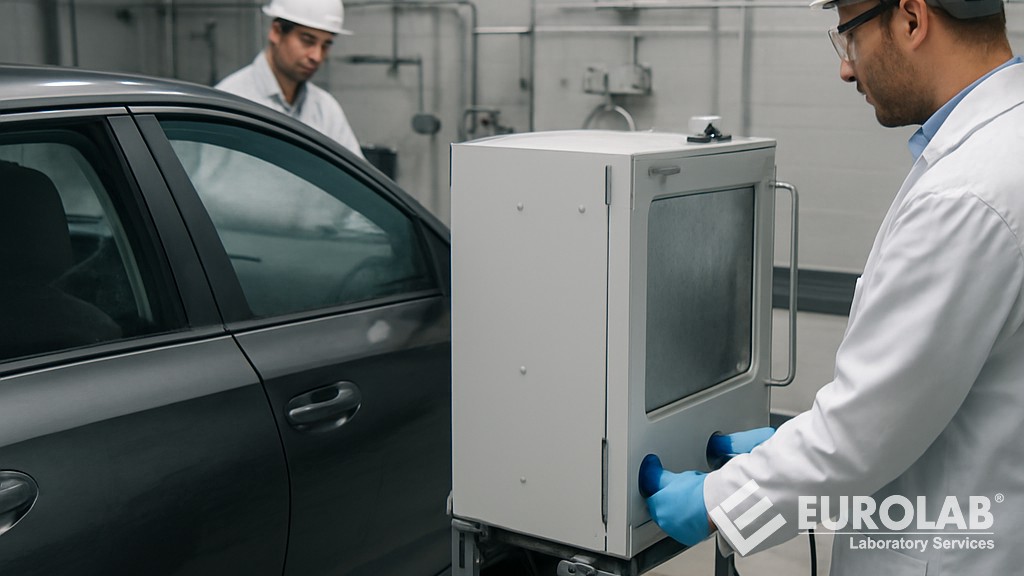
The standard laboratory conditions are a temperature of 23 degrees plus/minus 2 degrees and a relative humidity of 50 percent plus/minus 5 percent. The sample should be taken from the mass-produced product. The sample size should be in the form of circular test specimens with a diameter of 70 μm. Mass-produced products with a thickness of 20 μm or less are used. If the thickness of the finished product exceeds 20 mm, it is cut smoothly to a thickness of 10 mm. If the mass-produced products are not flat (e.g., PVC molded part), a sample of 10 g plus/minus 2 g is used.
All tests are performed on samples at least 48 hours after molding, and immediately following a conditioning period of at least 24 hours under the standard conditions specified in this standard.
The following equipment is used in the tests.
During the test, three circular specimens with a diameter of 70 mm are prepared. As shown in the figure, one specimen is placed in the container of the fogging test device with its surface facing upwards. A steel lid with a 40 mm diameter hole is placed on top of the beaker. A glass plate (with a fogging rate of 1% or less) 50 mm wide, 50 mm long, and 3 to 5 mm thick is placed over the hole. It is heated in an oil bath at 100 degrees for 5 hours. After heating, the glass is removed, and fogging is measured at three points in the center of the glass using the device (integral sphere type light transmittance meter) and according to the procedure specified in the table. Then, fogging is calculated according to the formula given in the standard, using the average of the measurements at three points per specimen. The average of the three specimens is accepted as the result.
In the high-risk automotive manufacturing world, where every component must meet stringent safety, performance, and environmental standards, Hyundai-Kia has established a series of proprietary test protocols under its material specification series. Among these, the MS300-54 standard stands out as a critical benchmark for interior quality, targeting fogging—a problem drivers may not notice until it's too late.
This standard assesses the potential of interior materials such as instrument panels, seats, headliners, and trim panels to release volatile organic compounds (VOCs) that can condense on glass surfaces, such as the windshield. This condensation, known as fogging, reduces visibility and poses a safety hazard, particularly in enclosed cabins where heat and humidity exacerbate the problem.
This method focuses on light transmittance, measuring how much haze or opacity the fog accumulation creates. Simply put, it simulates real-world conditions by heating material samples and evaluating the clarity of light passing through a cooled glass plate covered with emitted vapors. A passing grade guarantees that the approved materials will not affect driver visibility and will comply with global safety regulations such as the US federal motor vehicle safety standards (FMVSS).
This standard is part of a broader family of standards covering interior material performance. For example,
The Hyundai Kia MS300-54 standard specifically targets anti-fogging, making it indispensable for suppliers aiming to certify components for any given model.
Fogging is not only annoying, but also dangerous. In severe cases, it can reduce visibility by up to 20-30%, increasing the risk of accidents. With the rise of electric vehicles and autonomous technology, and with longer cabin lifespans and a wider variety of materials (such as synthetic leather, recycled fabrics, and antimicrobial coatings), controlling VOC emissions has become vital.
The Hyundai Kia MS300-54 standard guarantees compliance with international norms, including the European Union REACH regulations regarding chemical safety. By implementing such tests, brands minimize warranty claims related to interior defects and appeal to environmentally conscious consumers demanding low-emission cabins. In an era where supply chains span continents, this standard also facilitates supplier approvals. Third-party laboratories offer certified tests that allow global suppliers to verify parts before production.
The Hyundai Kia MS300-54 standard fogging test is a controlled laboratory procedure designed for repeatability and accuracy. The basic steps of this test are as follows:
For many years, our organization, with its competent and experienced staff, has been understanding the needs of its customers, providing the advanced testing services they require, and assisting in the establishment, implementation, and improvement of management systems. Within this framework, we also provide testing services to businesses in accordance with the "Hyundai Kia MS300-54 Standard test method - Fogging" standard.
To get an appointment, to get more detailed information or to request an evaluation, you can ask us to fill in our form and reach you.

