

The “GMW 14363 Determination of Indentation Stiffness of Foam Components Under Constant Force” standard, developed by General Motors Worldwide (GMW), is designed to determine the indentation stiffness of small elastic foam components, especially those where conventional foam stiffness methods are unsuitable due to their dimensions or geometry. This method is particularly important for automotive foam components where local stiffness, cushioning behavior, and consistency can affect perceived quality, comfort, fit, and component performance.
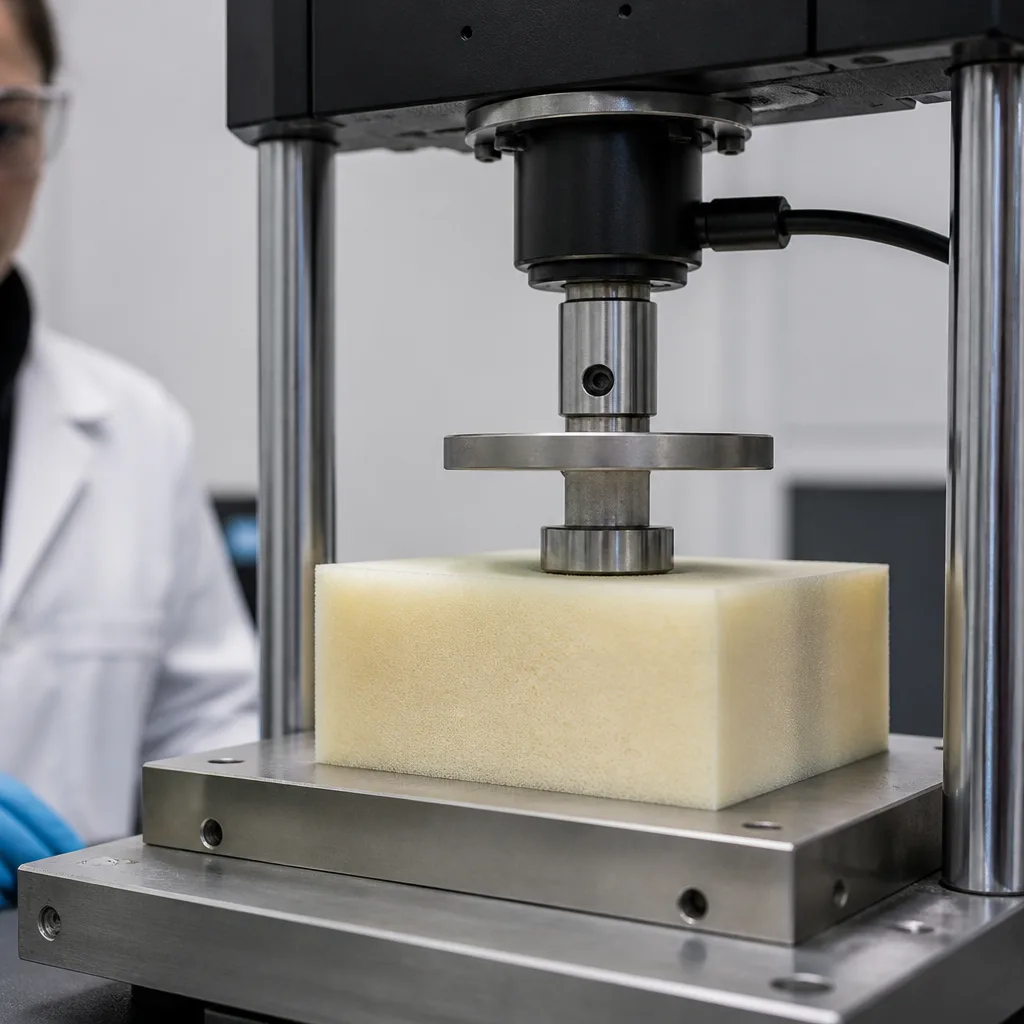
The primary objective of the GMW 14363 standard is to provide a controlled method for measuring the indentation stiffness of foam components under a constant applied force. Instead of measuring conventional compressive stress, this method determines how deeply a standardized indentation penetrates the foam when a specific force is maintained for a defined period of time.
Indentation hardness is defined by the depth in millimeters that a standard-shaped indentation penetrates the foam under a constant force. The indentation is typically maintained for 30 seconds, 60 seconds, or another specified time, depending on the specific requirement.
Indentation stiffness describes the resistance of a foam surface to local deformation when a force is applied through an indentation:
This makes the test particularly useful for assessing the local stiffness of relatively small foam particles. For example, automotive foam components can be used in:
Applying a constant force provides a controlled basis for comparing foam behavior. Foam is a viscoelastic material, meaning its deformation can change over time even if the applied load remains constant. Therefore, the penetration depth can depend not only on the magnitude of the force but also on the loading time. The GMW 14363 standard addresses this by specifying a controlled loading condition and measurement time. This is important because two foam materials may initially appear similar but exhibit different deformation behavior during continuous loading.
The general principle of the described method can be summarized as follows:
The exact dimensions, force, recess geometry, conditioning requirements, measurement procedure, and acceptance criteria of the device are specified in the GMW 14363 standard.
An important aspect of the GMW 14363 standard is that the results are highly dependent on the test configuration. However, the results obtained may not be directly comparable, especially in the following cases:
Consequently, testing laboratories must maintain the specified test configuration when comparing materials or production batches.
This method can be useful for quality control and development comparisons if foam components have sufficiently similar structures and are tested under the same conditions. For example, foam components with similar geometry and cellular structure can be compared using the same indentation point, applied force, loading time, test location, conditioning, and measurement procedure. This helps manufacturers determine whether formulation, density, processing, or supplier changes affect the local stiffness of the finished component.
Foam stiffness can significantly affect the perceived and functional performance of an automotive component. Excessively soft foam can cause:
Excessively firm foam can cause the following:
Therefore, indentation stiffness is not just a lab number. It can be a significant indicator of whether a foam component delivers its intended support, cushioning, and tactile performance.
The GMW 14363 standard can be integrated into supplier and production quality control programs. Testing can help identify variations resulting from:
For manufactured parts, tests performed at defined locations can also help identify local variations within a component.
However, the GMW 14363 standard should not be interpreted as a universal stiffness test for all types of foam. Measurements taken from components with different shapes, structures, locations, or indentation sizes may not be comparable. This means the test is most valuable when the test conditions are standardized. It is also important to distinguish indentation stiffness from other foam properties such as:
A foam can have a specific indentation stiffness while having significantly different values for these other properties.
The GMW 14363 standard is important because it provides a repeatable method for characterizing the local stiffness of small automotive foam components. The main benefits of this standard are:
In summary, the GMW 14363 standard is a specific automotive foam testing method for determining indentation stiffness under a constant force. The method is particularly useful when the component is very small or geometrically unsuitable for other conventional foam stiffness procedures. By measuring the penetration of a standardized indentation under controlled force and duration, it provides an objective indication of the foam's local stiffness and deformation behavior.
For many years, our organization, with its competent and experienced staff, has been understanding the needs of its clients, providing the advanced testing services they require, and assisting them in the establishment, implementation, and improvement of management systems. Within this framework, we also provide testing services in accordance with the GMW 14363 standard.
To get an appointment, to get more detailed information or to request an evaluation, you can ask us to fill in our form and reach you.

