

The “BMW PR 303 Climate Change Test” standard, developed by BMW, a multinational vehicle manufacturer, describes an alternative climate testing method for interior trim components. This standard is an in-house testing standard developed by BMW to evaluate the durability and reliability of vehicle equipment components under harsh environmental conditions. It incorporates a climate change test (climate cycle test) designed to simulate the rapid temperature and humidity fluctuations that automotive parts may encounter in real-world use. Primarily used by engineers, suppliers, and testing laboratories, this standard is a technical specification that ensures components such as interior trim, electronics, seals, or other equipment parts can withstand harsh conditions without deterioration, cracking, wear, or functional impairment.
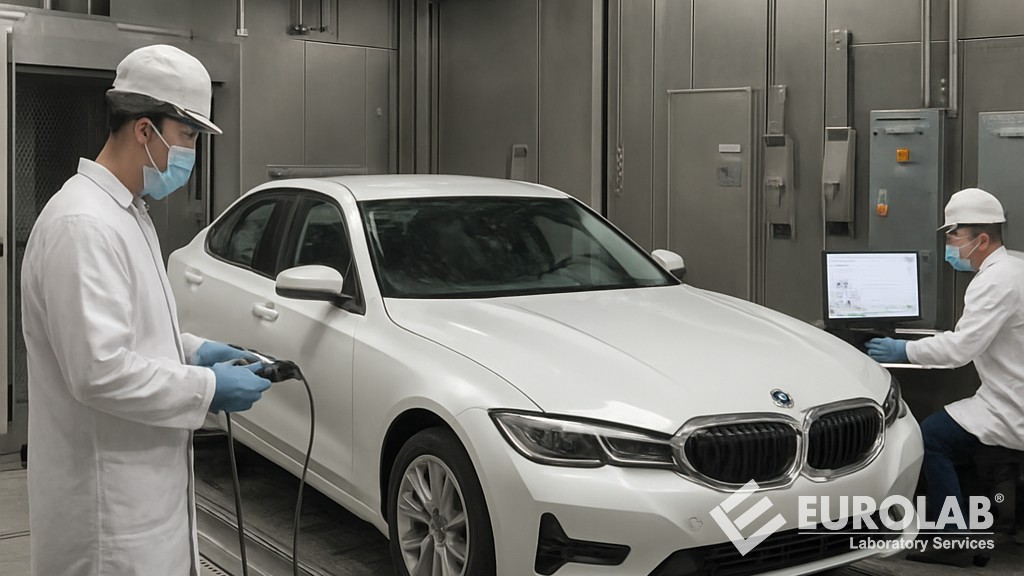
The primary purpose of the BMW PR 303 standard is to assess how resistant materials and parts are to thermal cycling and humidity changes. Vehicles operate in a variety of climates, from scorching deserts to freezing winters, and parts must withstand repeated expansion, contraction, and exposure to moisture. Failure to pass these tests can lead to problems such as:
This standard is applied throughout the development and quality assurance phases of BMW vehicles, helping suppliers meet BMW's demanding durability requirements.
The test method described in this standard involves a structured cycle lasting several days (typically 10 days or 240 hours in total). The test involves repeated transitions between extreme temperatures and controlled humidity levels in a climate chamber. A typical cycle includes:
This cycle is repeated multiple times (up to 25 times) by simulating years of environmental stress over a concentrated period.
BMW PR 303.4 version of this standard focuses on general climate cycle testing, while BMW PR 303.5 version is specifically designed for individual equipment parts and includes minor adjustments to the cycle parameters.
Today, advanced accredited testing laboratories offer certified BMW PR 303 compliance tests, validating their use across the automotive supply chain.
The BMW PR 303 standard, while not a consumer product or recall code, indirectly affects vehicle quality. Parts that pass this test contribute to BMW's reputation for long-lasting interiors and reliable performance in challenging weather conditions.
In short, this standard aims to evaluate how components will perform in real-world, varying climatic conditions by simulating changes in temperature and humidity over time. It is used for new parts, development versions, design changes, or secondary supplier components.
It ensures that interior or trim parts (plastics, coatings, components) remain durable and reliable in the varying climatic conditions (heat, cold, humidity) the vehicle may encounter. For suppliers and component manufacturers, passing the BMW PR 303 standard means that the part meets BMW's quality/aging expectations. It helps identify problems such as material deformation, coating failure, and moisture damage that could later lead to customer complaints.
Climate change testing is used to evaluate the resistance of materials to climatic environmental impacts. This test involves exposing test samples to varying temperature and humidity phases. The aim is to observe and evaluate the aging effects on the test samples to ensure they meet long-term durability requirements under different climatic conditions.
The BMW PR 303 standard reliably reveals common long-term failure mechanisms, such as those listed below:
These ensure that it is effective for quality assurance and design validation before production begins.
As part of BMW’s Product Validation Scheme (PVP) for interior components, the MMW PR 303 standard establishes a uniform benchmark across all suppliers. This prevents inconsistent material performance between suppliers or color variations.
According to technical discussions and laboratory data shared by automotive testing centers, parts that pass the BMW PR 303 test show a strong correlation with field durability (fewer warranty claims for deformation, peeling, or odor issues). Therefore, although it is an accelerated test in a laboratory environment, the results have predictive power for real-world service life.
Meanwhile, this standard focuses primarily on thermal moisture aging. It does not directly assess UV radiation, chemical exposure, or mechanical wear. These require complementary BMW tests (such as PV 3930, GS 97034). Furthermore, because the cycles are quite severe, this method may be overly conservative for some non-critical parts (leading to the rejection of acceptable materials).
In conclusion, the BMW PR 303 standard is an example of rigorous engineering that ensures a vehicle not only performs on the road but also withstands the world's toughest conditions for years to come. This standard is an effective and robust environmental aging standard for verifying interior and exterior components. Early detection of material and bonding weaknesses is particularly valuable for ensuring long-term dimensional and visual stability in realistic automotive climates.
For many years, our organization, with its competent and experienced team, has been understanding the needs of its clients, providing the advanced testing services they require, and assisting them in the establishment, implementation, and improvement of management systems. Within this framework, we also provide testing services to businesses in accordance with the "BMW PR 303 Climate Change Test" standard.
To get an appointment, to get more detailed information or to request an evaluation, you can ask us to fill in our form and reach you.

