

The “GMW 14865 Determination of Scratch Resistance of Organic Coatings - Simulation of Auto Wash Facilities” standard, developed by General Motors Worldwide (GMW), is a test standard used to evaluate the scratch resistance of organic paint and coating systems, particularly those applied to automotive exterior surfaces. Its purpose is to simulate the mechanical action of an automated car wash facility and determine how well a coated surface withstands repeated scrubbing in the presence of dirt or abrasive particles.
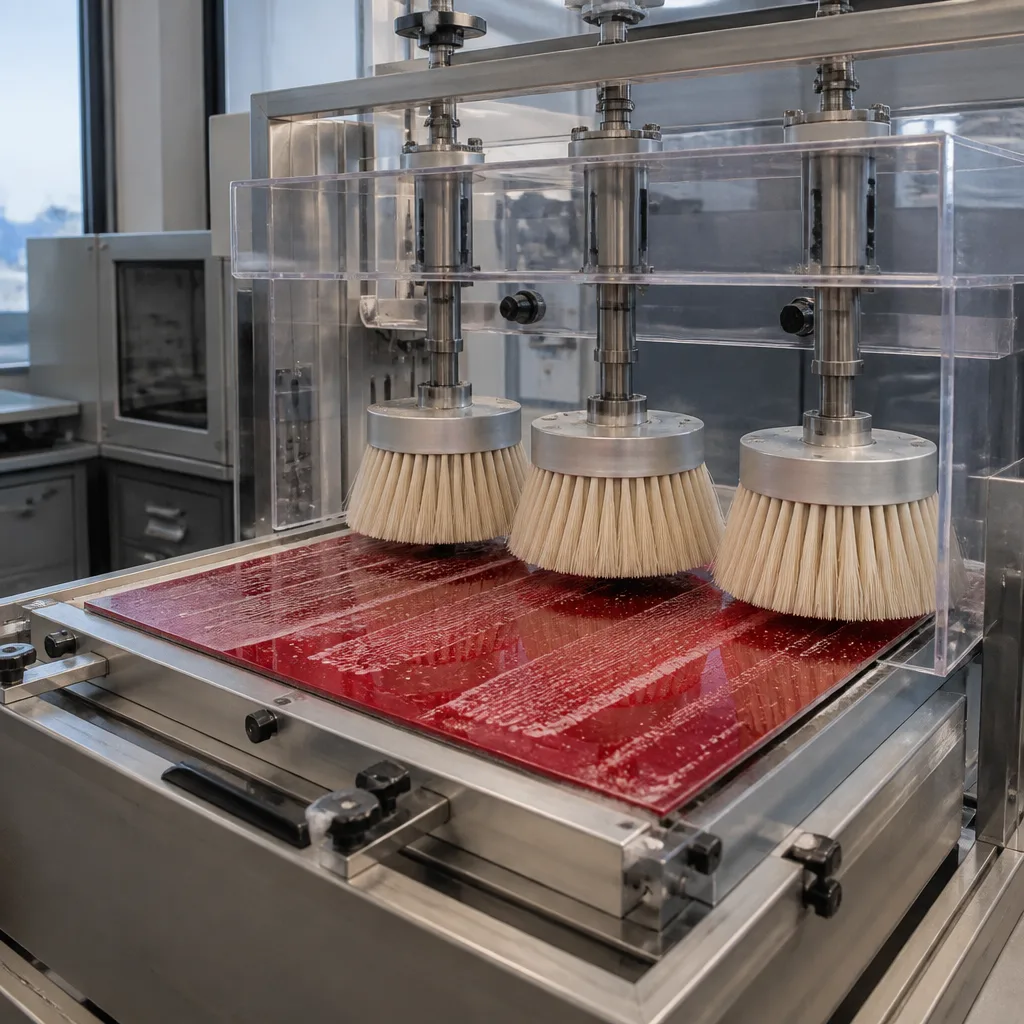
Automotive exterior coatings are subjected to repeated cleaning throughout their lifespan. Automatic car wash machines can create numerous fine scratches because the rotating or oscillating brushes carry dirt and other abrasive particles across the painted surface.
The GMW 14865 standard provides a controlled laboratory procedure to reproduce this type of damage. The test is designed to create fine surface scratches and evaluate the resistance of an organic coating to this type of abrasion. This standard is intended to determine how well an automotive paint coating withstands repeated car wash scrubbing.
This standard primarily relates to organic coating systems, particularly automotive paint coatings. Therefore, it may be applicable to the following types of painted exterior components:
The described method is particularly useful during the development and validation of paint systems where resistance to micro-scratches is an important appearance requirement.
The principle of the test is to expose a coated test surface to a mechanically operated brush while abrasive contaminants are present. The test equipment uses a brush that oscillates back and forth and employs synthetic dirt to create fine scratches similar to those that occur during a car wash. Therefore, the laboratory equipment attempts to reproduce the combined effects of:
This combination is important because a clean brush alone doesn't necessarily reproduce the scratching mechanism encountered in a real car wash.
One of the key features of the test is the presence of synthetic dirt/abrasive particles. A brush moistened with calcium carbonate particles is used to create the abrasive effect. The abrasive particles can become trapped between the brush and the surface of the coating. As the brush moves across the sample, the particles create fine scratches and surface marks. This makes the test more representative of real-world car wash conditions than a simple dry scrubbing test.
This test requires specialized equipment capable of reproducing controlled brush action on the coated sample. Generally, the key elements are:
The equipment must provide repeatable conditions to allow for the comparison of different coating formulations.
In general, the procedure follows these steps:
The intensity of the test is partly controlled by the number of brush passes or strokes. For example, 200 brush strokes are achieved with a brush moistened with calcium carbonate particles. However, this is not an automatically required condition for every GMW 14865 test. The precise evaluation and acceptance criteria are included in the standard.
The GMW 14865 standard primarily evaluates a coating's resistance to car wash-type scratches. Resulting damage can be assessed using visual or instrumental techniques, depending on the relevant requirements. Typical characteristics of interest include:
The GMW 14865 standard is important because appearance is a crucial quality attribute of an automotive vehicle. A paint system may initially have excellent shine and appearance, but after repeated washes, it can gradually develop fine scratches. These scratches can lead to:
A controlled laboratory car wash simulation allows coating developers to identify weak paint systems before they enter vehicle production.
The GMW 14865 standard should not be viewed simply as a general wear test. A traditional wear test might use a stationary abrasive wheel, pad, or friction element to determine material wear. The GMW 14865 standard, however, aims to reproduce a specific automotive usage condition, namely car washing. This makes the GMW 14865 standard particularly useful when evaluating the durability of paint appearance, rather than simply measuring mass loss or general wear resistance.
The GMW 14865 standard may be useful in the following situations:
The main advantages of the GMW 14865 standard are as follows:
In conclusion, the core value of the GMW 14865 standard is to determine whether an automotive paint or coating system can maintain its gloss, appearance, and surface quality after mechanical exposure such as car washing. Since appearance is a significant aspect of vehicle quality, this standard incorporates a useful test method for coating development, supplier qualification, and performance verification.
For many years, our organization, with its competent and experienced staff, has been understanding the needs of its clients, providing the advanced testing services they require, and assisting them in the establishment, implementation, and improvement of management systems. Within this framework, we also provide testing services in accordance with the GMW 14865 standard.
To get an appointment, to get more detailed information or to request an evaluation, you can ask us to fill in our form and reach you.

