

Developed by Great Wall Motor Company Limited (GWM), a Chinese automobile manufacturer, the “GWT A E01-02 Fogging Properties of Automotive Interior Materials” standard focuses on the fogging properties of automotive interior upholstery materials. This method, which includes test methods and limits for the fogging properties of upholstery materials in motor vehicles, is specifically defined as a gravimetric fogging test.
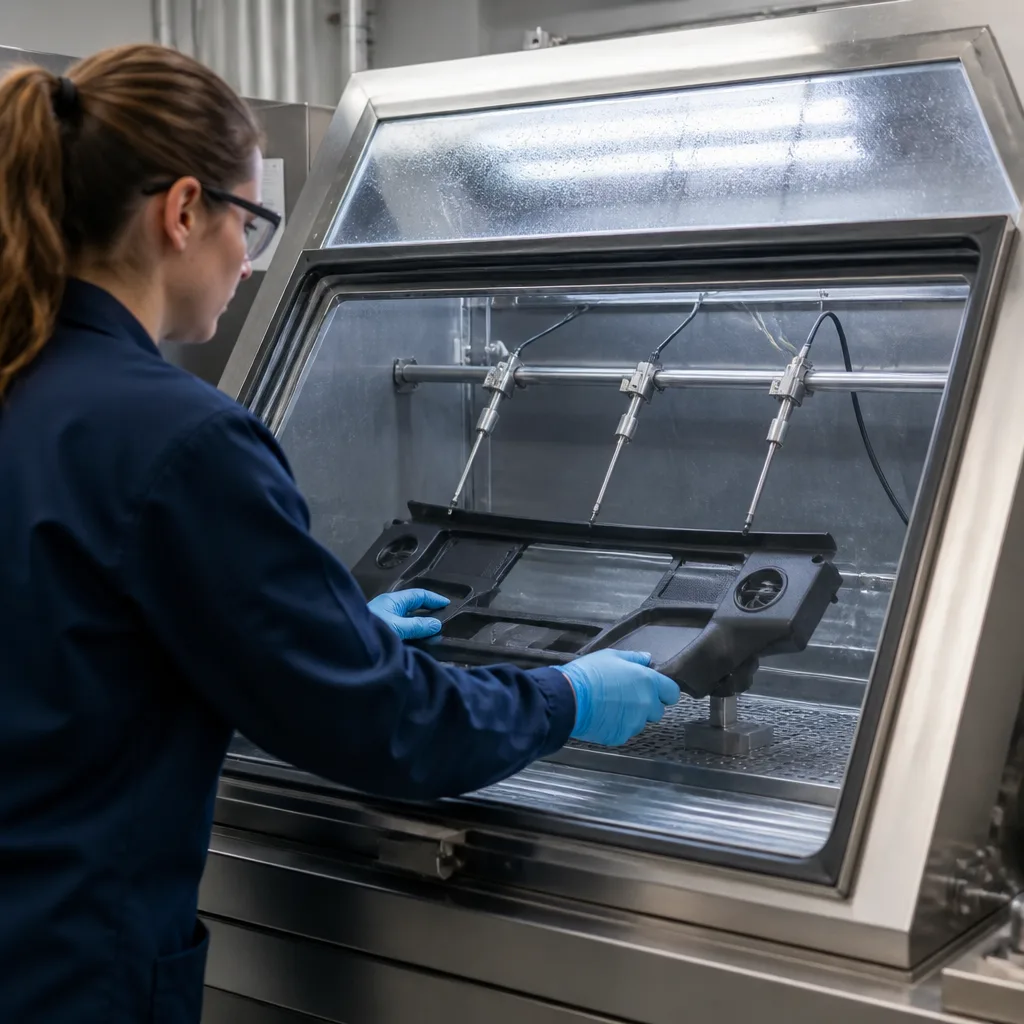
Condensation is the condensation of volatile or semi-volatile substances released from automotive interior materials onto cooler surfaces, particularly windshields and other glass surfaces. Interior materials may include the following substances:
When the vehicle interior heats up, these substances can evaporate. If the vapor then reaches a cooler glass surface, it can condense, forming a fine deposit. This phenomenon is important because excessive deposits can reduce the optical clarity of vehicle windows.
The primary objective of the GWT A E01-02 standard is to determine the tendency of interior materials to release condensable substances under high-temperature conditions. Therefore, the test allows for the controlled evaluation of: interior material, heating, release of condensable substances, condensation, and measurement. This standard combines the test procedure and acceptance limits, rather than simply defining a measurement technique.
Anti-fog performance is an important automotive interior quality feature for several reasons:
The GWT A E01-02 standard is defined as a gravimetric fogging method. In a gravimetric fogging test, a prepared material sample is placed in a fogging device and subjected to controlled heating. The general principle is as follows:
Therefore, the technique is called gravimetric, and the result is determined by mass measurement.
The general gravimetric concept is also used in other automotive fogging specifications, including DIN 75201, SAE J1756, GMW 3235, and ISO 6452.
A fogging test setup used in tests typically consists of the following:
The device must provide repeatable temperature conditions because the amount of substance released is greatly affected by temperature.
The test applies primarily to materials used in vehicle interiors:
The exact dimensions of the sample, conditioning requirements, test temperature, duration, and acceptance criteria are specified in the GWT A E01-02 standard.
In the gravimetric approach, the fundamental measurement is the mass of condensable material deposited on the collector. A simplified representation is: Fogging mass = Post-test mass - Pre-test mass. Generally, a lower deposited mass indicates that the material released less condensable matter and therefore has better fogging performance. However, the actual pass/fail decision should be made using the limits specified in the relevant GWT A E01-02 version. This distinction is important because automotive original equipment manufacturer specifications may use different sample preparation, temperature/time conditions, and limits.
Meanwhile, fogging should not be confused with volatile organic compound (VOC) testing.
The GWM test framework includes separate specifications for these properties. For example, the GWT A E01-01 standard addresses automotive interior odor, while the GWT A E01-04 standard deals with the sampling and measurement of volatile organic compounds and aldehydes/ketones from non-metallic interior components. Therefore, a material may have acceptable odor performance but still require fogging evaluation.
The GWT A E01-02 standard belongs to a broader family of automotive fogging methods:
While these methods have a similar basic objective, it should not be assumed that their detailed test conditions and limitations are interchangeable.
For an automotive supplier, compliance with the GWT A E01-02 standard is particularly important when sourcing interior materials or components. Testing during the material development phase can prevent fogging issues from arising once the material has already been integrated into a complete interior component.
What can cause poor fogging performance?
A good GWT A E01-02 result means that, under the specified laboratory conditions, the material releases a sufficiently low amount of condensable matter to meet the relevant GWM requirement. This result is particularly important for materials located near windows or commonly used in the passenger compartment.
In conclusion, the method described in the GWT A E01-02 standard uses a gravimetric approach where the condensable material released during controlled heating is collected and measured by mass. This standard is important because anti-condensation agents released from interior trim materials can adhere to vehicle windows and negatively affect optical cleanliness and perceived vehicle quality. Therefore, it provides a crucial material selection and quality control tool for automotive interior trim suppliers.
Detailed sample dimensions, temperatures, exposure times, and numerical acceptance limits are included in the GWT A E01-02 standard.
For many years, our organization, with its competent and experienced team, has been understanding the needs of its clients, providing the advanced testing services they require, and assisting in the establishment, implementation, and improvement of management systems. Within this framework, GMW cycle testing services are also provided to businesses.
To get an appointment, to get more detailed information or to request an evaluation, you can ask us to fill in our form and reach you.

