

Daimler - No More Feather Testing

Daimler - No More Feather Testing

The feather test, developed by the Daimler-Benz automotive company, is a defined, original equipment manufacturer-specific verification requirement for Daimler/Mercedes-Benz interior trim features, instrument panels, and glove box components. The relevant technical specifications are as follows:
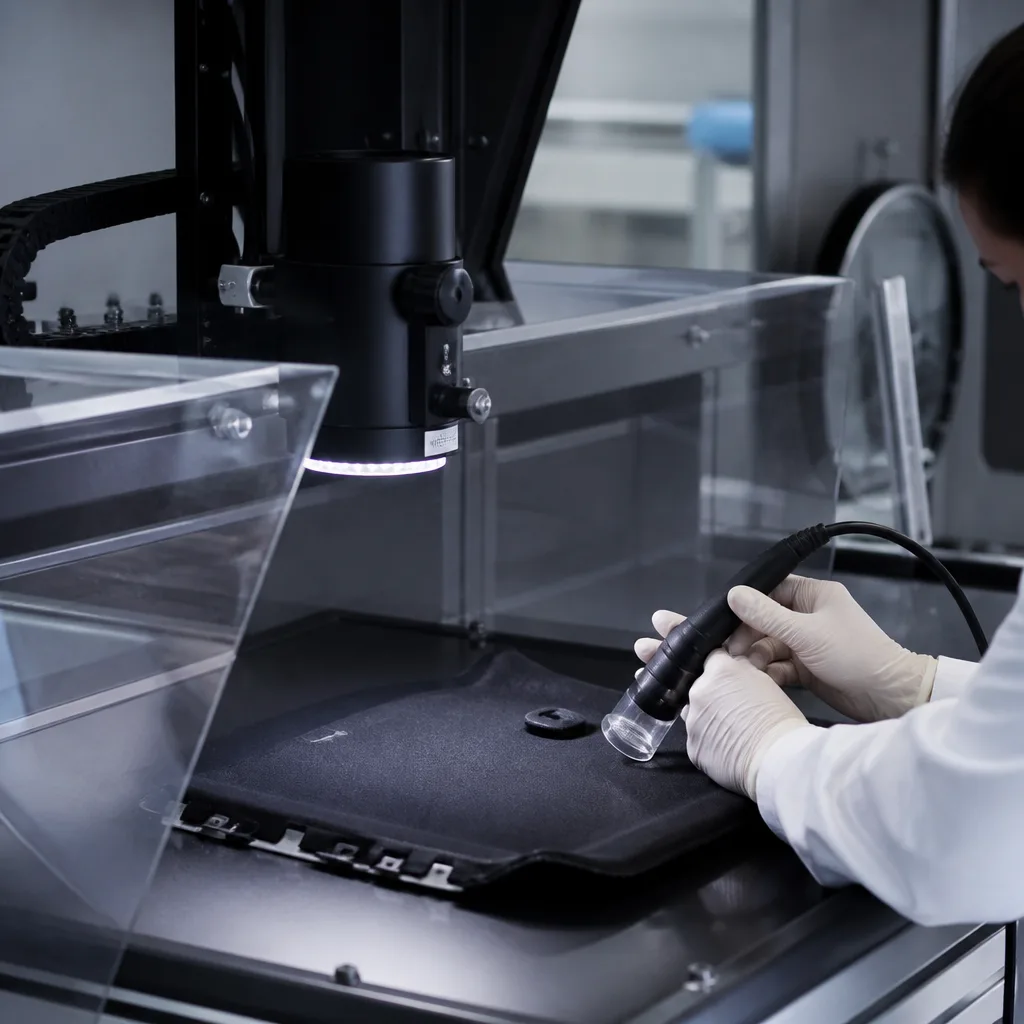
Daimler - No More Feather Testing

  • QEV111AF4KQP
  • QEV111AHSP9D

These apply to the following parts under Daimler's technical component requirements specifications:

  • Dashboard
  • glove compartment

In automotive interiors, the term "fiber" now refers to short textile fibers that are electrostatically applied to surfaces such as the following:

  • Inside the glove compartments
  • Storage compartments
  • Instrument panel compartments
  • Noise-reducing / squeak-preventing surfaces

The aim is to reduce noise, provide superior feel, abrasion protection and light absorption. Leftover down refers to loose, unbonded down fibers remaining after production. Therefore, Daimler uses the leftover down test to evaluate the following:

  • Whether excess fibers separate from the piece
  • Whether the cleaning was sufficient after the depilation process.
  • Whether the adhesive bond is strong
  • The component may contaminate the vehicle interior.

Original equipment manufacturers now typically evaluate the following in feather tests:

  • Fiber loss
  • Particle emission
  • Cleaning after friction or vibration.
  • Adhesion stability
  • Risk of contamination to adjacent parts.

Typical methods used in industry include:

  • Erase tests
  • Adhesive tape removal tests
  • Vacuum extraction
  • Friction/abrasion cycles
  • Visual assessment under specific lighting conditions,
  • Gravimetric particle evaluation

The reason the dashboard and instrument panel area are sensitive is that loose fiber particles can lead to the following:

  • Causing visible pollution
  • To cause customer complaints
  • Blocking HVAC airflow
  • To contaminate optical/electronic components.
  • Causing squeaking/rattling problems

Therefore, the requirement primarily relates to the following:

  • Cosmetics related
  • Regarding cleanliness
  • Regarding noise, vibration, and harshness (NVH)
  • Regarding customer perception

QEV documents are Daimler/Mercedes-Benz component requirement specifications and primarily define the following:

  • Material requirements
  • Size requirements
  • Odor/fogging limits
  • Flammability
  • Wear
  • Scratch resistance
  • Flock quality requirements

The feather test developed by Daimler/Mercedes is now necessary because velvet-covered interior parts can release loose fibers during manufacturing, transport, vibration, temperature changes, or customer use. In premium automotive interiors, even the smallest loose fibers are considered a quality risk. For components such as the instrument panel and glove box, testing provides protection against various problems:

  • Visual contamination / customer perception: Loose velvet fibers may become visible in the following areas:
    • On black upholstery
    • On piano black surfaces
    • On the screens
    • In ambient lighting areas
    • Inside the glove compartment

Customers might generally perceive this as dust, poor workmanship, wear and tear, or material deterioration. For premium brands like the Mercedes-Benz Group, interior appearance standards are extremely strict.

  • Noise, vibration, and harshness (NVH) performance: Velvet coating is typically applied for the following purposes:
    • To reduce squeaking and rattling.
    • Softening cushioning surfaces
    • To reduce vibration.

If the fibers separate,

    • The active flock layer becomes irregular.
    • Friction-preventing behavior changes.
    • The squeaking/clicking performance may deteriorate over time.

This directly impacts noise, vibration, and harshness (NVH) targets.

  • Cleaning requirements: Modern equipment includes the following:
    • Touch screens
    • Sensors
    • HVAC ducts
    • Electronic switches
    • Optical surfaces

Loose feather particles can migrate and contaminate the following:

    • Ventilation holes
    • electronics
    • Lenses
    • Connection points

The residual lint test confirms that the production cleaning process removes any unattached fibers before assembly.

  • Durability verification: The test indirectly evaluates the following:
    • Adhesive quality
    • Stability of the electrostatic feathering process.
    • Curing process
    • Supplier process consistency

Excessive fiber release during testing may indicate the following:

    • Insufficient adhesive
    • Improper curing
    • Contamination during production
    • Unstable process parameters

Therefore, testing is also a production process control tool.

  • Transportation and lifecycle durability: Vehicle interiors are subjected to wear and tear from vibration, thermal cycling, humidity, and customer interaction. A fuzzy surface that appears acceptable immediately after manufacturing may later shed fibers in the field. Fuzz testing now helps predict long-term behavior.
  • Original equipment manufacturer warranty and supplier quality control: For automotive manufacturers such as the Mercedes-Benz Group, this testing ensures the following:
    • A measurable acceptance criterion.
    • Repeatable supplier verification
    • Standardized inbound quality control.

Without a defined residual flock requirement:

    • Suppliers may deliver visually inconsistent parts.
    • Complaints increase in the field.
    • Root cause analysis becomes more difficult.

In conclusion, the reason the feather test now exists is that the feathering process is a deliberate fiber-based surface treatment, and automotive manufacturers must ensure the following:

  • The fibers remain stuck together
  • Keeping indoor spaces clean
  • Maintaining NVH performance
  • Maintaining superior appearance standards throughout the vehicle's lifespan.

For many years, our organization, with its competent and experienced team, has been understanding the needs of its clients, providing the advanced testing services they require, and assisting in the establishment, implementation, and improvement of management systems. Within this framework, we now also offer feather testing services to businesses.

WhatsApp

