

The “Toyota TSH1552G Salt spray test method” standard developed by the Toyota vehicle company describes a test method used to test the resistance of coatings and anti-corrosion materials to corrosion.
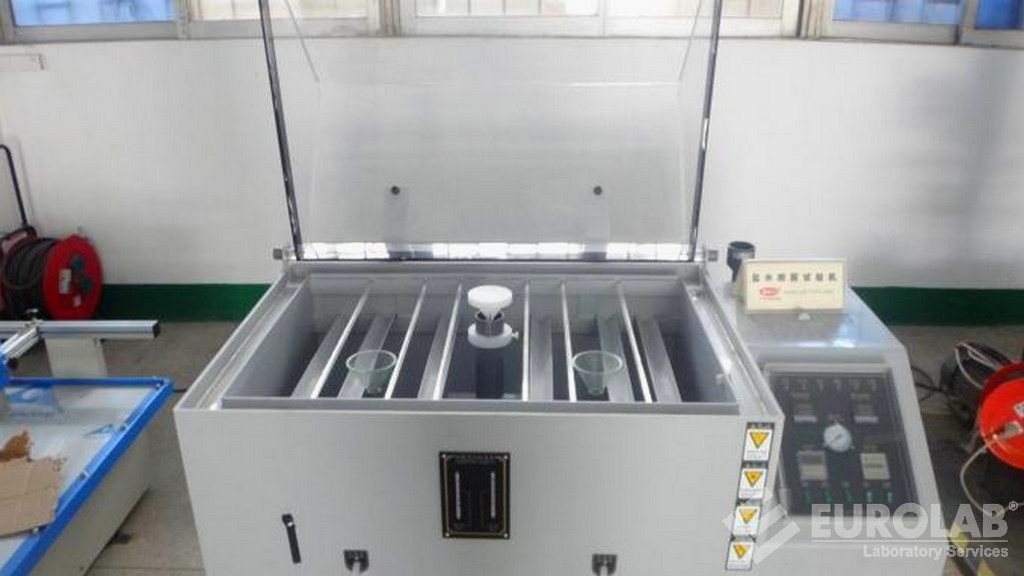
In order for this standard to be applied, the test chamber must comply with the requirements of the "JIS Z2371 Neutral salt spray test methods" standard and the "ASTM B117-19 Standard practice for the operation of salt spray (mist) device" standard.
The corrosive solution for Toyota TSH1552G standard uses refined salt and distilled or deionized water according to the standard “JIS K 8150 Sodium chloride (reagent)” or “ISO 6353-2 Reagents for chemical analysis - Part 2: Specifications - First series”. The corrosive solution will have a salt content of 5 percent and a pH of 6,5 to 7,2. The pH value of the solution can be adjusted using sodium hydroxide.
The test method defined in the Toyota TSH1552G standard is carried out at a temperature of 35 degrees by continuously atomizing the corrosive solution. Atomized fog collection rates will be 1mL-2mL per hour. Samples are rated for corrosion according to the rating scale listed in this standard.
The standard “ASTM D714-02 Standard test method for evaluating the degree of blistering of paints” is referenced in the test specification as a guide for the degree of corrosion.
Salt spray testing provides a controlled, accelerated corrosive environment to evaluate the relative corrosion resistance of the coating, substrate or part itself. Parts or panels are placed inside a chamber and exposed to continuous salt spray for a period of time, then evaluated for resistance to corrosion. This type of testing is also called salt fog testing.
Salt causes corrosion. Salty air is corrosive because it is hygroscopic, attracting water. Salt attracts moisture from the environment to the carbon steel substrate, which accelerates the oxidation (rusting) process. Salt is everywhere in the environment, which means that its effects can be found on the surface of materials that are susceptible to corrosion. It is no longer valid to describe the saline environment as a condition relevant to offshore structures.
The higher the salinity and pH value, the higher the corrosion rate. Damage due to corrosion (rust) is a common problem that causes material to deteriorate by interacting with the environment. This situation both spoils the appearance of the material or product and shortens its lifespan.
Salt spray testing is a standardized testing method used to check the corrosion resistance of coated or uncoated metallic samples. Since coatings can provide a high level of corrosion resistance over the intended life of the part in use, corrosion resistance needs to be controlled at an accelerated rate.
Salt mist testing is an accelerated corrosion test that creates a corrosive attack on coated samples to estimate their suitability for use as a protective finish. The appearance of corrosion products (oxides) or the adhesion of the coating is evaluated after some time. The test duration depends on the corrosion resistance of the coating. The more corrosion resistant the coating, the longer the test period without showing signs of corrosion.
Salt testing for corrosion in the automotive industry is used to test the relative resistance of paints on steel to corrosion when exposed to a changing climate of dilute salt spray at ambient temperature followed by high temperature air drying. Salt spray testing is a popular testing method in the surface coating industry.
Among the numerous testing, measurement, analysis and evaluation studies it provides for businesses in various sectors, our organization also provides testing services defined in the "Toyota TSH1552G Salt spray test method" standard, with a trained and expert staff and advanced technological equipment.
To get an appointment, to get more detailed information or to request an evaluation, you can ask us to fill in our form and reach you.

