

In the field of materials safety and environmental health, controlling volatile organic compound (VOC) emissions is of paramount importance, particularly in industries such as construction, furniture manufacturing, and automotive interiors. Formaldehyde, a colorless gas with a pungent odor, is one of the most studied volatile organic compounds (VOCs) due to its classification as a probable human carcinogen by organizations such as the International Agency for Cancer Research. The Q/SQR T1-8.1-2012 standard provides a rigorous framework for assessing formaldehyde emissions from composite wood products, adhesives, and related materials. While based on the European EN 717 series of standards and the criteria of the US Environmental Protection Agency, this standard adapts its methodologies to specific industrial needs.
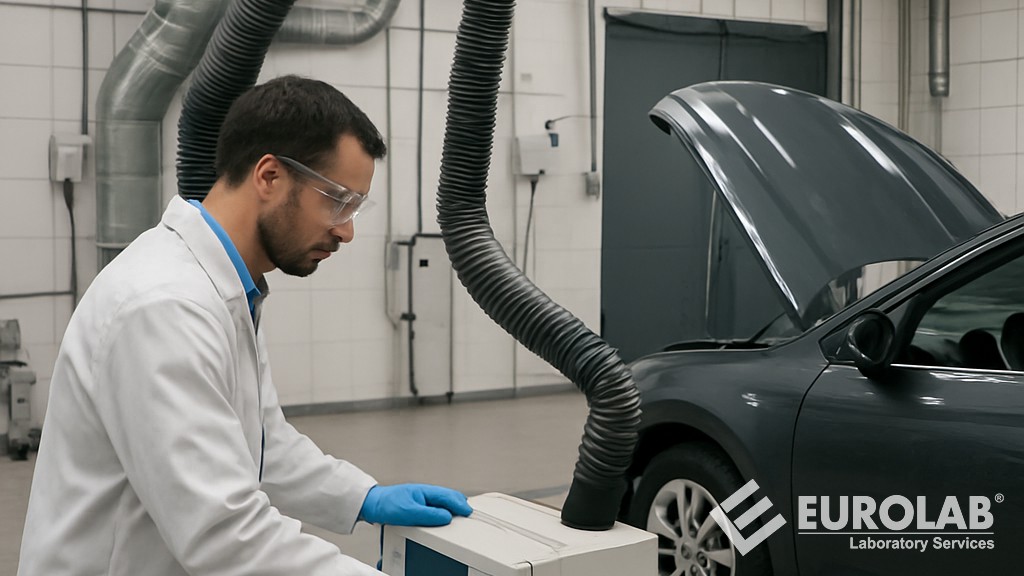
The “Q/SQR T1-8.1-2012 Emission Characteristics Test - Formaldehyde Content Test” standard, developed by Chery Automobile, one of China's leading global automobile brands, describes the formaldehyde content testing method for non-metallic interior trim and materials required for automobiles. This standard applies to the formaldehyde content testing method for non-metallic interior trim and materials required for automobiles.
During the test, a sample of specific dimensions is fixed in a 1-liter polyethylene bottle containing distilled water. The sample should be above the distilled water without touching the bottle wall or the water. The sample is conditioned at 60 degrees for 3 hours. After cooling, the formaldehyde and ammonium ions emitted from the sample react with diacetone to form dehydroacetic acid dihydrolutidine (DDL). DDL is a yellow complex and allows maximum absorption at a wavelength of 412 nm. The absorbance of the solution containing the yellow complex relative to the distilled water at a wavelength of 412 nm can be measured using a spectral photometer called the acetylacetone method. The formaldehyde content emitted from the sample can be calculated from the measured absorbance and the correction curve.
To prevent cross-contamination, the tested sample pieces are sealed during storage and transport. The sample size should be 40 mm x 100 mm, depending on the thickness of the material or part being tested. For composite spare parts (such as sunshades), the entire sample is recommended; if the sample thickness is more than 20 mm, the back is cut until it reaches 20 mm. Three samples are taken for each spare part or material; two are used to determine formaldehyde content, and one is used to determine moisture content. For soft spare parts and materials (such as genuine leather), the sample is cut with scissors and hung on a hook inside the cap of a 1-liter polyethylene bottle. For this purpose, a notch should be added to the sample (for soft materials). For hard spare parts and materials (e.g., hard plastic parts), the sample is cut with a band saw. To secure the sample to the hook, a hole larger than the diameter of the hook is drilled in each sample, and the hole is kept 10 mm away from the top edge and in the center.
Formaldehyde emissions pose significant risks in enclosed spaces, leading to sick building syndrome and long-term health problems such as respiratory irritation and cancer. Regulations worldwide mandate low-emission materials. The Q/SQR T1-8.1-2012 standard is emerging as an internal or industry standard to ensure consistency in testing formaldehyde emission rates.
The main objectives of this standard include:
This standard applies primarily to:
Reflecting advances in emission simulation, it emphasizes chamber testing over drying methods for accuracy.
The method defined in the Q/SQR T1-8.1-2012 standard, similar to the ISO 16000-9 standard, provides reproducible results by controlling variables such as temperature, humidity, and airflow.
This standard defines tiered limits based on end-use:
Compliance requires emissions to remain below these thresholds for 24 hours and optional accelerated aging tests for long-term verification.
In short, the Q/SQR T1-8.1-2012 standard is a cornerstone in formaldehyde emission control, blending scientific rigor with practical application to protect public health. As industries move towards more environmentally friendly practices, compliance with these standards not only reduces risks but also supports responsible innovation.
For many years, our organization, with its competent and experienced staff, has been understanding the needs of its clients, providing the advanced testing services they require, and assisting them in the establishment, implementation, and improvement of management systems. Within this framework, we also provide testing services to businesses in accordance with the "Q/SQR T1-8.1-2012 Emission characteristic test - Formaldehyde content test" standard.
To get an appointment, to get more detailed information or to request an evaluation, you can ask us to fill in our form and reach you.

