

The “VW PV 3015 Condensation behavior of materials used in vehicle interiors - Gravimetric determination of condensable components” standard, developed by the Volkswagen automotive company , describes a gravimetric method for determining the condensation behavior of materials used in the interiors of motor vehicles. This method can also be used to determine the condensation behavior of liquid, paste, powder, and solid raw materials that constitute or are used in the production of these materials.
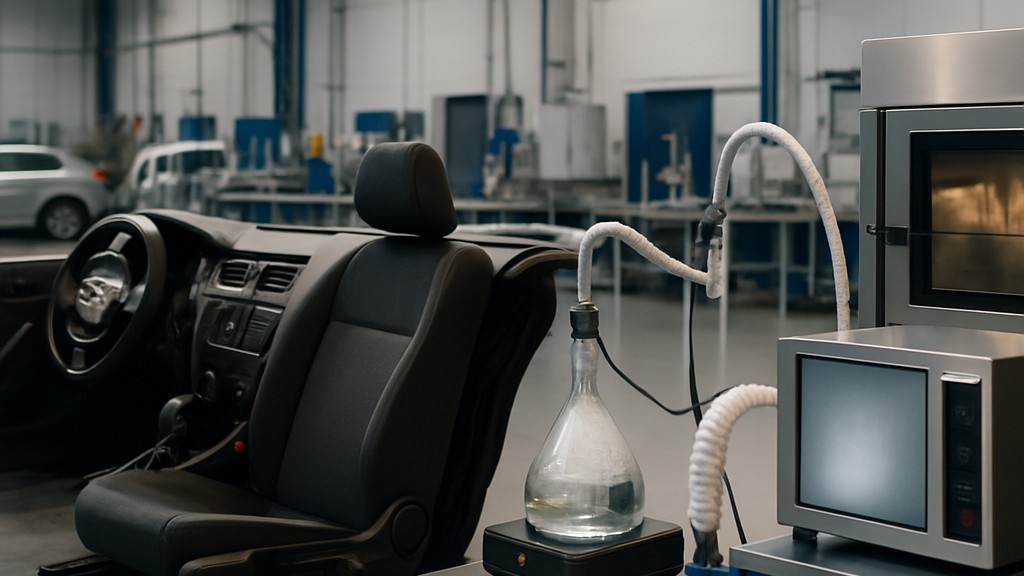
During the test, the sample is placed on the bottom of a beaker without a mouthpiece, with defined dimensions (in accordance with DIN 75201). The beaker is sealed, and a piece of aluminum foil is weighed to the nearest 0,01 mg. During the test, semi-volatile compounds in the sample condense on this aluminum foil. This aluminum foil is continuously cooled with water at 21°C (21°F) plus or minus 1°C (12°F). The prepared beaker is then left at 100°C (12°F) plus or minus 0,5°C (16°F) for 16 hours. The weight of the fogging condensation on the aluminum foil is determined by weighing the foil before and after the fogging test. Measuring the raw materials may not provide accurate information about the fogging behavior of parts made from these materials.
The following devices should be used in these tests:
Additionally, the following auxiliary equipment is used:
When preparing samples, flat, circular samples with a diameter of 80 mm plus or minus 1 mm are prepared from the sample material whenever possible. The sample thickness should not exceed 10 mm. For thicker materials, the material is removed from the underside until the thickness is no more than 10 mm. The underside is the side farthest from the visible surface. Rolls of products, such as textiles, artificial leather, leather, or nonwoven fabric, are cut or punched into a circular shape to obtain the samples.
In the case of large molded parts (including material composites) and large assemblies, the flattest possible specimens with a diameter of 80 mm plus/minus 1 mm are obtained.
In the case of large molded parts (including material composites) and large assemblies with complex geometry, the molded parts or assemblies are subdivided so that as few cut surfaces as possible are obtained.
Preferably, smaller molded parts made from a single material are tested without breaking them into smaller pieces. A total sample weight of 10 g plus/minus 2 g is used. The initial weight is stated in the test report.
Small assemblies and components made from composite materials (e.g., injection-molded parts with hard and soft components) are tested without further disassembly. The number of parts required to reach 10-20 weights is tested. The initial weight and number of parts are stated in the test report.
For powder, paste and liquid raw materials, samples weighing 10 g plus/minus 0,1 g each are used.
Unless otherwise specified during sample analysis, samples are pre-dried with silica gel (orange gel) in a desiccator for 24 hours. Materials listed in the table titled "Drying Time for Various Materials" should be pre-dried with silica gel (orange gel) in a desiccator for the specified time.
The material drying time is as follows:
Before starting the test, all beakers, seals, glass plates and metal rings are washed in a laboratory glass washing machine at a minimum of 80 degrees with a suitable dishwashing detergent and then deionized water is used to rinse.
For each fogging test, a toxicity study for diisodecyl phthalate (DIDP) is performed simultaneously. If the proportion of condensable components falls outside the range of plus or minus 0,25 mg per beaker compared to the control value after aging for 16 hours plus or minus 10 minutes and a bath temperature of 100°C plus or minus 0,5°C, the test conditions need to be checked.
The VW PV 3015 standard is used to evaluate how materials release volatile substances that condense on surfaces (especially glass or transparent components) in the vehicle interior.
This standard is considered important for the following reasons:
VW PV 3015 standard tests typically include the following:
Consequently, the VW PV 3015 standard is crucial for ensuring the safety, quality, and comfort of vehicle interiors. This standard helps automotive original equipment manufacturers and suppliers manage material emissions that impact visibility, odor, and health while complying with brand-specific requirements.
Our organization, which has been serving for many years and meticulously following global developments in science and technology, employs a skilled team and extensive infrastructure to conduct testing, measurement, and analysis in a wide range of areas for businesses across all sectors. In this context, we also provide testing services in accordance with the "VW PV 3015 Fogging Behavior of Materials Used in Vehicle Interiors - Gravimetric Determination of Condensable Components" standard.
To get an appointment, to get more detailed information or to request an evaluation, you can ask us to fill in our form and reach you.

