

The “VW PV 3001 Steering Wheel Surfaces - Wear Resistance” standard, developed by the Volkswagen automotive company, describes a method used to reproducibly verify the wear resistance of steering wheel surfaces (steering wheel assemblies and leather raw materials, as well as semi-finished products for steering wheel covers).
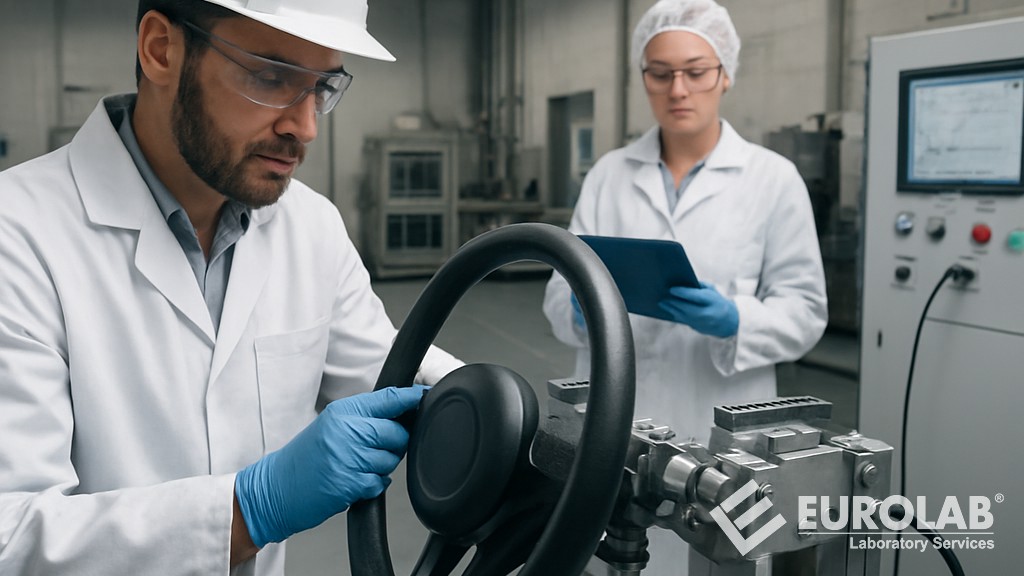
The steering wheel test rig simulates the mechanical load applied by the driver using oscillating movements on the outer diameter, e.g., at the 12 and 3 o'clock positions. The felt (white) must conform to the DIN EN ISO 11640 standard. The number of cycles is as shown in the drawing. The results must be documented in a table. Setup instructions for the test rig can be requested from the relevant department of the buyer. Examples of steering wheel test rigs are shown in the figure.
Prior to testing, samples must be conditioned for at least 24 hours at a temperature of 23 degrees Celsius and 50% relative humidity, in accordance with VW 50554 standard. Tests must be conducted in four different areas:
The VW PV 3001 standard is used to ensure that parts meet rigorous quality, durability, performance, and safety requirements before being used in manufacturing vehicles.
Volkswagen's PV standards encompass a wide range of tests for non-metallic materials, plastics, textiles, coatings, adhesives, and interior and exterior components. These include exposure to environmental factors (light, heat, humidity, chemicals), mechanical stress, emissions (e.g., volatile organic compounds and odors from interiors), and surface properties.
The VW PV 3001 standard appears in contexts involving material compatibility, emissions from automotive interiors, or specific resistance properties. Presumably, the initial qualification focused on a targeted aspect of material performance, such as adhesion or a specific exposure/compatibility test for suppliers.
These tests help Volkswagen in the following areas:
In short, the VW PV 3001 standard is a Volkswagen internal material specification used in the automotive industry to evaluate specific properties of supplied materials or components. It defines specific laboratory procedures, acceptance criteria, and reporting requirements to ensure parts meet Volkswagen's quality and performance expectations.
This standard defines detailed laboratory testing procedures to ensure that supplied materials meet Volkswagen’s stringent requirements for durability, safety, and environmental performance. It complements international standards such as ISO and DIN, but has been specifically tailored to Volkswagen’s engineering and manufacturing requirements.
The VW PV 3001 standard applies generally to automotive materials or components used in vehicle manufacturing, particularly those requiring verification of specific functional or environmental characteristics prior to approval for use. This standard can be used in the following situations:
It is generally used as a reference in Volkswagen's technical delivery terms or supplier contracts. Essentially, the method follows these steps:
These controlled parameters ensure reproducible and comparable results across different laboratories.
If test results fall outside the specified limits, the material or component may be rejected or require redesign.
The VW PV 3001 standard is primarily used in the following areas:
Suppliers providing materials to Volkswagen must demonstrate that the materials comply with the relevant PV specifications before being used in production.
Compliance with VW PV specifications is crucial for companies supplying materials or components to the Volkswagen Group. The benefits include:
In short, the VW PV 3001 standard is one of the internal testing procedures used by the Volkswagen Group to verify the performance and quality of materials and components used in automotive production. By defining standardized test conditions and acceptance criteria, it helps ensure that materials supplied to Volkswagen meet the company's rigorous engineering and safety standards.
For many years, our organization, with its competent and experienced staff, has been understanding the needs of its customers, providing the advanced testing services they require, and assisting them in the establishment, implementation, and improvement of management systems. Within this framework, we also provide testing services compliant with the VW PV 3001 standard.
To get an appointment, to get more detailed information or to request an evaluation, you can ask us to fill in our form and reach you.

