

The “GMW 16830 Tape Lamination to Automotive Components” standard, developed by General Motors Worldwide (GMW), is a test standard used to evaluate the adhesion performance of adhesive tapes applied to automotive components. This standard defines a 90-degree peel test designed to assess the quality of the bond between the adhesive tape and the component. This test is performed by measuring the peel strength and examining the resulting failure mode.
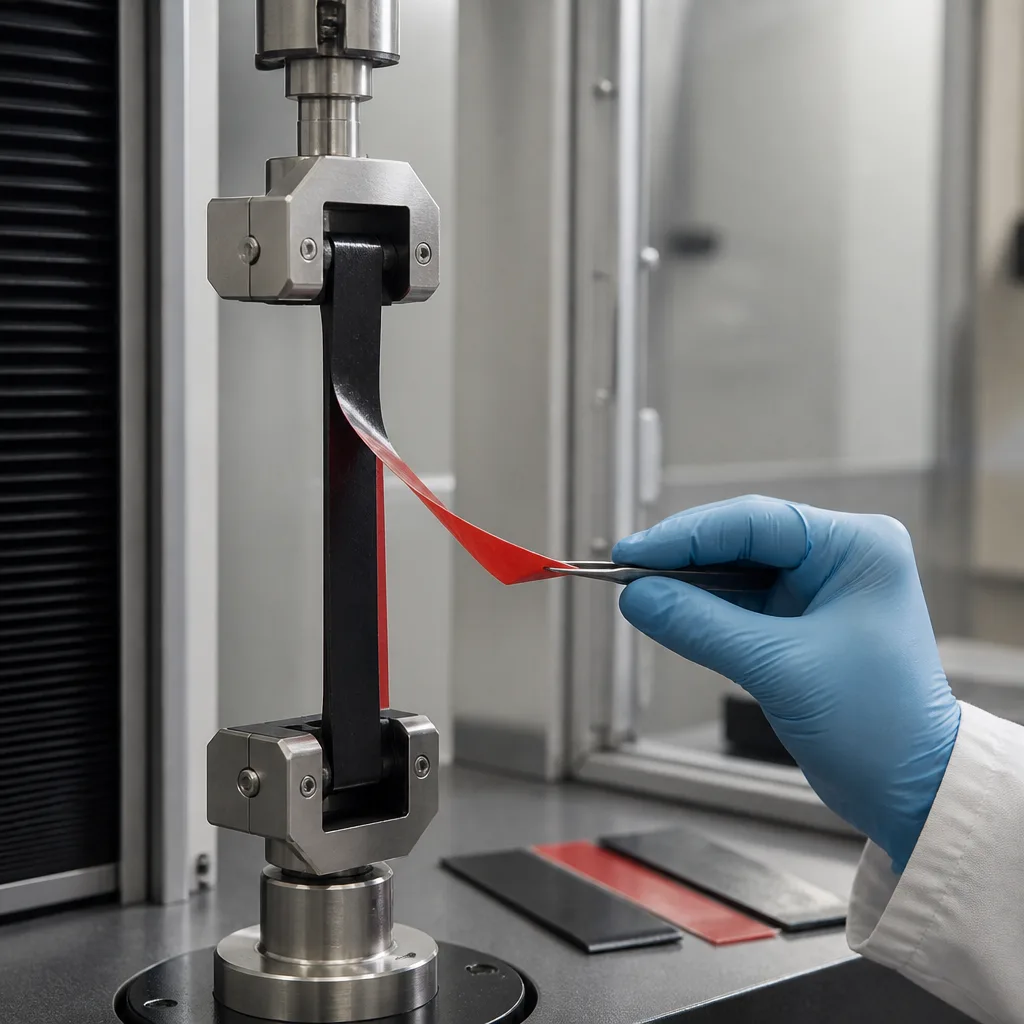
The GMW 16830 standard applies specifically to automotive trims and components installed using pressure-sensitive adhesive tapes instead of mechanical fasteners. Applications may include exterior and interior decorative parts such as body side moldings, emblems, nameplates, body claddings, appliques, door sill plates, dashboard trim strips, wheel arches, and roof gutter moldings.
The primary purpose of the GMW 16830 standard is to provide a routine quality control method for evaluating tape adhesion. A bonded component must maintain adequate adhesion during manufacturing, vehicle assembly, environmental exposure, and use.
This test method provides two important types of information:
This combination is important because a numerical peel strength result alone may not fully describe the quality of an adhesive bond. For example, failure could occur at the adhesive/substrate interface, in the adhesive itself, or within the tape or substrate.
The GMW 16830 standard applies to automotive components laminated with tape that has already been qualified and approved according to the relevant General Motors specifications for the substrate, adhesion enhancer, and tape. Therefore, it is primarily a quality and process control test rather than a replacement for material qualification. Typical applications include:
The basic principle of the test is the 90-degree peel test. Adhesive tape is applied to the specified automotive component under controlled conditions. Then, the free end of the tape is pulled from the component at approximately a 90-degree angle, and the force required to peel the tape is measured. The resulting force provides an indication of the adhesion level. At the same time, the operator examines the separated surfaces to determine the failure mode. This makes the procedure useful for monitoring whether the lamination process has formed a consistent and durable adhesive bond.
This method determines the following:
The location of the failure helps engineers differentiate between an adhesive problem and a substrate or processing problem.
Complete sample preparation, conditioning, equipment configuration, and acceptance criteria are included in the GMW 16830 standard.
This method essentially follows these steps:
Actual acceptance limits should not be inferred from the general description of the standard; they depend on the relevant component/material requirements and the approved conveyor system.
Adhesive tapes are widely used in automotive assembly because they can provide a clean, lightweight, and visually appealing bond without visible screws, clips, or other mechanical fasteners. However, poor adhesion can lead to:
Therefore, the GMW 16830 standard provides a practical way to monitor the consistency and quality of tape bonding during production.
One of the most useful aspects of the described method is that it does not rely solely on the measured peel strength. Two samples may produce similar peel strength values but exhibit different failure mechanisms. For example, one sample may show a desired cohesive failure in the adhesive system, while the other may show interfacial separation between the adhesive and the substrate. Consequently, peel strength and failure mode should be considered together when interpreting the test.
The GMW 16830 standard is particularly suitable for production quality monitoring as it can help identify variations in the bonding process.
Unexpected changes in peeling performance may indicate the following types of problems:
Therefore, the test can be integrated into supplier and production quality control programs.
The GMW 16830 standard offers several practical advantages:
However, the GMW 16830 standard should not be interpreted as a complete guarantee of the durability of an adhesive system. Peel strength can be affected by many factors, including substrate condition, surface preparation, temperature, dwell time, tape structure, and application conditions. Therefore, successful performance in a 90-degree peel test alone does not guarantee long-term performance in all automotive environmental conditions.
In conclusion, the test method described in the GMW 16830 standard is particularly useful for automotive trim components attached with adhesive tape, including moldings, emblems, appliques, door sill plates, and other decorative components. It helps manufacturers maintain consistent adhesive bonding and identify problems in the material, surface preparation, or lamination process. Therefore, for laboratories and automotive suppliers, this standard is an important tool for adhesion quality control and manufacturing process verification.
For many years, our organization, with its competent and experienced staff, has been understanding the needs of its clients, providing the advanced testing services they require, and assisting them in the establishment, implementation, and improvement of management systems. Within this framework, we also provide testing services in accordance with the GMW 16830 standard.
To get an appointment, to get more detailed information or to request an evaluation, you can ask us to fill in our form and reach you.

