

The “Hyundai Kia MS300-57 Test Method for VOC Emissions from Parts Assembly” standard, developed by Hyundai-Kia Motor Company, describes a test method involving a measurement process to determine the amount of volatile organic compounds (VOCs) released from parts inside a vehicle. The test sample is the assembly part, and the tests are performed in an environment using a 1 m³ VOC emission test chamber.
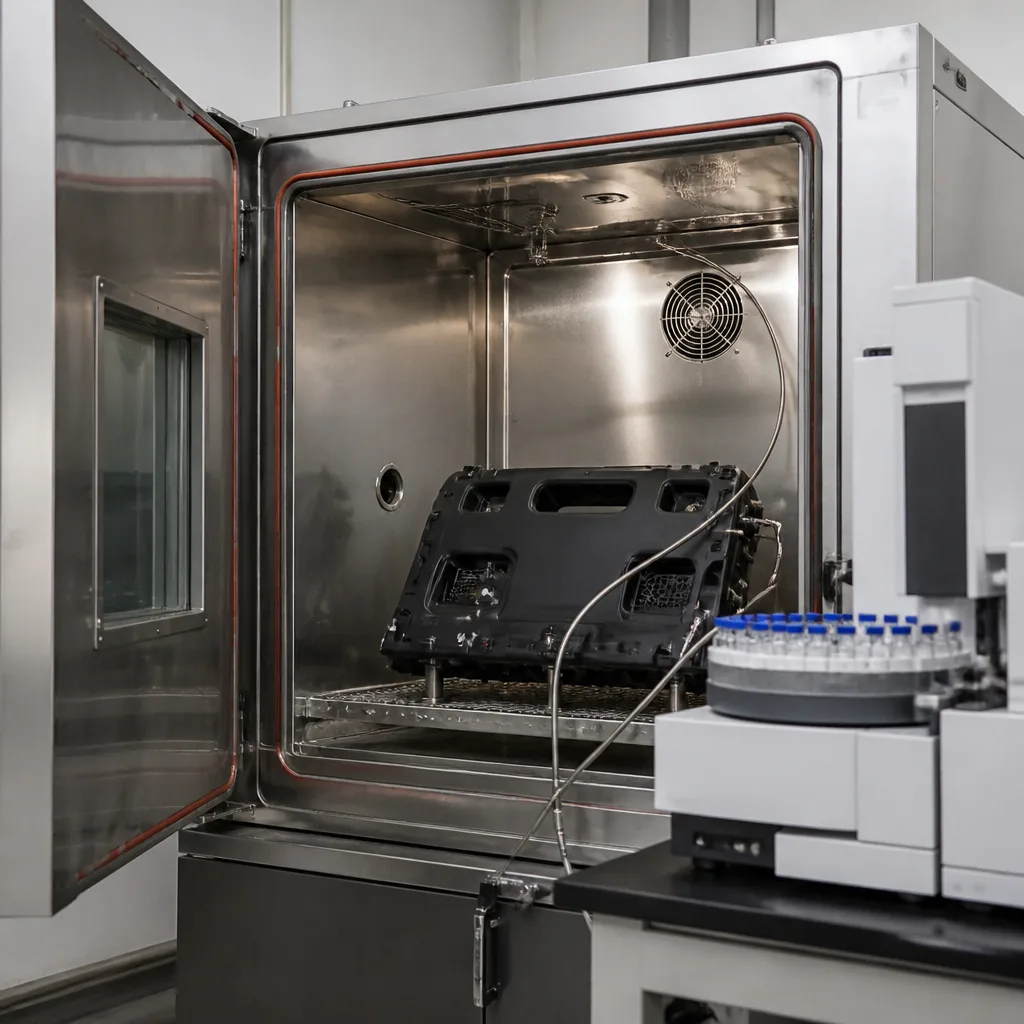
This test method describes the determination of volatile organic compounds (VOCs) emitted from an assembly part. The assembly part is placed in a 1 m³ VOC emission test chamber capable of controlling temperature and humidity, and the test chamber is operated for 2 hours under specified test conditions (temperature, humidity, ventilation). Then, a sample is taken from the air in the test chamber, and the samples are analyzed using analytical equipment (GC/MSD, HPLC).
This test method is intended for assembly parts mounted inside a vehicle. Each sample (part group) is tested to the extent of a vehicle containing all the detailed parts specified in the table entitled “Part Assembly for Testing” provided in the standard. For parts not listed in this table or additional parts, consultation with the relevant departments is required. If the result of this test meets the management criteria in the requirements section of this standard, the VOC emission test for the sub-components comprising the part group (MS300-55 standard) may be skipped.
Test samples must be in the same condition as they were immediately before assembly and must be tested within 72 hours of being shipped from storage to the assembly line. No additional processing or procedures are permitted for testing. When shipping test samples, they must be packaged in plastic or aluminum wrapping to prevent contamination during transport. Details of the samples must be recorded and stored.
In short, the Hyundai Kia MS300-57 standard is an internal automotive engineering standard that includes a test method for measuring volatile organic compound (VOC) emissions from assembled component modules used in vehicle interiors.
This standard defines how to assess the total amount of volatile organic compounds (VOCs) released from pre-assembled interior components (modules) in a controlled environment. This helps keep chemical emission levels low, reducing odors and improving passenger comfort and health, thus affecting in-vehicle air quality.
Unlike single-material tests, this standard targets assembled modules (such as door panels, instrument panels, or other grouped interior parts) to more accurately simulate real-world conditions.
This standard typically includes the following:
This standard may also include an odor assessment for the module (cross-referenced with related standards such as MS300-34). This complements the MS300-55 standard, which is typically used for individually molded parts or materials rather than complete assemblies.
Hyundai and Kia use standards such as MS300-57, MS300-55, and MS300-34 (odor assessment) as part of their supplier requirements and internal quality control to meet or exceed global expectations for low volatile organic compound (VOC) interiors.
Suppliers of interior components (such as plastics, upholstery, seats, and instrument panels) must test their modules according to this method to obtain approval for Hyundai Kia vehicles. Independent testing laboratories offer accredited testing services for compliance with the MS300-57 standard. This standard is included in the material and environmental specification lists along with flammability (MS300-08 standard), material requirements, and other performance tests.
The standards related to this standard are as follows:
In short, the Hyundai Kia MS300-57 standard is an important test standard used in the automotive industry to evaluate in-vehicle air quality. This standard specifically aims to measure and control volatile organic compounds emitted from vehicle interior components.
The main purpose of this standard is as follows:
This standard applies specifically to interior trim components such as plastics, textiles, adhesives, and coating materials.
The test method used under MS300-57 is a highly controlled and scientific process. A sample (usually an assembled part) is taken. The part is placed in a 1 m³ VOC emission test chamber. The ambient conditions are monitored in terms of temperature, humidity, and air exchange rate. The test is conducted for a specific period (usually several hours). Afterwards, air samples are taken from the chamber. The gas samples are analyzed using the following instruments:
This allows for precise determination of VOC types and quantities.
The standard typically analyzes the following:
The MS300-57 standard is primarily applied to the following components:
These parts are critical components that come into direct contact with passengers inside the vehicle or affect air quality.
Modern vehicles, especially when new, contain many plastics, adhesives, foams, textiles, and coatings that release volatile organic compounds (such as benzene, toluene, formaldehyde, or other hydrocarbons). In this respect, the MS300-57 standard test method is considered very important.
In conclusion, the Hyundai Kia MS300-57 standard is a specialized volatile organic compound emission test focusing on realistic module-level performance. It reflects the industry's ongoing efforts to create cleaner and more comfortable vehicle cabins by controlling chemical gas emissions from interior components.
For many years, our organization, with its competent and experienced staff, has been understanding the needs of its customers, providing the advanced testing services they require, and assisting them in the establishment, implementation, and improvement of management systems. Within this framework, we also provide testing services to businesses in accordance with the Hyundai Kia MS300-57 standard.
To get an appointment, to get more detailed information or to request an evaluation, you can ask us to fill in our form and reach you.

