

The standard “BMW AA 0081 Single Impact Test - Determination of the Release Layer of Multilayer Paint Systems by Single Impact Test Method”, developed by BMW, a multinational vehicle manufacturer, describes the single impact test, a mechanical test method used to determine the adhesion between layers, or more precisely, the release plane (release layer), in multilayer automotive paint and coating systems.
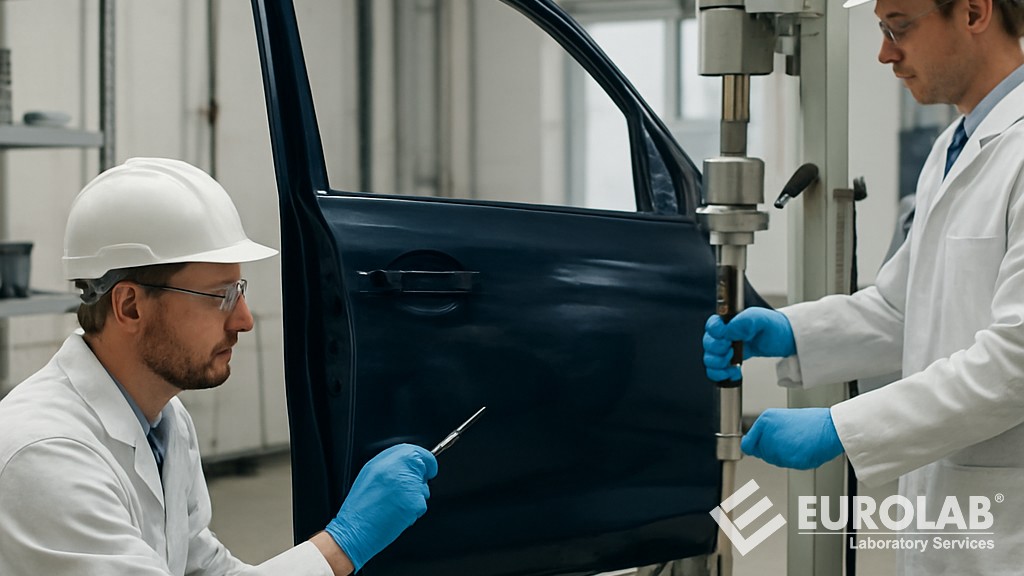
This test evaluates how well the various layers of a vehicle's paint system (e.g., primer, base coat, clear coat, and cathodic dip coating) adhere to each other and to the substrate (typically metal). This method is particularly useful for identifying weak points in adhesion under impact stress, simulating real-world conditions such as minor collisions or stone chips at low temperatures.
This procedure involves applying a single controlled pulse to a coated test panel, typically at low temperatures (e.g., minus 20 degrees Celsius), to evaluate the coating's behavior:
This test method is referenced in broader BMW Group standards such as BMW GS 90011 (coatings on metal parts) specified for exterior paint systems to verify low-temperature adhesion performance.
Automotive paints must withstand harsh conditions such as extreme temperatures, mechanical stress, UV exposure, and chemical attacks. Poor interlayer adhesion can lead to peeling, cracking, or corrosion over time, compromising both aesthetics and protection.
BMW has separate standards for multi-impact stone crack resistance (such as BMW AA-0079 or BMW AA-P 192), which simulate gravel bombardment. The BMW AA-0081 standard is specifically a single-impact method and is therefore ideal for targeted adhesion analysis rather than general crack simulation.
In general, this standard is used during material approval, quality control for suppliers, and verification of paint processes. It ensures that BMW's high-gloss, durable coatings perform reliably in cold climates or after minor impacts.
Essentially, BMW, as a leading automotive manufacturer, applies rigorous internal standards for materials testing to ensure the durability, safety, and quality of its vehicles. Within this framework, the AA series standards cover a wide range of materials testing, including chemical resistance (BMW AA-0055), formaldehyde emissions (BMW AA-0061), and stone chip resistance (BMW AA-0079). The BMW AA-0081 standard falls into the mechanical durability category, complementing environmental simulations such as cyclic corrosion tests.
The BMW AA-0081 single-impact test is a critical quality assurance tool in BMW’s paint and coating validation process. The necessity of this test stems from the demanding real-world conditions that automotive coatings must withstand, particularly in terms of long-term durability, corrosion protection, and aesthetic integrity.
The main reasons why this standard is considered important are:
In conclusion, the BMW AA-0081 standard is a precise, impact-based method that plays a critical role in guaranteeing the integrity of multi-layer coatings, enabling vehicles to withstand the rigors of daily driving and maintain their superior appearance for years to come.
For many years, our organization, with its competent and experienced team, has been understanding the needs of its clients, providing the advanced testing services they require, and assisting them in the establishment, implementation, and improvement of management systems. Within this framework, we also provide testing services in accordance with the BMW AA 0081 standard.
To get an appointment, to get more detailed information or to request an evaluation, you can ask us to fill in our form and reach you.

