Hyundai Kia MS300-34 Standard Test Method - Carpet
The standard “Hyundai Kia MS300-34 Standard test method - Carpet”, developed by Hyundai-Kia Motors Corporation, the oldest motor vehicle manufacturer in Korea, describes standard test methods for automobile carpets. The test items required in this standard shall be as specified in the table provided in the standard. If different test items and conditions than those specified in this standard are required, they shall be agreed upon by the responsible parties.
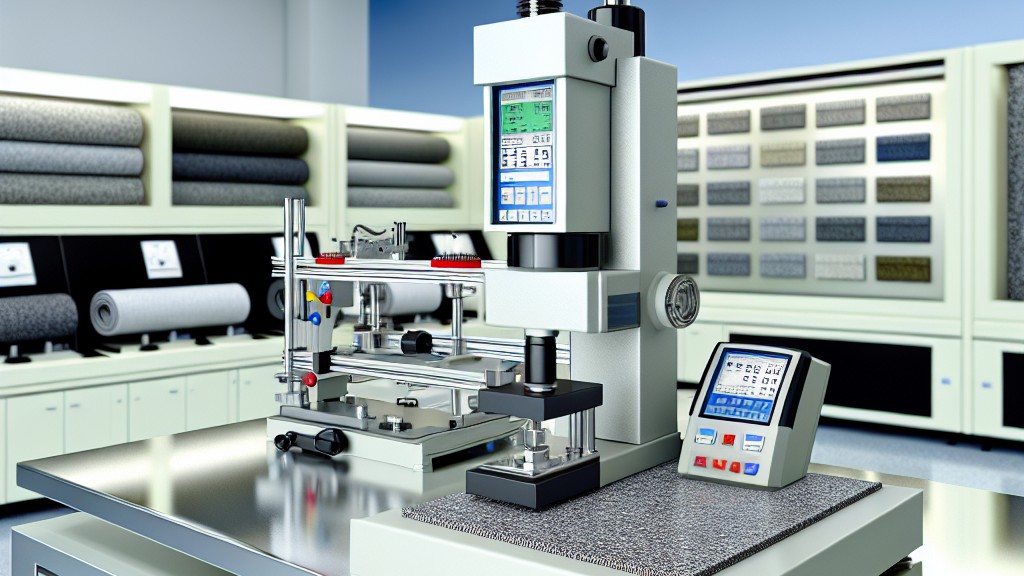
The general test conditions are determined as follows:
- The standard condition of the laboratory should be 23 degrees plus/minus 2 degrees temperature and 50 percent plus/minus 5 percent relative humidity.
- The test sample should be kept under standard laboratory conditions for at least 24 hours prior to testing.
- Each test is performed with 7 samples and the arithmetic average of the 5 values is taken, excluding the highest and lowest value.
- Carpet samples should be taken at least 50 mm from the edge and from random locations where the warp threads differ from the filling threads.
- Types and shapes of samples are shown in the table.
- Test results must be stated in accordance with the table. If test results are stated in numbers, they must be rounded in accordance with the KS Q 5002 and KS A 325-2 standards.
- Test results, if expressed in numbers, should be rounded in accordance with the standards ISO 5479, ISO 2584, ISO 2602, ISO 3301, ISO 3534-1-3 and ISO 8258.
The test methods defined in this standard include:
- Appearance test: When testing, the carpet sample is placed in daylight equipment or equivalent (avoiding direct sunlight) with the pile direction in the same direction as the standard sample. It is compared with the standard sample for color tone at seven points each. Stand approximately 1 m away from the carpet. The carpet is visually inspected for defects. The following are considered to be the major defects of the carpet: pile loss, strip line, rough mark, breakage, wool cutting, pit, faulty support, broken pick, soil, stains and the like.
- Thickness test: When testing, the platen is gently placed on a sample. It is held for 5 seconds and then the indicator is read to the nearest 0,01 mm. The test should be carried out at five points. The arithmetic average of the five tests is taken.
- Pile length test: When performing the shear test, the pile is held perpendicular to the substrate fabric. The pile length is measured from the top of the substrate fabric to the pile tip to the nearest 0,5 mm. When performing the loop test, the pile center is lifted vertically to the substrate fabric with a hook. The pile length is measured from the top of the substrate fabric to the pile loop top to the nearest 0,5 mm. This test is performed at 10 locations and the arithmetic mean is taken. The pile is lifted slowly to prevent any remaining elongation during the test.
- Weight test: When performing the test, an air circulation type temperature control cabinet is used. A sample is placed in an oven at 2 degrees plus/minus 105 degrees for 2 hours. After removing from the oven, the sample is transferred to desiccators at room temperature and kept. When the temperature of the desiccator drops to room temperature, the sample is weighed using a scale.
- Tensile strength and elongation test: A tension type tensile testing machine or equivalent is used when performing the test. Score marks are made in the center of the samples at a distance of 100 mm from each other. The sample is placed in the test machine with a distance of 150 mm between the mandrels and tension is applied at a rate of 200 mm per minute. Tensile strength and elongation are determined according to the maximum load. The average of three samples for both longitudinal and lateral directions is accepted as the result respectively. If the rupture occurs at a place other than between the scribed marks, the measurement is cancelled and the test is re-tested using the same number of new samples as the discarded samples.
- Tear strength test: When performing the test, the sample is placed in the testing machine with the two sides of the notch clamped in the relevant chucks at a distance of 100 mm from each other. The load is applied at a speed of 200 mm/min in the direction parallel to the notch. The average of three samples in both longitudinal and latitudinal directions or at most three are taken into account as the result respectively.
- Pile yarn removal strength test: When testing, a carpet pile placed on the carpet holder is caught by an extraction chuck. A tension of 200 mm per minute is applied and the maximum load is found.
- Compression elasticity test: When performing the test, an initial load of 7 gf/cm2 is applied to the sample and the thickness is measured. A load of 200 gf/cm2 is applied and held for 1 minute, then the thickness is measured. After the load is removed, it is held for 1 minute. The thickness is measured under the same load as the initial load. Compression elasticity is calculated using the given formula. The average of five samples is accepted as the result.
- Abrasion test: When testing, the sample is placed in the tester. The wheel is cycled as specified using a speed of 70 rpm and a load of 1.000 g. The abrasion is compared with standard samples or evaluated according to the table.
- Water immersion shrinkage test: When performing the test, the sample is immersed in room temperature water for 1 hour. After removal, the sample is read again to remove wrinkles and allowed to dry for 48 hours or more. The distance between the lines drawn in both longitudinal and lateral directions is measured and the average is determined. The water immersion shrinkage is calculated using the given formula.
- Color fastness test to washing: When performing the test, undyed cloth pieces of the same size as the sample are glued face to face on both sides of the sample and a layered sample is made. The layered sample is immersed in a beaker containing cleaning solution at 60 degrees plus/minus 2 degrees and stirred with a glass rod for 10 minutes. After removing the sample and cloth from the beaker, they are sufficiently rinsed and wrapped in a white cloth. They are squeezed and dried at 70 to 75 degrees. The sample is examined for discoloration and the undyed cloth is examined for staining. It is evaluated according to the table.
- Test of color fastness to rubbing with dry cloth: When performing the test, the rubbing shoe is covered with undyed cloth. 100 cycles of double-pass rubbing are performed on the sample surface under certain conditions. The extent of staining is evaluated according to the table.
- Fade resistance test: When testing, the sample is clamped to the holder and exposed to the fade meter for the specified hours. The exposed sample is compared to the unexposed sample. The degree of color change is evaluated according to the gray scale for color change. The backing is examined for hardening, discoloration, and other defects.
- Thermal aging test: When testing, the sample is heated in an oven at 168 degrees for 80 hours. After removing it, it is left to cool at room temperature according to the elements. The back side is bent outward and the sample is examined for cracks. When the back coating is sticky, the back side is bent inward and the adhesiveness is examined.
Our organization, which has been trying to support businesses from every sector with its testing, measurement, analysis and evaluation studies carried out in a wide range for years, has a strong staff that closely follows the developments in the world in the field of science and technology and constantly improves itself. In this context, testing services in accordance with the "Hyundai Kia MS300-34 Standard Test Method - Carpet" standard are also provided to businesses.



