

The standard “BMW GS 97034-9 Surface testing of motor vehicle interior materials – Scratch testing,” developed by BMW, a multinational vehicle manufacturer, describes a test procedure used to determine the resistance of surface materials in the passenger compartment to objects that cause scratches.
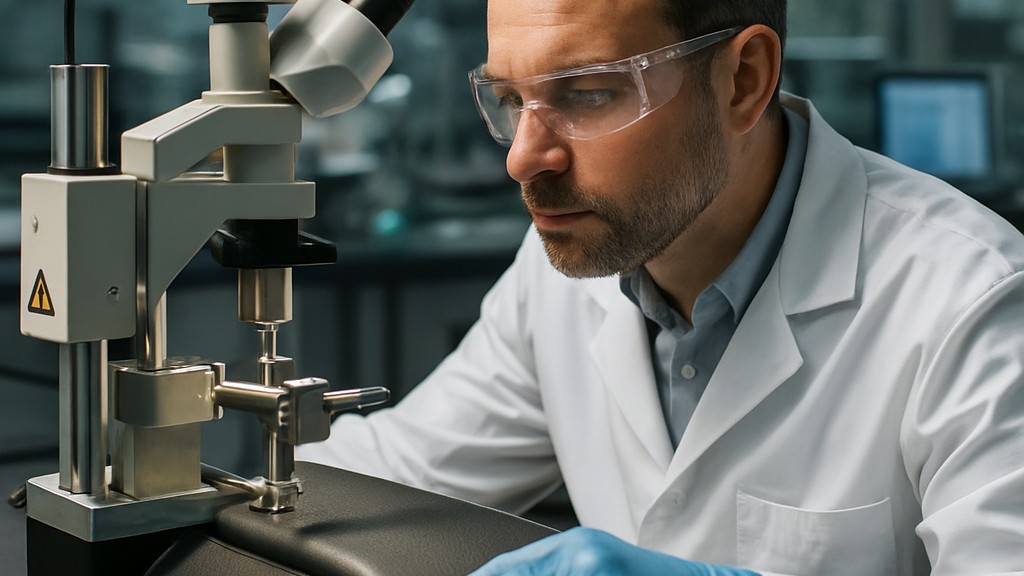
Surface materials in the passenger compartment come into contact with various objects, such as rings, keys, or other sharp-edged and hard objects. This standard defines a scratch test method. It is applicable to painted, coated, uncoated, and laminated surface materials.
The purpose of this standard is to define a standard test for material suitability. The components to be tested must be defined in agreement with the relevant specialist departments. Different conditions apply to aluminum surfaces. The requirements applicable to surface materials are defined in the relevant regulations.
Before testing, the samples must be conditioned for 24 hours in a standard atmosphere according to DIN EN ISO 291.
Before testing, samples should be cleaned without pressure using a microfiber cloth moistened with laboratory rinse. The specified test sample is moved relative to the test surface with a constant test force and constant speed. The test force is increased incrementally (1 N, 2 N, 3 N, 5 N, 8 N, 10 N, 12 N, 15 N, 20 N). Each test force is applied only once to the surface to be tested. Tests should preferably be performed on flat samples. The test path should be 50 mm to 100 mm. Any test setup that allows testing within the listed parameters is suitable for the test application.
The test speed is 40 plus/minus 5 mm/s, and the test force is 1 N, 2 N, 3 N, 5 N, 8 N, 10 N, 12 N, 15 N, and 20 N. The tip should be examined under 30x magnification before each test. It should be smooth, hemispherical, and free of scratches and dirt. The tip should be replaced or cleaned as necessary.
The sample length should be at least 90 mm and the sample width at least 50 mm. To better evaluate individual ratings, the line spacing should be shifted by 5 mm when the voltage is reversed after each scratch test. If the results are uncertain, the test is performed on equipment at BMW.
Tested samples should be cleaned with a microfiber cloth moistened with deionized water without applying pressure. Evaluation is performed after a 24-hour recovery period. Evaluation is performed according to the evaluation matrix in accordance with the BMW AA-0635 standard.
The test report shall include reference to this standard and indicate the type, name and construction of the material tested, and the test setup. Test parameters that deviate from this standard shall be documented in the test report.
In the high-stakes world of automotive manufacturing, where every detail, from engine performance to interior aesthetics, must withstand the rigors of daily use, BMW has long been a pioneer in setting quality standards. Among these, the BMW GS 97034 series stands out as a cornerstone for assessing the durability of interior materials. The BMW GS 97034-9 standard specifically focuses on scratches, one of the most common issues.
The BMW GS 97034-9 standard uses a methodical and repeatable procedure to simulate scratch forces. Generally, this procedure involves the following steps:
The precision of this protocol provides measurable data, allowing suppliers to quickly iterate designs. For example, a high-end piano black upholstery might need to withstand 20N without failing, while softer leathers require different thresholds.
With electric vehicles and autonomous technologies dominating the headlines today, the BMW GS 97034-9 standard directly influences material selection, driving innovations in scratch-resistant coatings such as nano-ceramics or self-healing polymers. Looking ahead, BMW is developing this standard for next-generation materials.
Our organization, with its competent and experienced team, has been understanding the needs of its customers for years, providing them with the advanced testing services they need, and assisting them in the establishment, implementation, and improvement of management systems. In this context, we also provide testing services in accordance with the "BMW GS 97034-9 Surface testing of motor vehicle interior materials - Scratch testing" standard.
To get an appointment, to get more detailed information or to request an evaluation, you can ask us to fill in our form and reach you.

