

GMI 60314 Determination of Weight Per Unit Area of ​​Support Material for PVC Coated Flooring Materials

GMI 60314 Determination of Weight Per Unit Area of ​​Support Material for PVC Coated Flooring Materials

The “GMI 60314 Determination of Weight Per Unit Area of ​​Supporting Material in PVC Coated Upholstery Materials” standard, developed by General Motors International (GMI), includes a material testing method used to determine the weight per unit area (surface mass) of the supporting material in PVC coated upholstery materials. This standard applies primarily to automotive interior upholstery materials such as artificial leather, coated fabrics, and upholstery coverings used in vehicle seats, door panels, armrests, and other interior components.
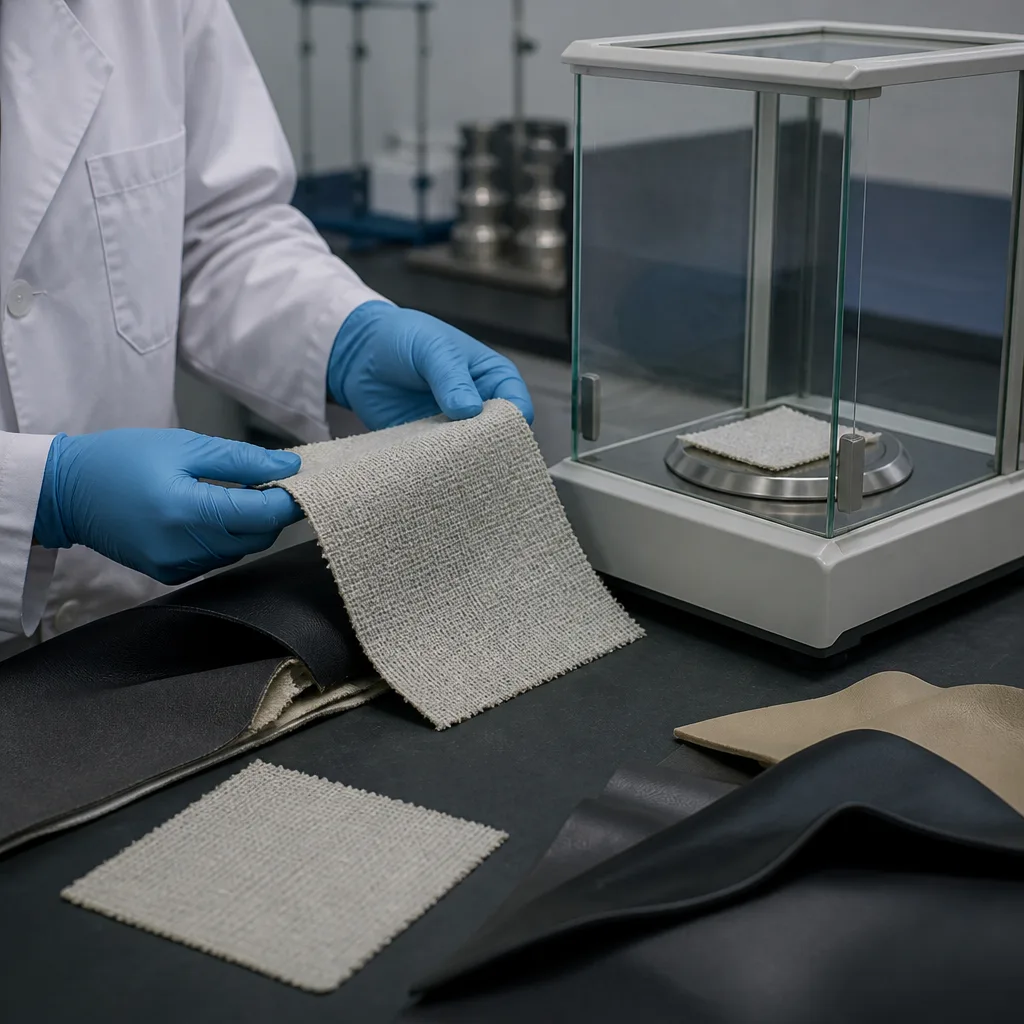
GMI 60314 Determination of Weight Per Unit Area of ​​Support Material for PVC Coated Flooring Materials

The described test method focuses specifically on the reinforcing textile backing layer rather than the entire PVC-coated structure. This allows General Motors engineers and suppliers to assess the consistency and quality of the reinforcement layer independently of the PVC coating.

The primary purpose of the MI 60314 standard is to measure the mass of the support material per unit area. The result is usually expressed in g/m² (grams per square meter). The measured value provides information about :

  • Fabric backing weight
  • Material consistency
  • Coating process control
  • Variation based on supplier party.
  • Mechanical performance potential of flooring material.

PVC-coated flooring materials are typically multi-layered structures consisting of the following:

  • PVC surface layer
  • Foam or interlayer (if any)
  • Textile backing / back layer

The backing material has a major impact on the following:

  • Tensile strength
  • Tear resistance
  • Dimensional stability
  • Sewing performance
  • Adhesion behavior
  • Long-lasting durability

A very lightweight backing fabric can cause the following:

  • Reduced mechanical strength
  • Flexing during assembly
  • Poor stitching performance
  • Premature failure during vehicle use

If the backing fabric is too heavy, this can cause the following:

  • Rising material costs
  • Higher component weight
  • Processing difficulties

Therefore, the GMI 60314 standard helps ensure that suppliers deliver materials with controlled structure and predictable performance.

The GMI 60314 standard generally applies to the following:

  • Automotive seat materials
  • Seat covers
  • Seat side panels
  • Headlines
  • Armrests
  • Interior furnishing materials
  • Door panel coverings
  • Console coverings
  • Instrument panel decorative trims
  • Synthetic leather materials
  • PVC artificial leather
  • Coated textile materials

In principle, the test procedure includes the following:

  • Step 1 Sampling: A representative sample of the PVC-coated flooring material is taken.
  • Step 2: Separation of the backing layer. The PVC cladding layer is removed or separated according to the specified procedure, leaving only the backing layer.
  • Step 3 Conditioning: The sample can be conditioned in a controlled laboratory environment before measurement. Typical conditioning conditions in automotive material testing include:
    • Temperature: Approximately 23 degrees
    • Relative humidity: Approximately 50 percent
  • Step 4 Measurement: The support sample is weighed and its area is determined. The surface mass is calculated.

The main factors that influence test results are as follows:

  • Removing the PVC layer: Prevents the effect of the coating weight.
  • Conditioning: Eliminates humidity fluctuations.
  • Balance accuracy: Provides repeatable measurements.
  • Support homogeneity: Represents production consistency.

The GMI 60314 standard is generally not a performance robustness test in itself. Instead, it supports other validation tests such as those listed below:

  • Tensile strength test
  • Tear resistance test
  • Seam strength test
  • Wear resistance test
  • Adhesion test
  • Aging resistance test

Support weight is generally related to the expected structural strength of the flooring material.

For suppliers producing PVC-coated interior materials, the GMI 60314 standard helps in the following ways:

  • Quality control: Ensures each production batch conforms to the approved material specifications.
  • Supplier approval: Provides General Motors with a measurable characteristic for material comparison.
  • Process monitoring: Detects changes in the following areas:
    • Textile supplier
    • weaving process
    • Coating process
    • material structure
    • Lightweight vehicle design

The GMI 60314 standard controls unnecessary material mass while maintaining performance.

This standard is important because it provides a standardized test method for determining the weight per unit area of ​​the backing layer (backing layer) of PVC-coated upholstery materials used in automotive interiors. This standard ensures that the textile or non-woven fabric bonded to the PVC coating meets quality and performance requirements.

This standard is considered important for the following reasons:

  • Ensures material consistency: The backing material significantly affects the overall properties of PVC-coated flooring. Measuring its weight per unit area ensures that each production batch has a consistent amount of reinforcing material, reducing variation between suppliers and production batches.
  • Improves mechanical performance: The backing provides many of the following properties of the flooring:
    • Tensile strength
    • Tear resistance
    • Dimensional stability
    • Resistance to stress during assembly.

If the support weight is too low, the material may be weak. If it is too high, the material may become unnecessarily heavy and difficult to process.

  • It supports production quality control: Vehicle manufacturers and suppliers use this standard as a quality control tool for the following purposes:
    • Verifying incoming materials
    • Comparing supplier products
    • Detecting production deviations.
    • Ensuring compliance with material properties.

This minimizes the risk of defective flooring materials entering the production process.

  • It helps preserve the interior appearance: The backing material affects how the PVC flooring behaves during the following processes:
    • Vacuum forming
    • Winding
    • Seam
    • lamination

Maintaining the specified weight of the support material helps prevent defects such as the following:

    • wrinkles
    • Corruption
    • Poor surface appearance
    • Irregular fit of internal components.
  • Increases durability: A suitable support material structure increases the flooring's resistance to the following factors, contributing to long-term performance:
      • Repeated loading
      • Flexibility
      • temperature changes
      • Aging

    This is especially important for automotive seats, door panels, armrests, and dashboard trim.

    • Supports supplier qualification: General Motors uses standardized material testing to ensure that suppliers worldwide evaluate products using the same procedures. This standard ensures:
      • Fair comparison among suppliers.
      • Consistent Production Part Approval Process (PPAP) documentation.
      • Reliable material approval.
      • Repeatable laboratory results
    • It reduces vehicle weight variability: Although the support represents only one part of the floor structure, controlling its mass helps manufacturers.
      • Estimating component weight
      • Maintaining vehicle weight targets
      • Improving production consistency

    In summary, the GMI 60314 standard is an automotive material testing method used to determine the surface mass of the backing layer in PVC-coated flooring materials. The backing layer is important because it controls many mechanical and manufacturing properties of automotive interior materials. By controlling the weight of the backing layer, General Motors and its suppliers can ensure consistent quality, durability, and manufacturing reliability in vehicle interiors.

    Tests frequently evaluated in conjunction with the GMI 60314 standard include those related to the abrasion resistance, adhesion, tensile properties, and aging behavior of automotive upholstery materials.

    For many years, our organization, with its competent and experienced team, has been understanding the needs of its clients, providing the advanced testing services they require, and assisting them in the establishment, implementation, and improvement of management systems. Within this framework, we also provide testing services compliant with the GMI 60314 standard.

    WhatsApp

