

The "BMW PR 378 Sewing Thread Abrasion Test," developed by BMW, a multinational vehicle manufacturer headquartered in Germany, describes a test method used to determine and evaluate abrasion resistance. This standard applies to sewing threads. These tests measure:
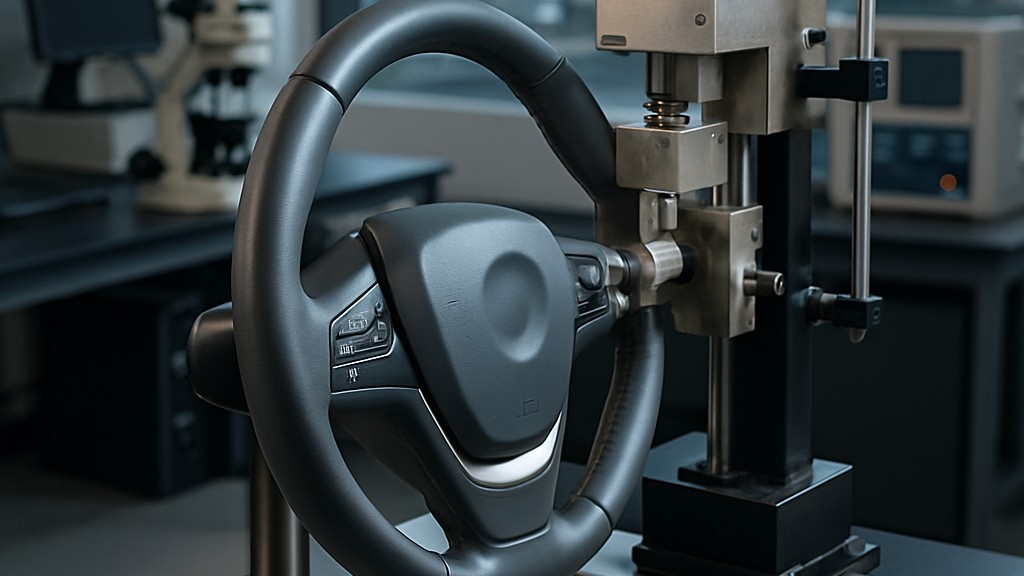
Five samples, each with a minimum length of 500 mm and five samples with a minimum length of 150 mm, are taken from the test material. The samples must be conditioned for at least 24 hours under standard climatic conditions (23°C, 50% relative humidity) according to ISO 554. Testing must be conducted under standard climatic conditions.
To compress yarn samples, short sections of yarn are placed around a metal rod to measure the diameter and secured to the tester to form a loop. The long section of yarn is passed through the attached loop and secured to the tester's slide. A weight is hung from the end of the slack yarn, and the tester is operated. The yarn must not rotate during the test. The test frequency is 36 plus/minus 2 load cycles per minute.
To determine the number of load cycles, the average load change until the yarn fails must be documented in the test report. When rating, the average load change must be compared with the relevant specifications.
The applicable standards in these tests are:
In the high-stakes world of automotive manufacturing, where every component must withstand the rigors of daily use, abrasion resistance is a critical measure of material durability. BMW has long set industry standards with its rigorous testing protocols. Among these, BMW PR 378 stands out as a specialized procedure for assessing thread abrasion in textiles and composites, essential for applications such as seat fabrics, interior upholstery, and protective covers.
Designed as part of BMW's comprehensive suite of internal standards, the BMW PR 378 standard is a procedural requirement focused on the abrasion susceptibility of yarn-based materials. Unlike more extensive surface tests, this standard focuses on the microscopic abrasion of individual yarn fibers under simulated real-world stresses (such as friction from passengers shifting gears, the friction of cargo, or environmental exposure). This protocol aligns with BMW's efficient dynamics philosophy, which emphasizes lightweight, durable materials that improve fuel efficiency without compromising safety or luxury.
This procedure utilizes established standards such as the Martindale abrasion test (ASTM D4966 standard) but adapts them to BMW's criteria. Introduced with the proliferation of new-generation vehicle interiors, the BMW PR 378 standard addresses the growing need for measurable data on thread integrity in high-wear areas. This procedure prevents cascading failures by isolating thread wear: a single worn fiber can lead to pilling, color fading, or structural weakening in fabrics.
The BMW PR 378 standard is today an integral part of BMW's supplier qualification process, ensuring that threads from global partners meet longevity thresholds that typically exceed 50.000 wear cycles before reaching measurable degradation.
The BMW PR 378 standard essentially uses a controlled abrasion simulator to simulate dynamic stresses in yarn samples. The protocol involves extracting monofilament or multifilament yarns from fabrics, mounting them in a tensile fixture, and subjecting them to oscillatory friction against an abrasive medium. The key elements are:
Testing is typically performed in climate-controlled laboratories using automated instruments, such as a Martindale tester adapted for yarn insulation. Post-abrasion analysis uses scanning electron microscopy (SEM) to detect surface pitting or delamination at the fiber level. For blended yarns (e.g., polyester-cotton or aramid-infused), the BMW PR 378 standard evaluates differential abrasion rates to ensure there are no weak links that could compromise the entire fabric.
This methodology not only identifies substandard materials, it also informs yarn engineering and paves the way for innovations such as high-strength polyesters or ultra-high molecular weight polyethylene blends for superior abrasion resistance.
Our organization, with its competent and experienced team, has been understanding the needs of its customers for years, providing them with the advanced testing services they need, and assisting them in establishing, implementing, and improving management systems. In this context, we also provide testing services in accordance with the "BMW PR 378 Sewing Thread Abrasion Test" standard.
To get an appointment, to get more detailed information or to request an evaluation, you can ask us to fill in our form and reach you.

