

The standard “VW 96395 Leather - Area shrinkage test and shrinkage force measurement” developed by the Volkswagen automobile company describes the test methods applied to determine the dimensional change (area shrinkage) and shrinkage force of leather under the influence of temperature and humidity.
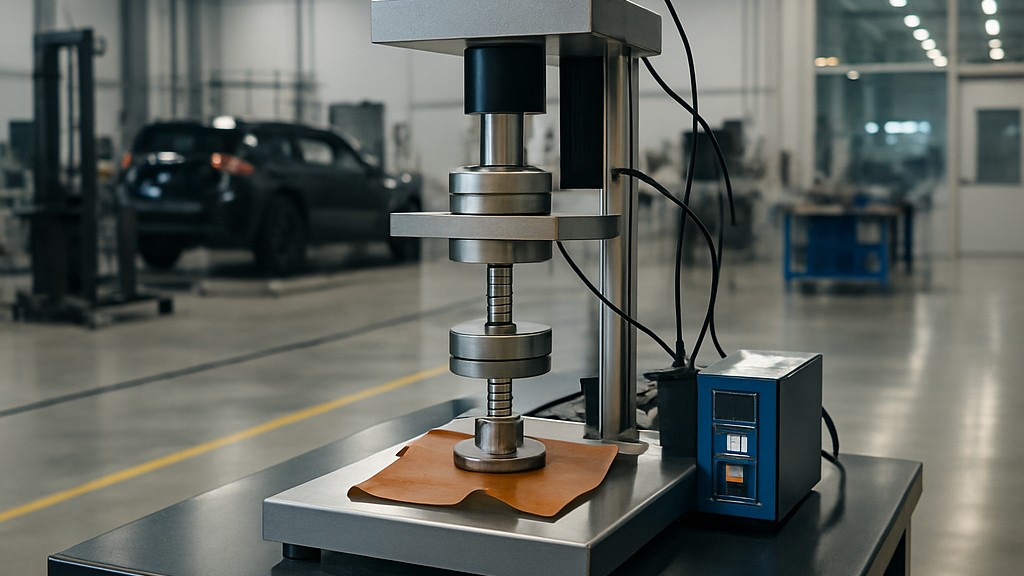
For the purposes of this standard, shrinkage behavior refers to the tendency of materials to change dimensionally under the influence of heat and humidity and thereby develop shrinkage forces.
When measuring area shrinkage in accordance with the standard “Porsche PPV 5002 Leather - Determination of shrinkage behavior”, the following equipment is used:
The specimen dimensions are approximately 550 mm x 550 mm according to DIN EN ISO 2418. The measuring length is 500 mm. The specimen is marked in the longitudinal and transverse directions.
The sampled leather samples are conditioned for at least 24 hours in a standard climatic environment according to DIN EN ISO 2419, and immediately afterward, measurement sections are marked in the longitudinal and transverse directions. The test cycle is repeated a total of 30 times. One test cycle consists of:
Measurements are taken after 10 and 30 test cycles. The first sample should be accompanied by a corresponding printout from the climatic chamber, where the location of intercept point 1 is clearly visible. The temperature and humidity curves shown in the figure provided in the standard must be strictly adhered to. Intercept point 1 in the test cycle is particularly important. The following values must be maintained for both temperature and humidity: Intercept point 1: 67°C, 48% relative humidity.
At this stage, longitudinal and transverse dimensions are determined. According to this test method, shrinkage behavior is expressed as a percentage. The table titled "Temperature/Humidity Intersection Points" identifies the temperature/humidity intersection points on the temperature/humidity diagram.
The following equipment is used when measuring shrinkage force in accordance with the standard “Porsche PPV 5002 Leather - Determination of shrinkage behavior”:
Sample dimensions are 150 mm x 50 mm (Length and Width) according to DIN EN ISO 2418, with a free compression length of 100 mm. The number of samples is 3. Leather samples are taken from a distance of approximately 50 cm, perpendicular to the ridge line. Thickness: 1,2 mm (can be divided if necessary).
The sampled leather samples are conditioned for at least 24 hours in a standard climatic environment according to DIN EN ISO 2419. Immediately afterward, the leather samples are fixed in a wrinkle-free position and preloaded with a preload of 1,0 N plus/minus 0,2 N. The conditioning cycle test and data logging system are then initiated. Force, temperature, and humidity data are recorded simultaneously and documented as ASCII data.
The test cycle should be as follows:
The maximum force after the 10th cycle is evaluated. According to this test method, the contraction force is expressed in N/5 cm width. In addition to the maximum force after 10 cycles, the entire cycle history (force, temperature, humidity) for the 10 cycles should be graphically displayed and raw ASCII data provided. Individual values for the three test specimens should be provided.
The following standards are required for the implementation of this standard:
In short, the VW 96395 standard defines the requirements for electrical and electronic components in vehicles. It is important because it specifies the environmental, mechanical, electrical, and lifecycle performance requirements for sensors, connectors, control units, and similar components, ensuring reliable operation in harsh automotive environments.
The VW 96395 standard is considered important for the following reasons:
Ultimately, the VW 96395 standard is vital because it ensures that electrical and electronic automotive components deliver high performance, safety, and reliability under harsh operating conditions. For suppliers, it's a must-have standard for doing business with VW.
Our organization, which has been supporting businesses across all sectors for years through a wide range of testing, measurement, analysis, and evaluation activities, has a strong team of employees who closely follow global developments in science and technology and are constantly improving themselves. In this context, we also provide testing services in accordance with the "VW 96395 Leather - Area Shrinkage Test and Shrinkage Force Measurement" standard.
To get an appointment, to get more detailed information or to request an evaluation, you can ask us to fill in our form and reach you.

