

ASTM D6894-10 Standard Test Method for Evaluating the Bleed Resistance of Engine Oils in Direct Injection Turbocharged Automotive Diesel Engines
The standard "ASTM D6894-10 Standard test method for evaluating the resistance of engine oils to aeration in a direct injection turbocharged automotive diesel engine" published by the American Society for Testing and Materials (ASTM) describes a test method for evaluating the resistance of an engine oil to aeration in automotive diesel engine service. This test method is generally referred to as the engine oil aeration test.
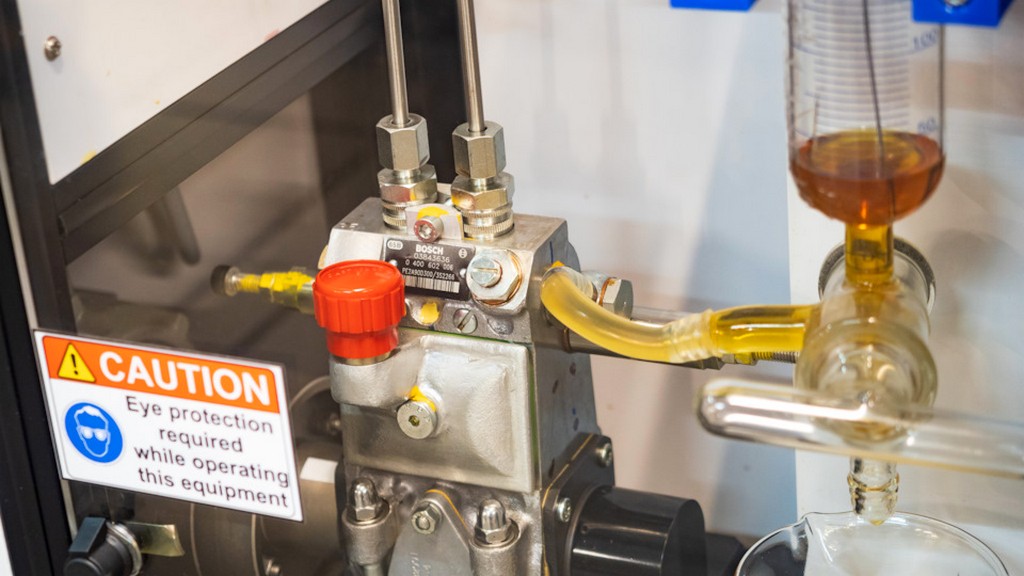
This test is performed using a 7,3 L, direct injection, turbocharged diesel engine specified on a dynamometer test stand. This test method was developed to replace the method described in ASTM D892-01, Standard Test Method for Foaming Characteristics of Lubricating Oils, after it was determined that this bench test was not associated with oil aeration in actual service. Engine oil aeration testing was first included in API Service Category CG-1995 in 4. Supplemental test methods used to evaluate engine oil performance for the requirements of this standard are covered in the latest update of ASTM D4485-09, Standard Specification for Performance of Engine Oils.
For the purposes of this standard, the following terms and definitions apply:
- Automotive refers to the descriptor of equipment generally associated with self-propelled machinery, such as vehicles powered by internal combustion engines.
- To calibrate is to determine the indication or output of a device (e.g. thermometer, manometer, motor) with respect to a standard.
- Candidate oil refers to an oil that is intended to have the performance characteristics required to meet a specification and must be tested against that specification.
- Engine oil refers to a fluid that reduces friction or wear, or both, between moving parts within an engine. This oil specifically removes heat from the underside of the pistons and acts as a combustion gas seal for the piston rings. It may contain additives to improve certain properties. Examples include preventing engine rust, deposits, valve train wear, oil oxidation, and foaming.
- Foam refers to a collection of bubbles that form on or within the surface of a liquid in which air or gas is the main component by volume.
- Heavy-duty, internal combustion engine operation is characterized by average speeds, power outputs, and internal temperatures close to potential maximums.
- Heavy-duty engine, in the internal combustion engine types, refers to an engine that is designed to allow it to operate continuously at or near its peak output.
- Lubricant refers to any material that is placed between two surfaces and reduces friction or wear, or both, between them.
- A non-reference oil is any oil other than the reference oil, such as a research formulation, commercial oil, or candidate oil.
- Reference oil refers to an oil with known performance characteristics that is used as a basis for comparison.
- A test oil is any oil that is subjected to evaluation in a specified procedure.
- Used oil is any oil found in a piece of equipment (for example, an engine, gearbox, transformer, or turbine), whether or not it has been used.
- Aeration refers to the action of impregnating liquids with air, which forms bubbles in or on the surface of a liquid or is present as a dispersion in that liquid.
- Flushing refers to the act of cleaning the engine oil system using new test oil to remove any residue and minimize any possible carryover effect from the previous test oil.
The test engine used is equipped with a hydraulically operated and electronically controlled injector unit fuel system. It is housed in a fully equipped test cell. The test sequence consists of a five-step warm-up period followed by a 20-hour single-step evaluation period at maximum power. Aerated oil samples are taken after 1 hour, 5 hours and 20 hours and the percentage of aerated oil is calculated from the initial volume and the final volume after standing undisturbed for 30 minutes.
Among the numerous tests, measurements, analyses and evaluation studies that our organization has carried out for businesses in various sectors, our organization also provides testing services defined in the standard “ASTM D6894-10 Standard test method for evaluating the air intake resistance of engine oils in direct injection turbo-charged automotive diesel engines” with its trained and expert staff and advanced technological equipment.

