EN 17128 Personal Light Electric Vehicles (PLEV) - Requirements and Test Methods
The European standard “ EN 17128 Light motor vehicles and related installations for the carriage of people and goods and those not subject to type approval for road use - Personal light electric vehicles (PLEVs) - Requirements and test methods” applies to personal light electric vehicles that are wholly or partially electrically powered by self-contained power sources, with or without a self-balancing system. Vehicles designed for rental from unattended stations are excluded.
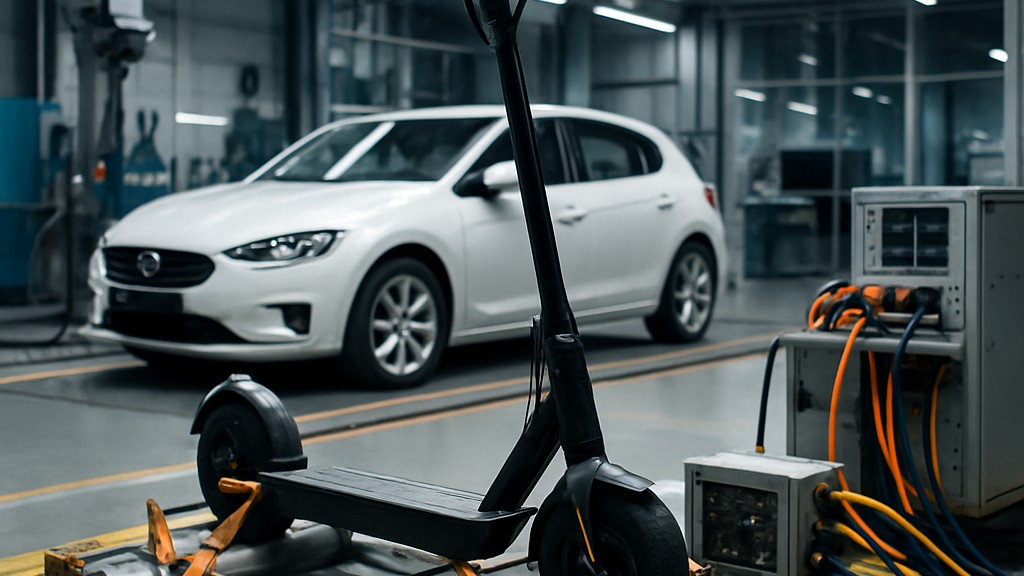
This standard applies to personal light electric vehicles, fully or partially electric powered by self-contained power sources, with battery voltages up to 100 Volts direct current, with or without an integrated battery charger, with input for up to 240 Volts alternating current.
This standard describes the safety requirements, test methods, markings and information relevant to personal light electric vehicles to reduce the risk of injury to both third parties and the user during intended use, i.e. when used as intended and under conditions of misuse reasonably foreseeable by the manufacturer.
However, this standard does not apply to:
- Vehicles considered toys
- Vehicles without seated self-balancing systems
- Vehicles for competition purposes
- Electric-assisted bicycles
- Instruments or devices designed for medical care use
- Electric vehicles with a maximum design speed of over 25 km/h
- Vehicles with a nominal voltage higher than 100 Volts direct current or 240 Volts alternating current
- Vehicles without a driving operator on board.
The EN ISO 13482 standard specifies requirements for vehicles without an on-board operator. Local regulations may limit vehicle operation to a speed below 25 km/h.
For the purposes of this standard, personal light electric vehicle means a partially or fully motorized wheeled vehicle used for the transport of a person in a public or private area.
PLEV (light personal electric vehicle) refers to small, battery-powered electric vehicles, typically with two to four wheels and weighing less than 100 kg. Examples include electric scooters, skateboards, unicycles, and electric pedal bikes. These are typically designed for short-distance travel. PLEVs are commonly used in discussions of transportation and urban mobility. For example, some PLEVs are motorized vehicles with a maximum speed of 6-20 km/h and require registration or an operating license.
The EN 17128 standard outlines specific test methods for assessing safety, performance, and durability. These include:
- Structural integrity tests: These tests are performed to ensure that the vehicle's chassis, handlebars and components can withstand mechanical stresses:
- Static load tests: A specific force (e.g., equivalent to or greater than the user weight) is applied to components such as the frame, handlebars, or folding mechanisms to check for deformation or failure.
- Dynamic load tests: Simulate repeated stress (e.g. vibrations or impacts) to evaluate fatigue resistance.
- Drop tests: PLEV is dropped from a specific height to simulate accidental falls and its structural strength is tested.
- Brake system tests: These tests are performed to verify that the brake system can stop the vehicle safely within a specified distance and under various conditions:
- Braking distance test: The distance required to stop from maximum speed on a flat, dry surface is measured.
- Emergency brake test: Performance is evaluated in sudden braking scenarios to ensure balance and control.
- Wet surface braking: Braking efficiency is tested on wet surfaces to simulate real-world conditions.
- Dynamic behavior tests: These tests are performed to evaluate balance, handling, and control during operation, including self-balancing systems (if applicable):
- Stability tests: Evaluates the vehicle's ability to remain upright and stable at various speeds, slopes, and turns, especially for self-balancing vehicles such as electric unicycles.
- Maneuverability tests: The vehicle's response to steering inputs and obstacle avoidance is determined.
- Incline tests: Performance on inclines is measured (for example, maximum climb angle) to ensure motor and balance capabilities. For example, an electric unicycle is tested to ensure it maintains its stability while navigating a 10-degree incline.
- Electrical safety tests: These tests are performed to verify the safety of electrical components, including batteries, motors, and chargers:
- Battery safety tests: Battery stability is evaluated under conditions such as overcharging, short circuiting, or thermal stress to prevent fires or explosions. Tests may include thermal runaway scenarios.
- Insulation tests: By checking electrical insulation, shocks are prevented and voltage limits are adhered to.
- Electromagnetic compatibility (EMC): Electromagnetic interference testing is carried out in accordance with directive 2014/30/EU to ensure that the vehicle does not disturb other devices.
- Environmental durability tests: These tests are performed to ensure that the vehicle can withstand environmental stresses such as vibration, humidity and temperature changes:
- Vibration tests: The vehicle is subjected to broad-band random vibrations to simulate road conditions.
- Water resistance tests: Ingress protection (e.g. IP rating) is tested to ensure the vehicle can operate in light rain or splashes.
- Temperature tests: The vehicle is exposed to high and low temperatures to verify component reliability.
- Noise emission tests: In these tests, sound levels are measured to ensure the vehicle does not exceed acceptable noise limits:
- Sound power level testing: Noise is measured using sound pressure levels in a controlled environment. For example, the motor noise of an electric skateboard is tested to ensure it meets urban noise regulations.
- Performance tests: These tests are performed to verify that the vehicle meets performance criteria such as speed, range and battery efficiency:
- Maximum speed test: Verifies that the vehicle does not exceed the regulatory speed limit.
- Range test: the distance the vehicle can travel on a single charge under standard conditions is measured.
- Motor power test: The motor's ability to provide consistent power under load is evaluated.
Our organization, which has been supporting businesses across all sectors for years through a wide range of testing, measurement, analysis, and evaluation activities, boasts a strong team of employees who closely follow global developments in science and technology and are constantly improving themselves. In this context, we also provide testing services in accordance with the standard "EN 17128 Light motor vehicles and related facilities for the transport of persons and goods, and those not subject to type approval for road use - Personal light electric vehicles (PLEV) - Requirements and test methods."



