

The “GMW 3016 Testing of Volatile Organic Compounds in Sealants and Adhesives” standard, developed by General Motors Worldwide (GMW), is an engineering standard used to determine the amount of volatile organic compounds released from sealants and adhesives during the curing process. This standard is particularly important for materials used in automotive manufacturing that may be exposed to high temperatures during paint shop or other thermal processing operations.
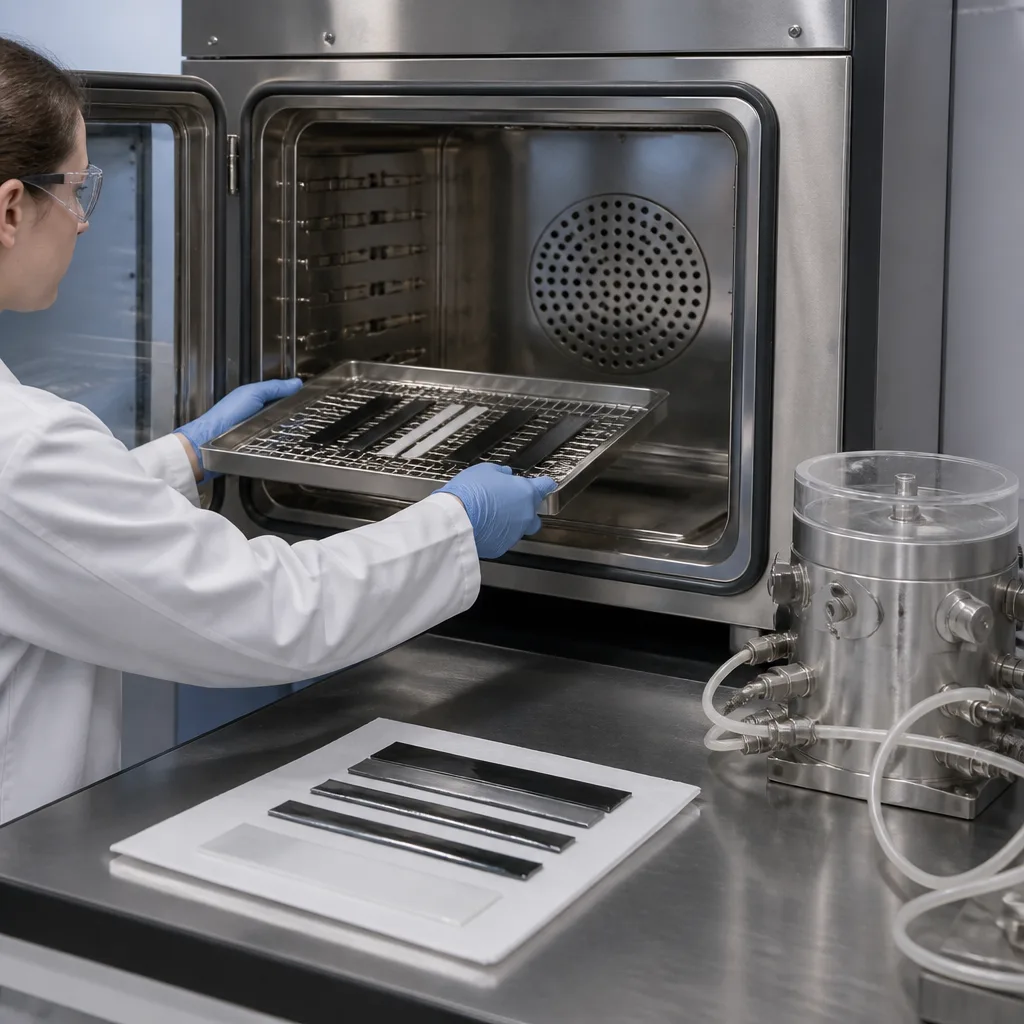
The volatile organic compounds released from these materials can migrate into the manufacturing environment and, more importantly for the vehicle manufacturing process, interfere with subsequent coating processes. Excessive volatile compound release can contribute to surface defects such as cratering, poor wetting, and other paint quality issues.
The primary purpose of the GMW 3016 standard is to evaluate the volatile matter content or volatile matter emissions of sealants and adhesives under baking conditions representative of automotive manufacturing. This test helps determine whether the material is suitable for processes where the adhesive or sealant is heated, especially when the material is located under or near a painted surface. Therefore, the standard supports the following:
Sealants and adhesives may contain components that evaporate or decompose when exposed to high temperatures. In a vehicle manufacturing process, these materials may undergo a baking cycle after application. If volatile substances (volatile organic compounds) are released during this process, they can reach nearby painted surfaces. Depending on the chemistry and amount of material released, this can interfere with paint film formation. Possible effects include:
Consequently, measuring volatile substance emissions is a crucial part of characterizing sealants and adhesives used in automotive manufacturing.
The GMW 3016 standard is generally defined as a volatile compound condensation test in an oven. The material is subjected to the relevant baking conditions, and the volatile compounds released during heating are collected and evaluated. The basic process sequence can be described as follows: sealant/adhesive sample, controlled heating/baking, release of volatile compounds, condensation/collection, determination of volatile compound quantity, evaluation according to requirements.
Sample preparation, equipment configuration, temperatures, heating times, weighing procedures, and acceptance criteria are all included in the GMW 3016 standard. These details may vary depending on revisions and specific material specifications.
The GMW 3016 standard is particularly important for automotive body sealants, adhesives, and related materials that are exposed to high temperatures during vehicle manufacturing. For example, a sealant may be applied to a body part before it enters the oven. Volatile components may be released during baking. The GMW 3016 standard provides a standardized method for evaluating this behavior. This method can therefore be used in the following situations:
One of the most important aspects of the GMW 3016 standard is its connection to automotive paint shop quality. A sealant may meet mechanical and adhesion requirements, but may not be suitable for a particular production process if it releases excessive volatile matter during curing. Therefore, volatile matter testing should not be considered solely as an environmental or chemical characterization test. It can also be a production compatibility test. A material with controlled volatile matter release reduces the risk of the paint process being affected by emissions from the adhesive or sealant.
The GMW 3016 standard is a test method rather than a universal material specification that provides a single acceptance limit for every adhesive and sealant. The applicable material specification or engineering requirement determines whether the measured result is acceptable. For example, the GMW 16920 standard defines the GMW 3016 standard as an oven-baked volatile matter test and specifies a maximum volatile organic compound (VOC) level of 2 percent by mass for the material specified in this specification. It also specifies that the test is performed under maximum baking conditions followed by a defined conditioning period.
Therefore, it is important not to assume that the 2 percent value is automatically the acceptance criterion for every material tested according to the GMW 3016 standard. The applicable product or material specification should be checked.
A GMW 3016 standard test report typically provides information that allows for an assessment of the material's volatile behavior according to the relevant requirement. A result below the specified limit indicates that the material exhibits controlled volatile matter release under the foreseen test conditions. A result above the requirement may indicate that the formulation requires further investigation. Possible measures include:
If a material exceeds the specified VOC limit, additional chemical characterization may be required. For example, according to the GMW 16920 standard, when the reported volatile organic compound exceeds the 2 percent mass requirement, the VOC composition must be declared.
The GMW 3016 standard provides a common methodology for evaluating a key property of adhesives and sealants before they enter the automotive manufacturing process. This standard is considered important for the following reasons:
In conclusion, the GMW 3016 standard is a crucial test method used to evaluate volatile substances emitted from automotive sealants and adhesives during thermal processing. Its primary purpose is to identify excessive organic volatile substance release that can contribute to paint cratering, poor wetting, and other coating defects. Therefore, for automotive suppliers, the GMW 3016 standard is a vital part of material qualification and manufacturing process compliance. Since acceptance limits may not be the same for every application, the test result should always be interpreted in conjunction with the relevant material or component specification.
For many years, our organization, with its competent and experienced staff, has been understanding the needs of its clients, providing the advanced testing services they require, and assisting them in the establishment, implementation, and improvement of management systems. Within this framework, we also provide testing services in accordance with the GMW 3016 standard.
To get an appointment, to get more detailed information or to request an evaluation, you can ask us to fill in our form and reach you.

