

The "ISO 7591 Road vehicles - Retro-reflective registration plates for motor vehicles and trailers - Technical specifications" standard, published by the International Organization for Standardization (ISO), describes the provisions applicable to registration plates. Compliance with national regulations in terms of dimensions, shape, letters, and numbers is checked by the competent authorities on a fully finished plate. This standard includes photometric and colorimetric properties for both day and night. It defines sampling and various testing methods.
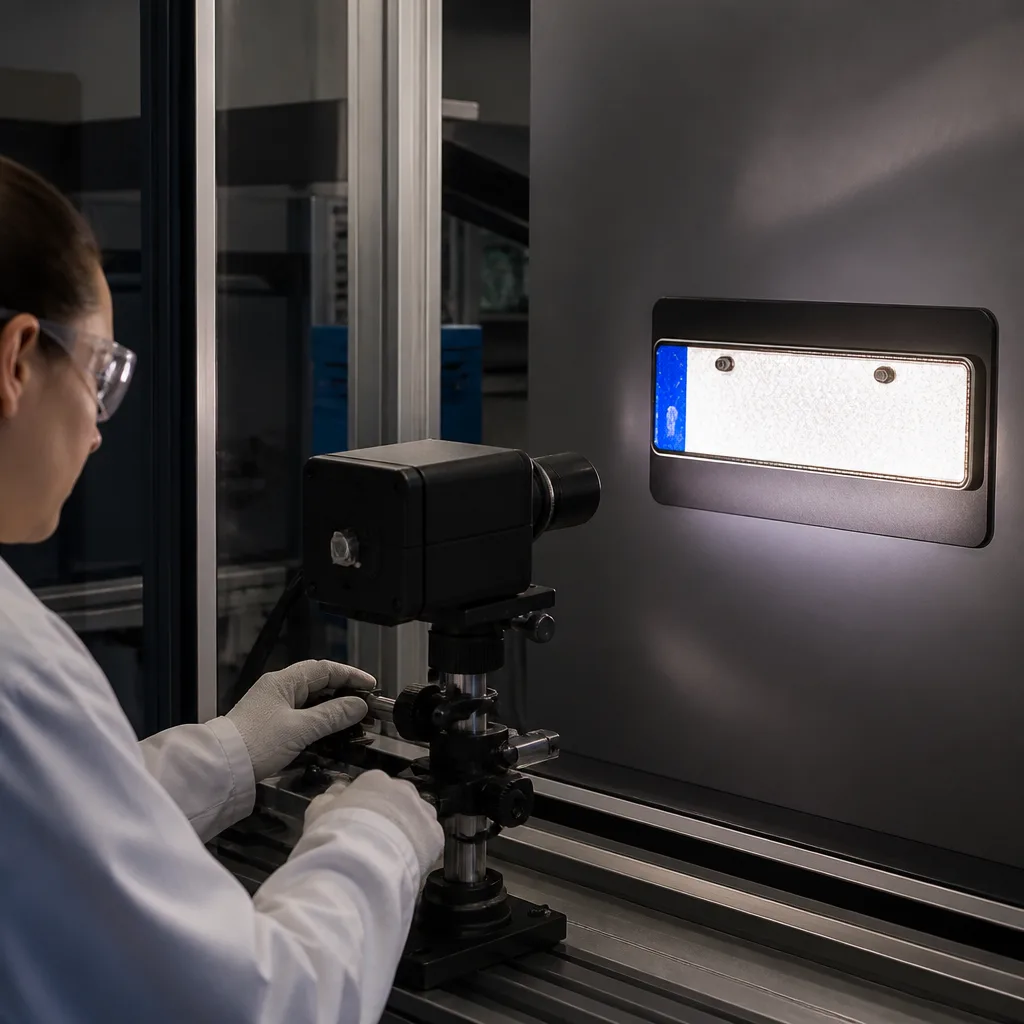
Retro-reflective license plates are vehicle license plates that use a special reflective material designed to reflect light back to its source. This makes the plate highly visible when illuminated by headlights at night.
Unlike ordinary painted license plates, retro-reflective license plates contain a reflective layer made of tiny glass beads or microprisms. These optical elements redirect incoming light back toward the emitting vehicle or camera, significantly improving visibility.
When a car's headlights hit a retro-reflective license plate:
A typical reflective plate consists of the following:
There are two main technologies:
The ISO 7591 standard enhances vehicle identification and road safety by ensuring license plates remain clearly visible in both daytime and nighttime conditions. The primary purpose of this standard is to define the technical specifications that retro-reflective license plates must meet. Rather than defining national plate sizes, numbering systems, or fonts, this standard focuses on the optical and physical performance of the finished license plate.
This standard helps license plates ensure the following:
The ISO 7591 standard applies to retro-reflective license plates used on the following vehicles:
This standard applies specifically to the finished license plate and its reflective surface. National authorities are responsible for the following requirements:
Compliance with these regulatory requirements is verified separately by the relevant government agency.
The basic requirements are determined as follows:
These features allow police officers, toll booths, traffic cameras, and other drivers to identify vehicles during nighttime operations.
Proper color control improves readability and prevents confusion in varying lighting conditions.
These features help maintain readability throughout the plate's service life.
Tests are performed on completed registration plates instead of individual raw materials.
ISO 7591 standard tests generally evaluate the following:
Manufacturers can also conduct additional environmental durability tests to meet regional regulations.
The ISO 7591 standard is used in the automotive and transportation sectors by:
It also supports suppliers of reflective materials used in vehicle identification systems.
Implementing the ISO 7591 standard offers several advantages:
The ISO 7591 standard complements, rather than replaces, national vehicle registration laws. Countries generally set their own requirements regarding the following:
This standard allows each country to maintain its own registration system while providing a common technical basis for reflective performance.
The ISO 7591 standard is particularly important for the following sectors:
In conclusion, the ISO 7591 standard is a significant international standard for the performance of retro-reflective vehicle registration plates. By defining reflectivity, color, durability, and testing requirements, it helps ensure that plates remain visible and legible in both daytime and nighttime conditions. While it does not regulate the appearance or numbering of the plates, it establishes internationally accepted quality criteria that support road safety, traffic control, and reliable vehicle identification worldwide.
For many years, our organization, with its competent and experienced staff, has been understanding the needs of its clients, providing the advanced testing services they require, and assisting them in the establishment, implementation, and improvement of management systems. Within this framework, we also provide testing services compliant with the ISO 7591 standard.
To get an appointment, to get more detailed information or to request an evaluation, you can ask us to fill in our form and reach you.

