

ISO 7637-2 Road Vehicles - Part 2: Transient Electrical Transmission Along Supply Lines Only
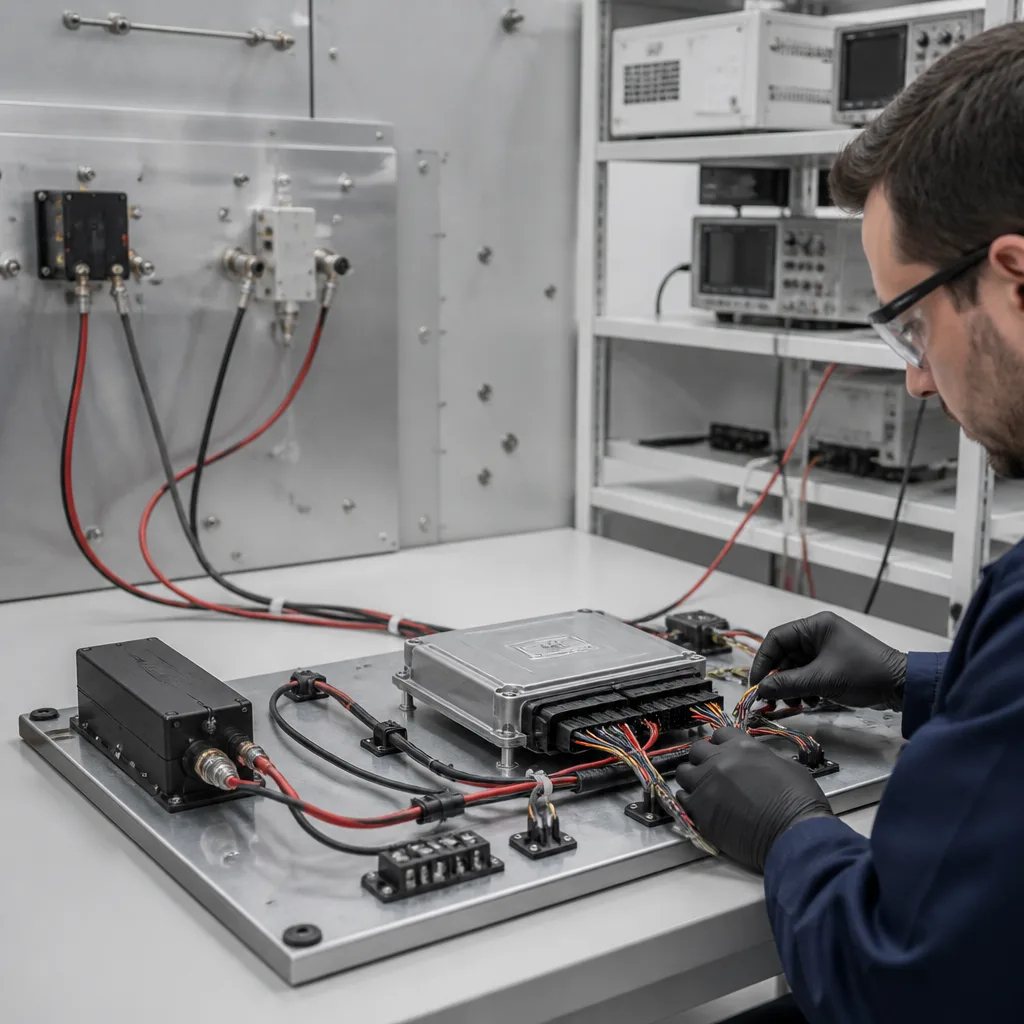
The ISO 7637-2 Road vehicles - Electrical disturbances due to transmission and coupling - Part 2: Transient electrical transmission along supply lines only standard, published by the International Organization for Standardization (ISO), describes test methods and procedures to ensure the compatibility of equipment fitted to passenger and commercial vehicles equipped with 12-volt or 24-volt electrical systems with transmitted electrical transients. This standard also describes bench tests for both the injection and measurement of transient events. This standard is applicable to all types of road vehicles, regardless of the drive system (e.g., spark-ignition or diesel engine, electric motor). A functional performance status classification for immunity to transient events is also provided.
ISO 7637-2 is a key automotive electromagnetic compatibility (EMC) standard used to evaluate the immunity of electrical and electronic components to conductive electrical currents in vehicle power lines.
This standard is particularly important because automotive electrical systems are subject to short-term voltage disturbances generated by switching loads, motors, relays, inductive components, and other electrical events. This standard establishes standardized laboratory methods for reproducing these disturbances and determining whether an electronic device continues to function correctly.
The primary purpose of the ISO 7637-2 standard is to verify the ability of automotive electrical and electronic equipment to withstand conductive transient failures occurring at power supply connections. These failures can occur during normal vehicle operation. Examples include:
This standard provides bench test methods for injecting and measuring transient shocks, and also offers performance status classifications for the equipment being tested.
The ISO 7637-2 standard applies to electrical and electronic equipment installed in road vehicles with nominal 12-volt or 24-volt electrical systems. Importantly, this standard is applicable regardless of the vehicle drive type, including:
Therefore, although this standard originated in the context of traditional vehicle electrical systems, its principles are also applicable to modern automotive electronic equipment. This standard focuses specifically on transient currents transmitted along supply lines. Therefore, it should be distinguished from other parts of the ISO 7637 series. For example, while ISO 7637-3 addresses transient current transmission via capacitive and inductive coupling over lines other than supply lines, ISO/TS 7637-4 deals with protected high-voltage supply lines.
An electrical transient is a brief change in voltage or current. Unlike a normal change in vehicle supply voltage, the rise of a transient current can be very rapid and may only last for a very short time.
Some automotive transients are positive, while others are negative. Their amplitudes, durations, rise times, and repetition rates depend on the electrical event that produces them. Even if the disturbance lasts only microseconds or milliseconds, it can cause:
Therefore, temporary immunity is a crucial part of automotive EMC validation.
One of the most recognizable features of the ISO 7637-2 standard is the use of standardized transient pulses. The pulse types typically referenced are:
A typical ISO 7637-2 laboratory test includes the following:
During testing, the functional behavior of the equipment is monitored both during and after the application of the transient condition. Typical observations include:
This standard provides function-performance status classifications to assess immunity to transient states. The exact acceptance criteria also depend on the product requirement and the accepted performance class.
Modern vehicles contain numerous electronic systems. A vehicle may include the following electronic control units:
These systems share the vehicle's electrical environment. Therefore, a transient condition originating in one part of the vehicle can affect another electronic module. The ISO 7637-2 standard provides a repeatable laboratory method to determine whether a product can withstand these disturbances before being installed in a vehicle. This helps manufacturers by:
Automotive manufacturers frequently refer to the ISO 7637-2 standard in their component specifications. An original equipment manufacturer specification might define the following:
Therefore, simply passing the ISO 7637-2 standard does not mean that an electronic control unit is approved by a particular vehicle manufacturer. The relevant original equipment manufacturer specification should always be checked against the ISO standard.
In short, the ISO 7637-2 standard applies to road vehicles regardless of drive technology and establishes laboratory procedures for producing and measuring transient disturbances. Impact-based tests address disturbances associated with inductive switching, motors, rapid switching events, starting, and unloading conditions. Equipment is monitored to determine whether it maintains the required functionality when subjected to such disturbances.
In this respect, for automotive electronic control unit and component manufacturers, the ISO 7637-2 standard is a crucial part of design verification, EMC verification, reliability testing, and original equipment manufacturer (OEM) qualification testing.
For many years, our organization, with its competent and experienced staff, has been understanding the needs of its clients, providing the advanced testing services they require, and assisting them in the establishment, implementation, and improvement of management systems. Within this framework, we also provide testing services compliant with the ISO 7637-2 standard.
To get an appointment, to get more detailed information or to request an evaluation, you can ask us to fill in our form and reach you.

