

The “Ford FLTM BI 109 Automotive Color and Appearance Consistency of Interior and Exterior Materials” standard series, developed by Ford Motor Company (Ford), is a group of test methods (FLTM) that define how to evaluate the color and appearance consistency of automotive interior and exterior materials. It is part of Ford’s broader quality system to ensure that materials such as plastics, textiles, paints, and upholstery components meet stringent aesthetic and appearance requirements.
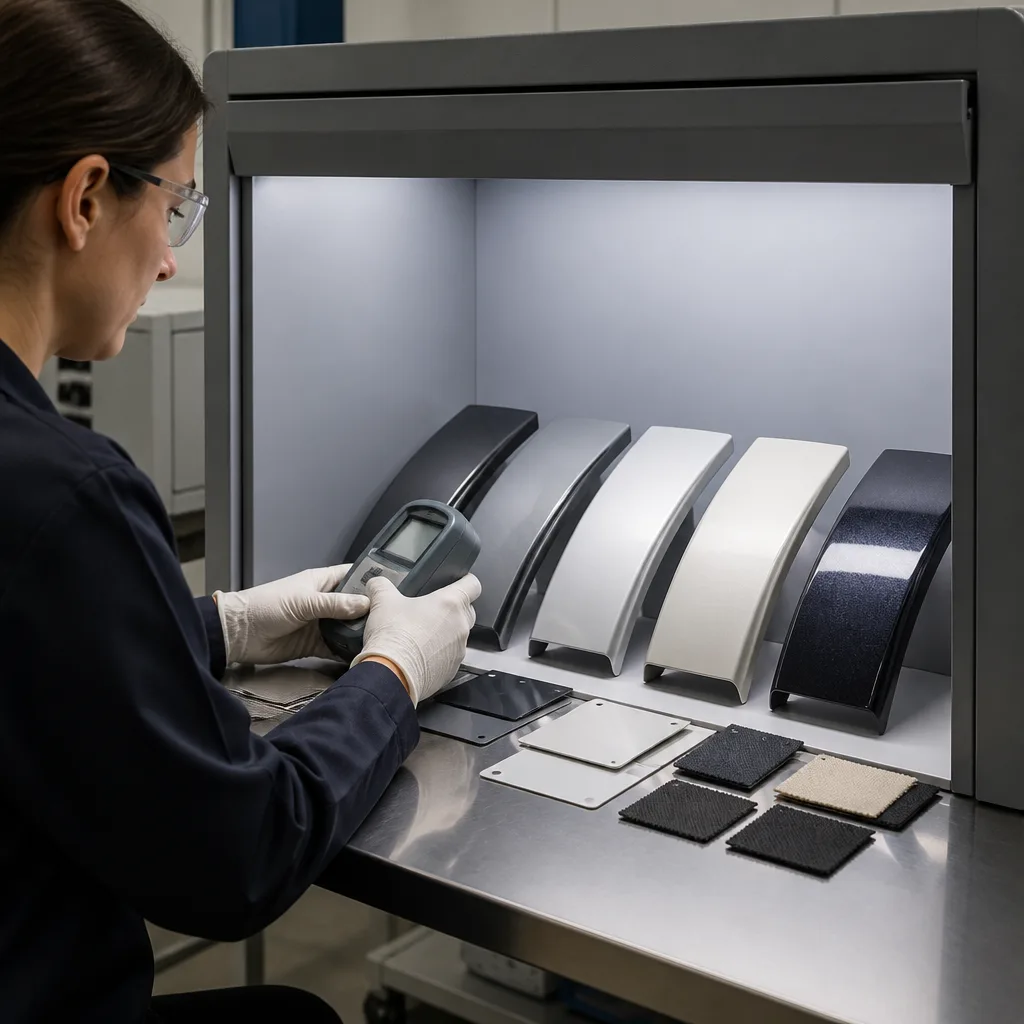
The Ford FLTM BI 109 standard family focuses not only on instrumental color measurement but also on human visual perception under controlled lighting conditions, which remains the ultimate authority in acceptance decisions.
The primary goal of the Ford FLTM BI 109 standards is to ensure the following:
A fundamental principle in all the methods described is that visual assessment invalidates numerical measurement when inconsistencies occur.
The Ford FLTM BI 109 standard consists of the following sub-sections:
This method is commonly used for both solid colors and effect (metallic/pearlescent) coatings.
The fundamental principle of this standard is that visual assessment always takes precedence over instrumental (measurement) results. Even if colorimeters show acceptable values, final acceptance is based on human visual assessment under standardized conditions.
This standard categorizes visual differences into specific components:
These parameters help engineers explain why two parts look different, not just whether they are different or not.
The evaluator compares the test sample to the main reference standard. Under controlled lighting, they assign a score based on detectability:
If there is a discrepancy between visual and instrument results, visual assessment is decisive.
The primary goal of the Ford FLTM BI 109-02 standard is to provide an objective, repeatable, and quantifiable method for evaluating color variation in automotive materials. This standard is used to measure color differences in the following materials:
This standard ensures that color evaluation is not based solely on human perception, but is also supported by quantitative data obtained from colorimeters.
The main objectives are as follows:
The described method is designed to closely mirror human perception, yet remains entirely instrument-controlled and repeatable. This standard defines the following controlled conditions:
These parameters ensure consistency in results across different laboratories and suppliers.
The Ford FLTM BI 109 standard is critical to automotive development and manufacturing for the following reasons:
The Ford FLTM BI 109 standard is often used in conjunction with other appearance-related standards, such as:
These standards collectively ensure visual consistency for automotive materials.
In conclusion, the Ford FLTM BI 109 standard is a fundamental automotive quality method used to check and evaluate color appearance consistency. It uniquely combines the following:
It also ensures that visual perception remains the ultimate acceptance criterion in Ford's appearance quality system.
For many years, our organization, with its competent and experienced team, has been understanding the needs of its customers, providing the advanced testing services they require, and assisting them in the establishment, implementation, and improvement of management systems. Within this framework, we also provide testing services compliant with the Ford FL™ BI 109 standard.
To get an appointment, to get more detailed information or to request an evaluation, you can ask us to fill in our form and reach you.

