Renault D51 3022 Interior Trim Materials - Right-Angle Peeling
The method described in the “Renault D51 3022 Interior trim materials - Right-angle peeling” standard, developed by the French automotive company Renault, aims to evaluate cohesion through peeling and characterize the bond between the rigid fastener and the flexible layer. This method is not applicable to products where the peeling force is greater than the tearing force of the complex material. This test measures the force required to cause separation by peeling at a 90-degree angle.
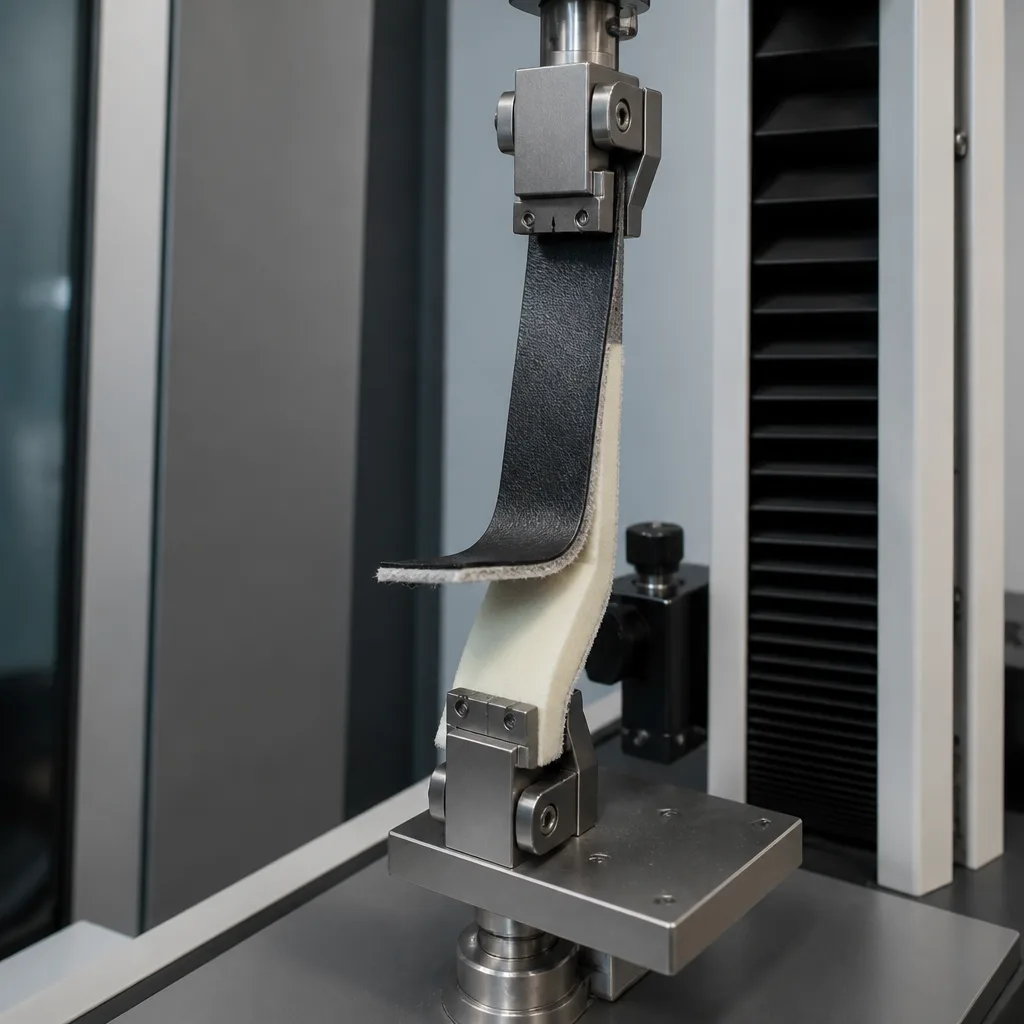
Before testing begins, all parts are conditioned for 48 hours at a temperature of 23 degrees plus/minus 2 degrees and a relative humidity of 50 percent plus/minus 5 percent.
When preparing samples, for parts covered with textile:
- The flat areas on the parts are marked. Then, using a cutting tool, 3 longitudinal and 3 transverse samples of the textile coating are taken from the designated areas of the part, with dimensions of 200 mm plus/minus 5 mm x 70 mm plus/minus 2 mm.
- Using a ruler, a strip 50 mm wide plus/minus 1 mm is drawn along the longitudinal direction of the sample on the flexible sheet, at an equidistant point from the sample.
- Without cutting the rigid fixture, the flexible sheet is cut along the line drawn using a ruler and cutting tool.
- The two side strips of the flexible layer are removed. If any pieces of the flexible layer (foam) remain, they are gently scraped off with a finger.
- A first parallel line is drawn 50 mm plus/minus 1 mm from the tip of the sample, and a second parallel line is drawn 130 mm plus/minus 1 mm from the first line.
- The flexible strip of film from the tip of the sample to the first line is removed with the fingers. To facilitate holding the strip in place on the chin, an adhesive strip can be added to the textile substrate.
- After separating the strip, no part of the flexible layer should remain on the rigid fixture. Otherwise, a new sample is used.
When preparing samples, on parts covered with foam (outer foam part) or adhesive felt,
- Using a cutting tool, a plan test support measuring 200 mm plus/minus 5 mm x 70 mm plus/minus 2 mm is prepared for each sample on the parts provided for this purpose.
- Fixtures are cleaned by wiping with lint-free paper soaked in pure heptane, then dried with another lint-free paper. They are left to air dry for 5 minutes before the entire process.
- The test fixture refers to all receiving elements that have passed through the planned production range for the series part before the application of foam or adhesive felt.
- Example of adhesive fixing in nonwoven textiles: Three longitudinal and three transverse samples are cut from a nonwoven textile with dimensions of 200 mm plus/minus 5 mm x 50 mm plus/minus 2 mm and a constant thickness in the complex layer, using a cutting tool.
- Example of adhesive fixing in plastic film: Five samples, made from non-woven textile, measuring 200 mm plus/minus 5 mm x 50 mm plus/minus 2 mm and with a constant thickness in a complex layer, are cut using a cutting tool.
In short, the Renault D51 3022 standard is an original equipment manufacturer (OEM) test standard used in the automotive industry, specifically to evaluate the adhesion performance of vehicle interior trim materials. This standard aims to check the durability and reliability of multi-layer materials used on vehicle interior surfaces.
The main purpose of this standard is as follows:
- Measuring the adhesion strength of coatings, fabrics, leather, or foam layers used in interior trim materials to the substrate.
- To assess the risk of material combinations separating during long-term use.
- To improve production quality and customer satisfaction.
This standard is particularly critical for the following parts used in vehicles:
- Door panels
- Instrument panel trims
- Seat covers
- Ceiling tiles
The Renault D51 3022 standard is based on the 90-degree peel test. In principle, a sample is prepared (e.g., fabric + foam + plastic backing). The top layer is pulled at a specific angle (90 degrees), and the force required during pulling is measured.
This test measures and analyzes the following:
- Adhesion force
- Fracture behavior of the material
The sample being tested is usually multi-layered:
- Surface finish: textile, leather or coating.
- Intermediate layer: polyurethane foam
- Substrate: rigid plastic or load-bearing surface
This structure simulates real in-vehicle materials.
The parameters measured are as follows:
- Peeling force: The average force is measured. A force-elongation curve is plotted graphically.
- Types of rupture: This standard classifies the types of ruptures:
- Adhesion failure; Separation from the adhesion surface.
- Integrated failure: The material breaks down from within.
- Mixed failure: A combination of both types.
This classification is critical for identifying the material's weak points.
The Renault D51 3022 standard is widely used in the following areas:
- Automotive interior trim development
- Supplier quality control processes
- Material selection and validation
- Testing new adhesive systems.
The Renault D51 3022 standard is essential because it ensures that the interior trim materials in vehicles function reliably throughout the vehicle's lifespan. Without such a standard, manufacturers face quality inconsistencies, safety risks, and customer dissatisfaction. The main reasons why this standard is considered important are as follows:
- Prevents layer separation (material detachment): The internal components are made of layered materials (fabric, foam, plastic). Over time, these layers can separate due to factors such as heat (exposure to sunlight), moisture, and mechanical stress (touch, pressure, vibration). This standard verifies that the adhesion strength is sufficient to prevent peeling or separation during actual use.
- Ensures long-term durability: Vehicles are expected to withstand a variety of conditions for many years. This standard helps to ensure the following:
- The materials retain their adhesive strength over time.
- Premature deterioration of internal parts
- Performance remains stable under environmental stress.
- Improves safety: Poor adhesion can lead to:
- Loose inner parts
- Obstructed controls or vision
- Unexpected separation while driving.
By meeting minimum adhesion requirements, this standard contributes to overall vehicle safety.
- Maintaining aesthetic quality: Customers expect interiors to look first-class and flawless. Without proper adhesion, bubbles or wrinkles can form on surfaces, edges can peel, and visible imperfections reduce the perceived quality. This standard ensures that interiors remain visually appealing and flawless.
For many years, our organization, with its competent and experienced staff, has been understanding the needs of its customers, providing the advanced testing services they require, and assisting them in the establishment, implementation, and improvement of management systems. Within this framework, we also provide testing services in accordance with the Renault D51 3022 standard.



