

The standard "PSA D27 1571 Paint coatings - Swelling from humidity" developed by the Peugeot automobile company describes a test method used to measure the resistance of the final coat of paint to swell in a humid environment. This test method determines the density of bubbles formed after a certain period of exposure to flowing humidity (condensation water flow).
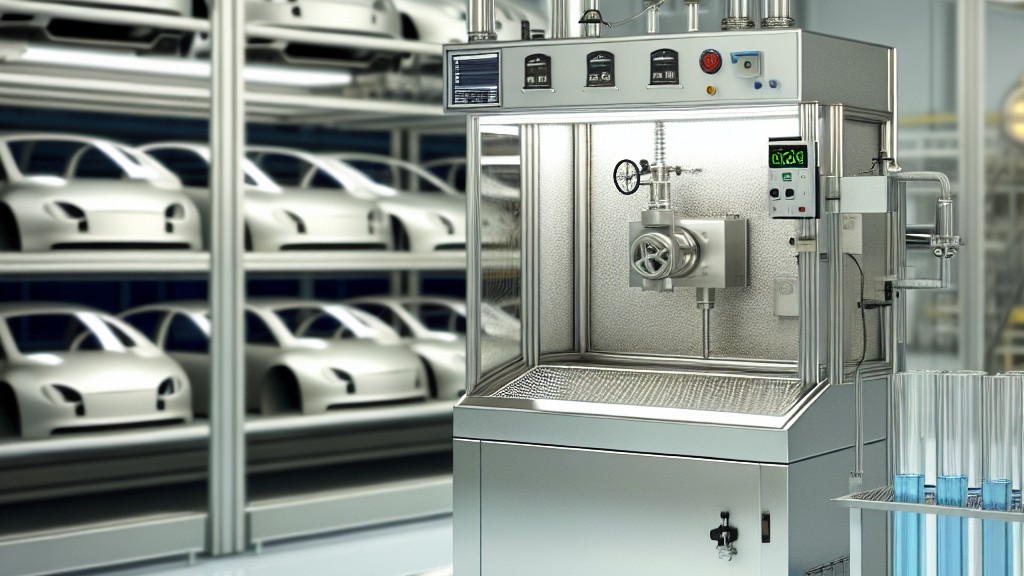
The equipment used in these tests includes:
The test panel or samples should be representative of the scale to be characterized. To ensure this representation, it is necessary to find out the basic characteristics of the population under study. The selection criteria for the test panel or samples should be stated in the test report in accordance with the PSA A10 0156 standard. In case of doubt about the sampling, the PSA should be contacted to find out the instructions to be followed.
When preparing test plates or pieces, plates or flat pieces of at least 85 mm x 165 mm (thickness 0,8 mm plus/minus 0,1 mm if there are metal supports) must be covered with the products to be tested. The test plates are ventilated at a temperature of 23 degrees plus/minus 2 degrees and a relative humidity of 50 percent plus/minus 5 percent for the following period:
The tests are carried out in an environment of 23 degrees plus/minus 2 degrees. After assembly, the tank is filled with deionized water to a height of 100 mm. The device is opened to adjust the operating speed (60 degrees plus/minus 1 degree) and checked with a thermometer. The painted test panels are placed in the windows provided in the cover, then the lower parts are fixed to the cover with waterproof tape. The empty windows should be masked. In order to minimize the inconvenience caused by opening the device, the test panel should not be removed too often. 60 mm is filled with 100 degrees of water every day to compensate for losses due to evaporation. The test panels are examined after the exposure time specified in this standard. To perform the examination, the test panels are quickly wiped with a soft cloth without rubbing. After being kept for 23 hour in an environment of 2 degrees plus/minus 50 degrees and 7 percent plus5-minus 1 percent relative humidity, the bubble and color deviation are evaluated according to the indicators.
Scoring for blistering is carried out on the following scale using examples given in the standard “ASTM D714-02 Standard test method for evaluating the degree of blistering of paints”:
Observation of chromatic aberration is carried out in the light box according to the method of the PSA D15 5504 standard.
The expression of the result must take into account the rating and index of the photograph embodying the distortion.
A local distortion is not taken into account if the surface concerned is less than 5 percent of the total surface or if an incidental character (fingerprints) can be definitely detected. Chromatic deviation is not taken into account for any paint that does not have a visual function.
The form and minimum contents of the test report are defined in the PSA A10 0156 standard. In addition to the results obtained, the test report must state:
Our organization, which has been trying to support businesses from every sector with its wide range of testing, measurement, analysis and evaluation studies for years, has a strong staff that closely follows the developments in the world in the field of science and technology and constantly improves itself. In this context, testing services in accordance with the "PSA D27 1571 Paint coatings - Moisture swelling" standard are also provided to businesses.
To get an appointment, to get more detailed information or to request an evaluation, you can ask us to fill in our form and reach you.

