

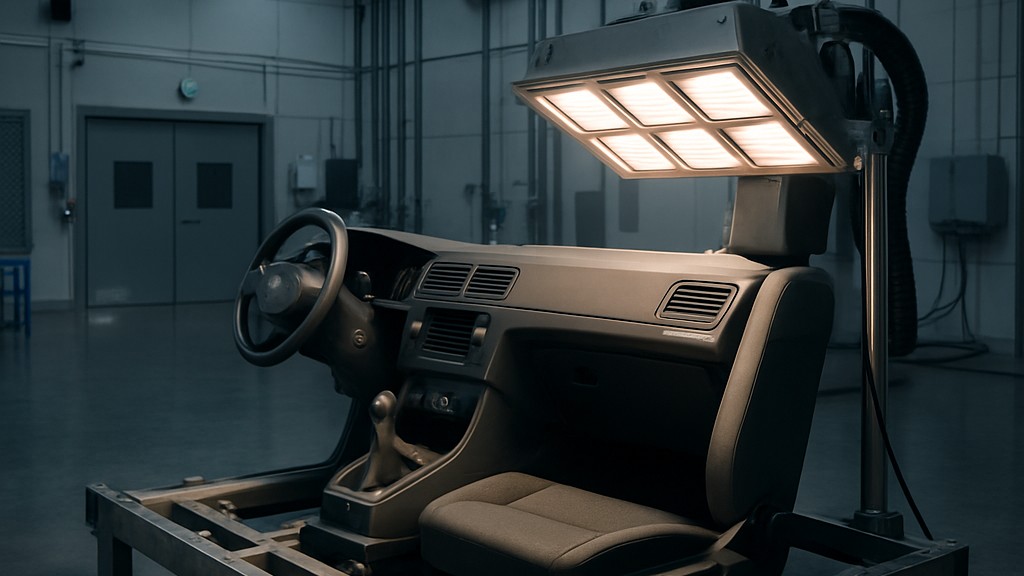
The “ VW PV 1303 Non-metallic materials - Exposure test of passenger compartment components” standard, developed by the Volkswagen automotive company , covers the testing of planar fabrics, plastic parts, rubber parts, paints, leathers, decorative wood parts, and textile and film-coated components in vehicle interior upholstery for color fastness, light and heat resistance, and the evaluation of parts exposed to light for sample and standard production tracking. This standard involves simply exposing samples to a filtered xenon arc lamp in a testing device. The exposed samples can also be used to determine residual tear strength, residual tear elongation, and residual abrasion resistance.
For the purposes of this standard, the following definitions apply:
The number of required cycles is specified in the technical supply standards, depending on the component's location. Additional tests may also be required during intermediate checks and after completion of light exposure to assess the material's light fastness (e.g., brushing, Crockmeter, or Martindale abrasion testing).
In principle, samples are irradiated under the instrument conditions of "Non-rotating mode" and "Dry exposure." The high heat stress (high-temperature light exposure) on equipment materials in the vehicle interior is also taken into account. Each of the specified test conditions defines an exposure time (according to DIN 75202).
Light exposure testers complying with DIN 75202 are used in the tests. To ensure comparable test results between the supplier and the customer, the selection of the type of equipment to be used in specific cases must be coordinated with the VW Group. It is recommended that the test equipment be installed in an air-conditioned room. Otherwise, the use of a connected cooling unit may be necessary.
Filter systems described in the standard should be used in terms of light exposure conditions.
Test strip dimensions should preferably correspond to the maximum clampable test surface on the original sample holders. For colorfastness testing, the minimum sample size depends on the evaluation procedure. Samples smaller than the corresponding sample holder surface should be attached to white cardboard. For yarn tests, a continuous piece of yarn (at least 5 cm wide) is tightly wound along the length of a piece of white cardboard and secured to the back or an unexposed area.
Exposed specimens should have the same thickness as the finished part in the assembled condition. Laminates should be exposed at the original composite material thickness, if possible. The maximum thickness for all instrument types is 15 mm, determined by the specimen holder design.
If textile samples are not to be laminated, a white, non-woven polyester (PET) backing is applied (gross density 60 kg/m3).
All sample carriers are equipped with full-surface stainless steel carrier panels (0,7 to 0,1 mm). Some models utilize both standard sample carriers and specialized sample carriers for embedded sample installation. The design of the standard sample carriers on some models allows them to be used for all samples. The sample carriers are used for testing all non-laminated textiles and films, as well as non-bonded felt materials. Each of these samples, whose dimensions are determined according to this standard, is secured to a white cardboard sheet, without tension, at its narrow edge, due to their inherent lack of stability, and mounted on the sample carriers, with a support provided if necessary. Special sample carriers are used for testing all materials exceeding 5 mm in thickness or that, due to their design, cannot be secured to the standard sample carriers. If the samples are too small or lack sufficient inherent stability, they are secured to a white cardboard sheet.
When performing the assessment, exposed samples are generally assessed both visually and colorimetrically for color change (e.g., fading), using an unexposed sample as a reference. The requirements are specified in the relevant technical procurement specifications and drawings.
For visual assessment, each exposed sample is evaluated at least twice by several trained, normally sighted individuals under appropriate illumination as described in DIN 5033-3, using a grayscale level (EN 20105-A02) to assess color change. Exposure results are usually expressed as grayscale level "GM" according to EN 20105-A02.
In order to avoid relatively large deviations in colorimetric assessment between individual assessors and repeated assessments, a colorimetric assessment according to the VW 501 90 standard should be performed in addition to the visual assessment, if possible.
In short, the VW PV1303 standard is a Volkswagen standard used to test the light and heat resistance of non-metallic materials used in vehicle interiors (such as fabric, leather, plastic, rubber, decorative wood, and laminate components). This standard is used to simulate harsh climates, particularly in dry and hot regions.
Samples are exposed to filtered xenon arc lamps that closely mimic natural sunlight, under strictly controlled conditions—dry exposure, no rotation (i.e., parts always face the same direction toward the light), and high temperature conditions.
The described method simulates UV and thermal aging similar to two years of outdoor exposure in arid environments. One exposure period is approximately 64 hours. For visually evaluated parts, in grayscale, a maximum deviation of GM≥4 is allowed according to the DIN EN 20105 - A02 standard, but any color shift is unacceptable.
After testing, no cracks, holes or surface changes should occur, reflecting durability expectations under real-life environmental stress.
Beyond light exposure, the VW PV 1303 standard can be supplemented with further material evaluations, such as abrasion resistance, permanent tear strength, or elongation at tear. These evaluations are typically performed using methods such as Martindale or Crockmeter tests.
As a result, the VW PV 1303 standard is important because it ensures that non-metallic interior materials in Volkswagen vehicles can withstand prolonged exposure to intense sunlight and heat, which is critical for both product durability and customer satisfaction.
Our organization, which has been operating for many years and meticulously follows global developments in science and technology, employs a skilled team and extensive infrastructure to conduct testing, measurement, and analysis in a wide range of areas for businesses across all sectors. In this context, we also provide testing services in accordance with the "VW PV 1303 Non-metallic materials - Exposure testing of passenger compartment components" standard.
To get an appointment, to get more detailed information or to request an evaluation, you can ask us to fill in our form and reach you.

