

The “GMW 14671 Organic Coating Performance for Engine Compartment and Underbody Components” standard, developed by General Motors Worldwide (GMW), is an engineering materials specification that defines performance requirements for organic coating surfaces used on automotive underbody and under-hood components. This specification is particularly important for components exposed to moisture, road contaminants, chemicals, oils, fuels, temperature variations, and mechanical wear.
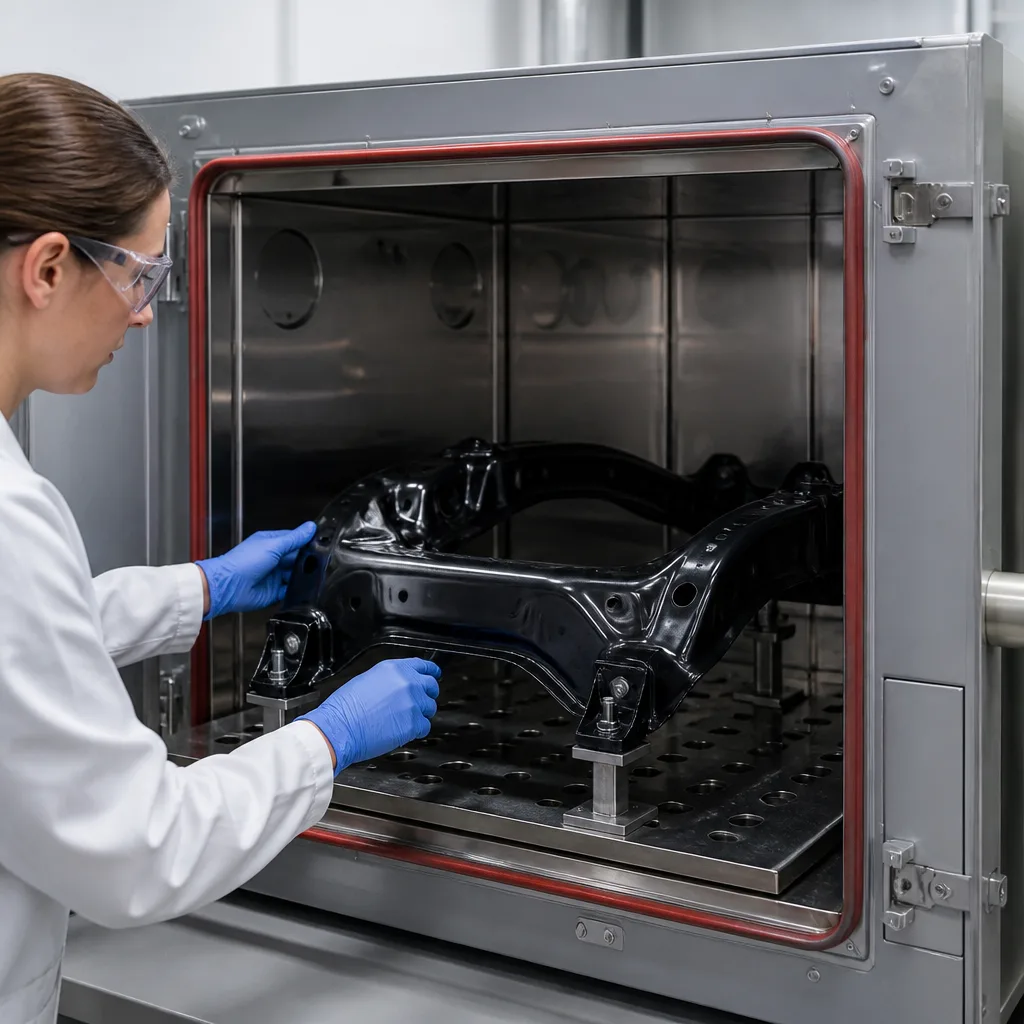
The primary goal of the GMW 14671 standard is to establish consistent performance requirements for organic coatings applied to automotive underbody and under-hood components. These coatings offer more than just an attractive appearance; they are primarily used to protect metal components against the following factors:
This standard also provides a method for determining the type of coating material required for a particular component.
Coatings conforming to the GMW 14671 standard are typically used on chassis, underbody, and engine compartment components. Examples include:
Coating selection depends on the component's location and the environmental conditions it will be exposed to. For example, a component placed under a vehicle may require particularly strong resistance to water, salt, corrosion, and mechanical damage, while a component under the hood may be more exposed to heat and automotive fluids.
One of the notable features of the GMW 14671 standard is its recognition of various coating systems. This standard defines eight coating types, from A to H.
The H-type is particularly associated with demanding components such as high-strength control arms, links, cradles, and frame components, and is typically applied to bare steel substrates.
GMW 14671 standard is not just a paint material specification, but a performance specification. Consequently, the coating must demonstrate appropriate performance under a variety of conditions. Depending on the coating definition and application, the evaluation may include the following characteristics:
An important practical aspect of the GMW 14671 standard is that the specification can be directly referenced in engineering documentation. This approach allows the engineering drawing or component specification to communicate the required coating performance without needing to reproduce the entire test requirements in the drawing.
Electroplating is particularly important in automotive corrosion protection. During electroplating, an electrically conductive metal component is immersed in a plating bath, and the electrical potential causes the plating material to deposit onto the component. The GMW 14671 standard defines types A and B as cathodic electroplating systems with different thickness ranges. Electroplating is valuable because it can provide a relatively uniform coating on complex metal components and create a strong foundation for corrosion protection.
The areas under the hood and underbody of a vehicle are some of the toughest environments for painted metal components. A vehicle may encounter: water, road salt, mud, stones, oils, chemicals, heat, humidity, and repeated temperature changes. Without adequate coating protection, exposed steel can corrode relatively quickly. Corrosion can lead to:
Therefore, the GMW 14671 standard provides General Motors with a common framework that guarantees coating systems provide an appropriate level of durability for their intended automotive application.
For a component supplier, compliance with the GMW 14671 standard is important because the coating is part of the component's overall durability system. Here are some things a supplier should typically check:
A coating that performs well in the laboratory but is applied inconsistently in production can still lead to corrosion problems. Therefore, process control plays a crucial role in ensuring reliable compatibility.
GMW 14671 standard should be viewed not as an isolated paint requirement, but as part of a broader General Motors corrosion protection strategy. The coating acts as a barrier between the metal surface and the environment. Its effectiveness depends on several factors: metal surface, pretreatment, coating, coating thickness, curing, and environmental resistance. Failure at any of these stages can reduce overall corrosion resistance. Therefore, coating specifications generally work in conjunction with pretreatment and coating material specifications.
In conclusion, the main objectives of the GMW 14671 standard are to ensure that coating systems exhibit satisfactory properties:
This standard covers various coating technologies, including cathodic electroplating, powder coating, dip coating, and spray coating, with the appropriate type selected according to component requirements.
For many years, our organization, with its competent and experienced staff, has been understanding the needs of its clients, providing the advanced testing services they require, and assisting them in the establishment, implementation, and improvement of management systems. Within this framework, we also provide testing services in accordance with the GMW 14671 standard.
To get an appointment, to get more detailed information or to request an evaluation, you can ask us to fill in our form and reach you.

