

The purpose of the test method described in the “Renault D49 1977B Sound Absorption in Fibrous and Cellular Materials in Distributed Field” standard, developed by the French automobile company Renault, is to determine the diffuse field sound energy absorption factor of absorber material plates. This standard also allows for the measurement of shaped parts (such as engine compartment, interior trim absorbers) under specific conditions.
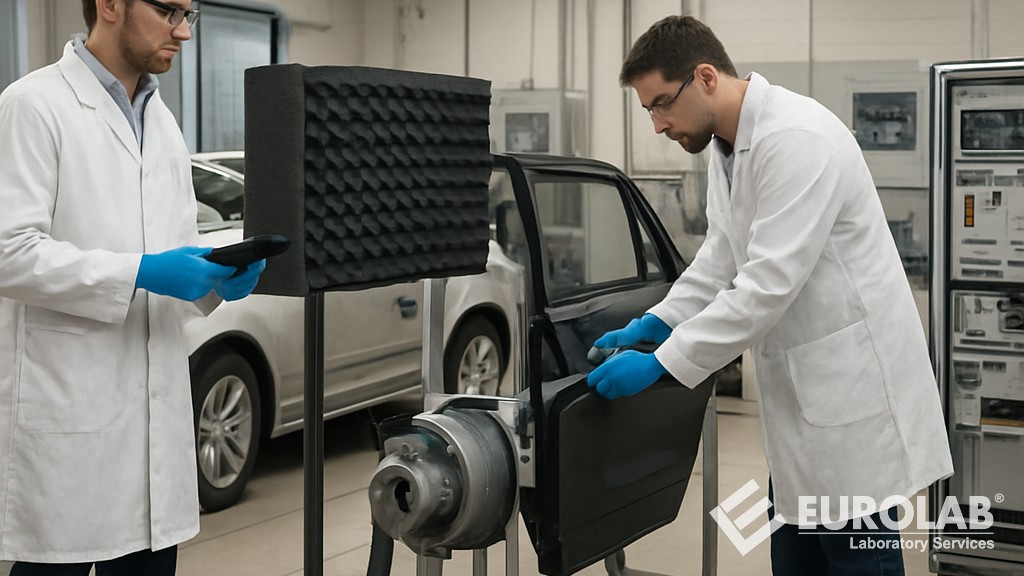
This standard applies to non-extensive materials such as felts, cotton wools, complex textiles embroidered on cotton wool, and polyurethane or polyethylene foam with flat and parallel surfaces.
In principle, the measurement is performed in a mini reverberation chamber with a volume of 6,44 m³ where the sound field is propagated. An audio signal is generated in the chamber, and reverberation times are measured with a microphone operating in the frequency range of 400 Hz to 10.000 Hz. The reverberation time corresponds to the time required for the sound level to drop by 60 decibels after the stimulus is discontinued.
Absorption power is obtained from two reverberation time measurements:
The absorption capacity of a material is expressed by its absorption coefficient in the case of plates. The corrected equivalent absorption surface is valid for parts; the absorption coefficient can also be expressed knowing the surface areas.
For the purposes of this standard, the absorption coefficient is the ratio of the absorbed acoustic power to the incident acoustic power. The indicated corrected equivalent absorption surface corresponds to a fully absorbing surface with the same absorption capacity as the part under investigation (absorption coefficient = 100 percent).
The reverberation chamber used in the tests is made of damped steel sheet welded to a steel tubular structure. Its walls are designed to provide high sound insulation, resulting in very low background noise throughout the measurement range. The diffused field is created by the asymmetry of the walls and a series of reflectors attached to them. Overall dimensions are 3170 mm x 2290 mm x 2030 mm, volume 6,44 m³, interior surface area 22,2 m², total empty weight 1900 kg, and the dimensions of the measured parts range from a minimum of 0,8 m² to a maximum of 2,4 m².
The conditioned test chamber temperature is 22 degrees plus/minus 3 degrees, and the relative humidity is 60 percent plus/minus 10 percent. Before testing, plates and parts must be conditioned in the air-conditioned chamber for 24 hours.
Before each measurement series:
In the automotive industry, noise, vibration, and harshness are critical focus areas for manufacturers seeking to improve vehicle comfort and safety. The Renault D49 1977B standard focuses on the acoustic properties of porous materials used in vehicle interiors and exteriors.
A dispersed field refers to a controlled acoustic environment where sound waves are uniformly distributed, mimicking reverberation conditions in a vehicle cabin. This setup allows researchers to measure absorption coefficients more accurately than free-field tests, providing practical insights for real-world applications.
Engine noise, road noise, and wind turbulence penetrate cabins, causing driver fatigue and a decrease in perceived quality of life. Traditional barriers such as metal sheets and glass provide limited damping, especially at mid-to-high frequencies. Fibrous materials (e.g., glass wool, felt) and cellular foams (e.g., polyurethane, polyethylene) have emerged as promising absorbers. These porous structures dissipate sound energy through frictional and viscous losses within their matrices.
The materials tested under this standard are:
Absorption coefficients were derived using the impulse response method, an advancement over the previously widely used steady-state sine wave techniques. A broadband impulse (e.g., via a starter gun or electronic blast) was emitted, and the decay rate of the chamber was measured with and without the sample. The random event absorption formula is included in the standard.
Tests are conducted under conditions of 20–25 degrees Celsius temperature and 50–60 percent humidity, covering frequencies from 100 Hz to 5000 Hz in one-third octave bands. Edge diffraction is minimized using closed mounting frames, and multiple repetitions ensure statistical reliability (5 per condition). This rigorous approach contrasts with simpler tube methods that only measure normal occurrence and often overestimate real-world performance.
The effects of these tests on automotive design have been as follows:
In conclusion, the Renault D49 1977B standard remains a groundbreaking study that combines theory and practice in sound absorption. By emphasizing diffuse area measurements, it provided engineers with tools to tame the symphonies of vehicle noise, paving the way for today's exceptionally quiet electric vehicles. Going forward, these principles will continue to be applied to sustainable alternatives such as recycled PET felts and biofoams.
For many years, our organization, with its competent and experienced staff, has been understanding the needs of its customers, providing the advanced testing services they require, and assisting in the establishment, implementation, and improvement of management systems. Within this framework, we also provide testing services to businesses in accordance with the "Renault D49 1977B Sound absorption in fibrous and cellular materials in a distributed area" standard.
To get an appointment, to get more detailed information or to request an evaluation, you can ask us to fill in our form and reach you.

