

Developed by BMW, a leading German multinational company in the automotive industry, the “BMW PR 363 Evaluation of Cleanability of Vehicle Interior Surface Materials” standard describes a specific test method for evaluating the cleanability of interior surface materials after intentional soiling. This standard is part of BMW’s broader set of material and component testing requirements to ensure that upholstery, instrument panels, door panels, trim, and other visible/interior surfaces maintain their appearance, durability, and quality under real-world usage conditions.
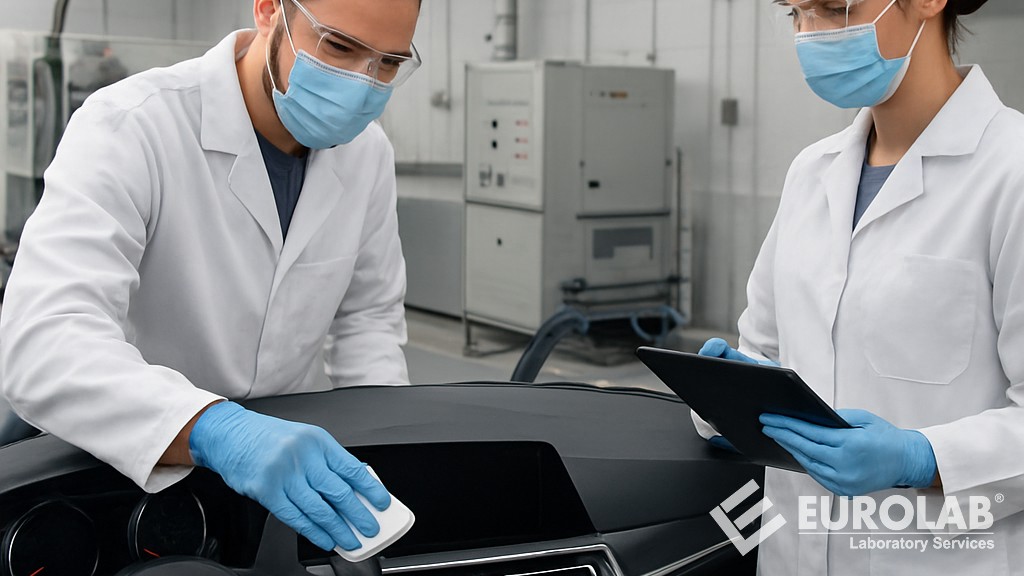
Vehicle interior surfaces are exposed to a variety of contaminants, including dust, oils, food residues, and airborne particles. The BMW PR 363 standard specifically simulates contamination from everyday household dirt and evaluates how effectively these contaminants can be cleaned without damaging the material or leaving visible residue/stains.
This test method focuses on cleanability after contamination with cigarette dust, fine sand, and wall sand. This is a standardized artificial dirt mixture used in the procedure:
This combination produces realistic and persistent dirt in tests against both oily and sticky, as well as dry particulate contamination.
The basic characteristics of this test method, known as BMW PR 363.1, are as follows:
This test is listed in various independent testing laboratory catalogs as a mandatory or optional verification for parts and supplier materials supplied by BMW.
BMW uses the BMW PR 363 standard, along with other interior material standards (e.g., the BMW GS 97034 standard series for resistance to cleaning agents or the BMW PR 368 standard for seam strength), to qualify components. This ensures premium finishes that perform well throughout the vehicle's lifespan, resist everyday dirt, and are easy to maintain without harsh chemicals.
For a supplier, engineer, or quality specialist working with BMW interiors, the BMW PR 363 standard is a critical benchmark for cleanability performance. This standard ensures that surfaces look and feel new for longer, even after exposure to real-world dirt and grime.
BMW PR 363 (specifically BMW PR 363.1) is a key interior material specification focusing on the cleanability of interior surface materials after controlled contamination with a standardized mixture containing smoke flour—a fine, smoke-like or oily particle mimicking tobacco residue, cooking smoke, or greasy dust—fine powdery contaminants, and abrasive fine sand or wall dust mimicking domestic/environmental sand.
This standard plays a critical role in BMW’s overall approach to interior quality for the following key reasons:
In conclusion, the BMW PR 363 standard is not just a test procedure, but a cornerstone of the quality BMW promises. It ensures that the vehicle remains impressive even after years of the wear and tear of daily life.
For many years, our organization, with its competent and experienced team, has been understanding the needs of its clients, providing the advanced testing services they require, and assisting them in the establishment, implementation, and improvement of management systems. Within this framework, we also provide testing services in accordance with the BMW PR 363 standard.
To get an appointment, to get more detailed information or to request an evaluation, you can ask us to fill in our form and reach you.

