

The “GM 9070P Flammability Test Procedure for Materials” standard, published by General Motors (GM), is an engineering standard that specifies the flammability testing procedure for materials used in vehicle interiors. This standard was developed to ensure that materials used in passenger cars, trucks, buses, and multi-purpose vehicles exhibit acceptable fire performance and do not contribute to rapid flame spread during a vehicle fire.
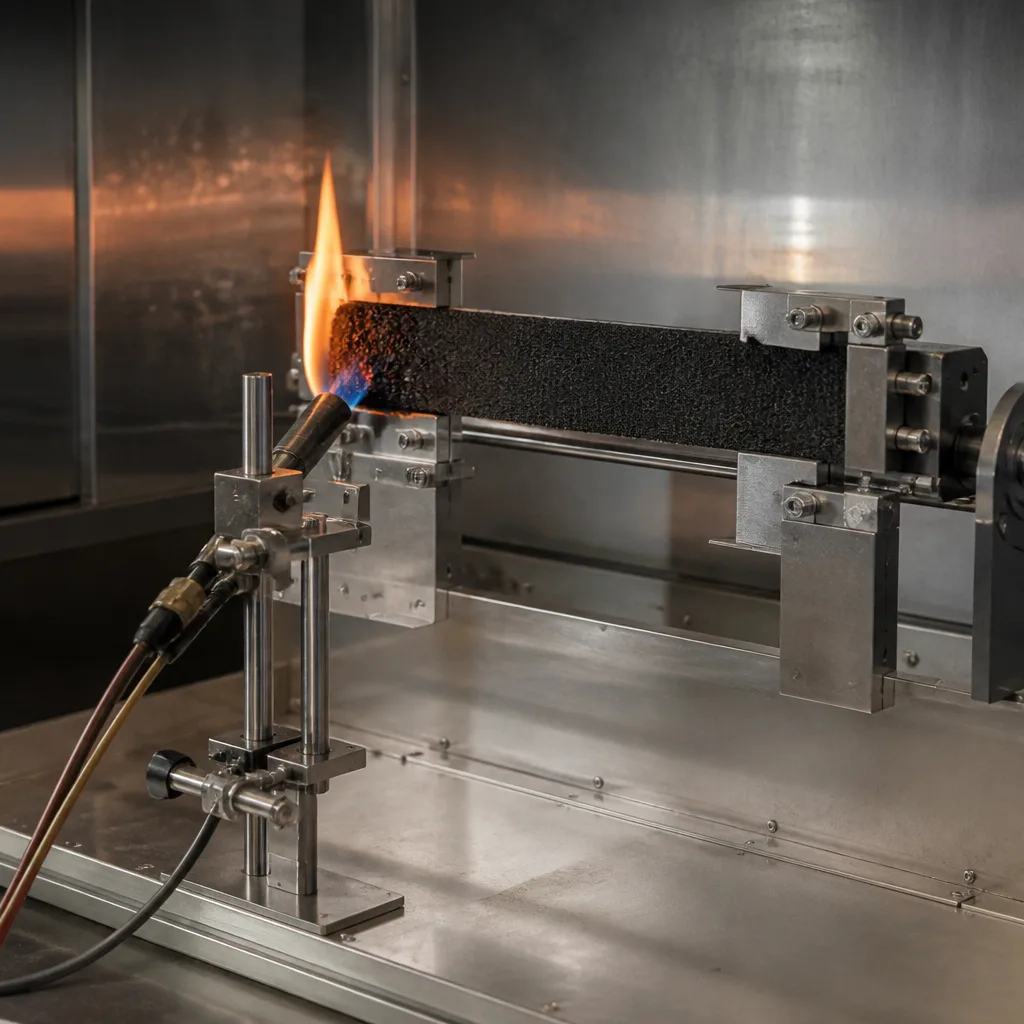
Although the GM 9070P standard is no longer recommended for new vehicle programs, it remains an important historical specification as many suppliers still refer to it when characterizing older automotive components. This standard has been superseded by General Motors' current global flammability testing specification, the GMW 3232 standard.
The primary purpose of the GM 9070P standard is to evaluate the horizontal combustion properties of automotive materials. This test determines whether a material possesses the following characteristics:
These features are crucial for minimizing the spread of a fire inside a vehicle and providing passengers with valuable evacuation time.
The GM 9070P standard applies to materials used in a vehicle's interior, including:
This specification applies to passenger cars, SUVs, trucks, buses, and multi-purpose vehicles.
In principle, this standard uses a horizontal combustion test with a concept similar to the test described in FMVSS 302 and ISO 3795 standards. The applied test method generally follows these steps:
The measured combustion rate is then compared against acceptability requirements.
The equipment typically used in these tests includes:
The device is designed to provide repeatable ignition conditions and minimize the effects of external airflow.
Most interior materials are prepared as rectangular samples with controlled dimensions and thickness. Depending on the product, samples can be taken from:
Multiple samples are usually tested to ensure consistent results.
The main evaluation criteria are as follows:
Many materials pass through the following tests:
Some materials may even be reported as "non-flammable," indicating that they do not support combustion under test conditions.
The GM 9070P standard is closely related to various international flammability standards:
Because the test methodology is very similar, many laboratories can apply multiple standards using the same equipment.
Although originally developed for General Motors, tests according to the GM 9070P standard are widely required by the following industries:
Many laboratories continue to offer the method because older GM programs still refer to this standard.
Vehicle fires can be caused by:
Highly flammable interior materials can cause flames to spread rapidly throughout the entire passenger compartment.
The GM 9070P standard helps manufacturers in the following areas:
Although this standard has been modified for newer GM designs, the fundamental fire safety principles remain valid.
Tests conducted according to the GM 9070P standard offer several advantages:
The GM 9070P standard is no longer active for new General Motors programs. General Motors has developed the GMW 3232 standard, which harmonizes flammability testing across global GM vehicle platforms and reflects updated engineering requirements. However, the GM 9070P standard still appears in legacy drawings, supplier specifications, and qualification documents from older vehicle programs.
In conclusion, the GM 9070P standard played a significant role in establishing fire safety requirements for automotive interior materials. By providing standardized horizontal flammability testing, this standard enabled manufacturers and suppliers to evaluate the combustion behavior of plastics, textiles, foams, and composite materials used in vehicle cabins. Although superseded by GMW 3232, the GM 9070P standard remains an important legacy standard, and its methodology continues to influence modern automotive flammability testing practices.
For many years, our organization, with its competent and experienced staff, has been understanding the needs of its clients, providing the advanced testing services they require, and assisting them in the establishment, implementation, and improvement of management systems. Within this framework, we also provide testing services compliant with the GM 9070P standard.
To get an appointment, to get more detailed information or to request an evaluation, you can ask us to fill in our form and reach you.

