FORD WSS-M98P13-F Exterior Plastic Performance - Color Mold
The standard "FORD WSS-M98P13-F Exterior plastic performance - Color molding," developed by Ford Motor Company (FORD), describes the minimum durability and performance requirements for exterior molded color plastic components. This standard was originally designed for unpainted molded color plastic components used in exterior subsystems including, but not limited to, exterior rearview mirrors, hood grilles and leaf screens, bumpers, radiator grilles, door handles, wipers, pickup box liners/moldings, and exterior trim. Typical manufacturing methods include injection molding, blow molding, and extrusion.
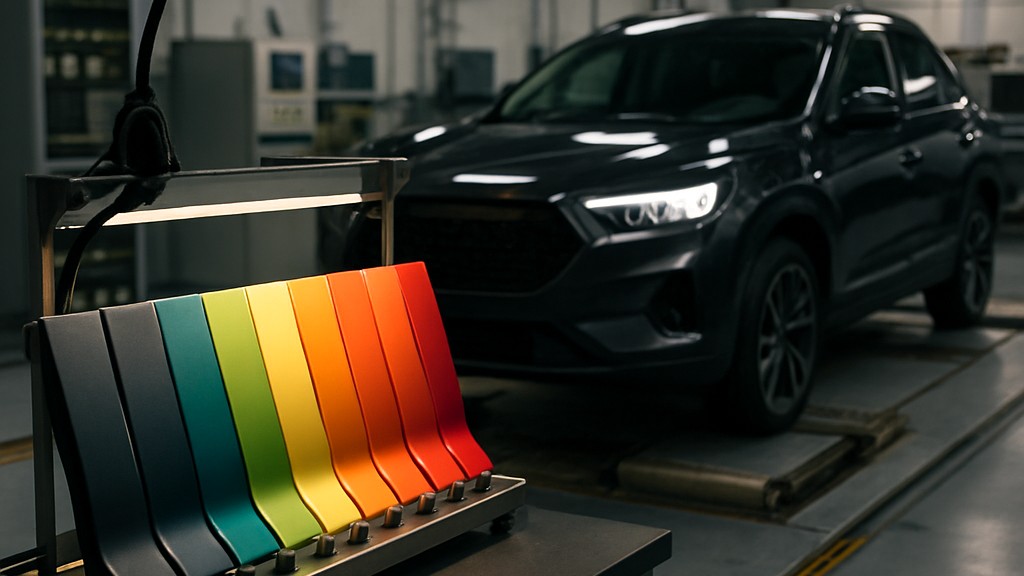
The requirements in this standard are specified as follows:
- Approved sources: This specification is performance based and does not have approved sources.
- Materials used in all exterior systems must withstand the installation facility paint repair process (or be protected by shielding) without deformation, functional damage, or loss of appearance or other specified physical properties.
- The part's color/pigment loading, texture, and material affect scratch performance and cleanability. Materials engineering recommends avoiding highly geometric textures or sharp-edged textures.
- UV/process/heat stabilizers should be in the base resin from the material supplier, especially for press-in-mold color applications.
- All painted exterior components must meet the requirements of standard WSS-M2P180-E or the latest requirements for rigid surfaces and standard WSS-M2P181-C or the latest requirements for flexible surfaces.
- All electroplated external components must meet the requirements of the WSS-M1P83-E2 standard or the latest requirements.
- All external rubber components must meet the requirements of the WSS-M9P14-A1 E2 standard or the latest requirements.
- All external components using laminated color film materials must meet the requirements of the SS-M99P37-B E2 standard or the latest requirements.
- All dynamic seals must meet the visible or invisible requirements of the WSS-M9P9-E E2 standard or the latest requirements.
- All static seals must meet the requirements of the WSS-M9P10-D E2 standard or the latest requirements.
- All external plastic components containing recycled resin must meet the requirements of the WSS-M98P16-A1 standard or the latest requirements.
- All outdoor lighting components must meet the requirements of the WSS-M98P10-C standard or the latest requirements.
- Completed parts:
- Tests should be performed on actual production parts. When part dimensions limit equipment access, plates representative of production processes, color, and grain can be used in place of production parts. If regrinding is used, testing must be performed at the maximum loading level. When plates are used as substitutes, this must be clearly stated in the laboratory test report.
- Conditioning: Test samples must be conditioned at a temperature of 23 degrees plus/minus 2 degrees and a relative humidity of 50 percent plus/minus 5 percent for at least 24 hours before testing.
- Test requirements in the table: PEC/FEC/PV/MCDCC tests must be performed in accordance with program milestones unless otherwise determined by Ford Engineering. Tests for molded-color components are detailed in the table unless otherwise determined by Ford Materials Engineering.
- Appearance: Color, gloss, and finish must match the main appearance sample approved by the Ford design department or as specified in the engineering drawing. Mold flow analysis should be evaluated to verify that weld lines and appearance issues resulting from mold conditions and processing are minimized.
- Heat aging:
- Horizontal parts or parts above the belt line (A, B, C, D-pillar appliques, roof rack, hood vent grille, fixed running boards, step pads, etc.): The production-grade part must be tested. The test specimen is exposed to 92°C (92°F) plus/minus 2°C (192°F) in a mechanical convection oven for 16 hours. After heat exposure, the specimens are allowed to cool to 23°C (92°F) plus/minus 2°C (192°F) for at least 1 hour before evaluation.
Unless otherwise stated, the tested part shall not show a color change exceeding gray scale grade 4 when compared to the original part. There shall be no visible evidence of cracks, blisters, softening, dulling, or material deterioration when viewed with the naked eye at a distance of 300 mm plus/minus 30 mm.
- Vertical parts or parts below the belt line (body side molding, rocker molding, wheel lip molding, etc.): Production-grade parts must be tested. The test specimen is exposed to 82°C (182°F) plus/minus 2°C (82°F) in a mechanical convection oven for 16 hours. After heat exposure, the specimens are allowed to cool to 23°C (82°F) plus/minus 2°C (82°F) for at least 1 hour before evaluation.
Unless otherwise stated, the tested part shall not show a color change exceeding a gray scale rating of 4 when compared to the original part. There shall be no visible evidence of cracks, blisters, softening, dulling, or material deterioration when viewed with the naked eye at a distance of 300 mm plus/minus 30 mm.
In short, the FORD WSS-M98P13-F standard is a standard specifically focused on long-life coolants. This standard is deemed necessary for the following reasons:
- Ensures compatibility with Ford engines: Ford designs its engines with specific materials (e.g., aluminum, gaskets, seals) that require coolant with specific chemical properties. This standard ensures that the coolant will not damage or degrade these materials over time.
- Corrosion protection: This standard includes requirements for corrosion inhibitors that protect vital engine parts like the water pump, radiator, and cylinder head. This is particularly important in aluminum-intensive engines, which are more prone to corrosion without the right additives.
- Long service life: Coolants that meet this standard are typically long-life coolants (typically up to 10 years or 150.000 miles). This means fewer coolant changes are needed, reducing maintenance costs and environmental impact.
- Temperature and pressure stability: Properties allow the coolant to perform well over a wide range of temperatures and pressures, preventing: boiling at high temperatures, freezing in cold climates, and scale buildup that can clog the cooling system.
- Prevents chemical incompatibility: Using an unapproved coolant can cause chemical reactions that produce sludge or scale. This standard ensures the coolant maintains the correct pH and additive balance throughout its life.
In short, this standard is required for:
- Protecting engine components
- Ensuring long-term reliability
- Meeting Ford's specific material and engineering requirements
- Reducing maintenance intervals and costs of ownership
Our organization, which has been supporting businesses across all sectors for years through a wide range of testing, measurement, analysis, and evaluation activities, has a strong team of employees who closely follow global developments in science and technology and are constantly improving themselves. In this context, we also provide testing services to businesses in accordance with the "FORD WSS-M98P13-F Exterior Plastic Performance - Colored Mold" standard.



