

The “VW PV 3339 Cooling Hoses - Sediment Determination” standard, developed by the Volkswagen automotive company, describes a procedure for determining the presence of sediment in cooling hoses.
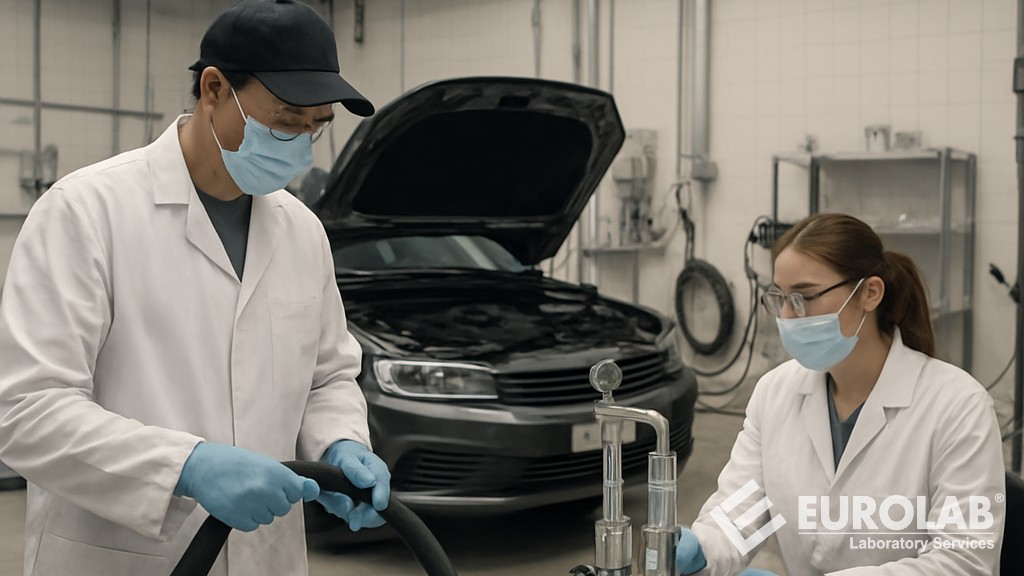
In cooling systems, a number of residues may form, including those resulting from extraction from elastomers. The stated maximum/limit value (percentage by weight) should be taken from the drawing or applicable material standard.
During test preparation, 10 mm x 10 mm sections (approximately 1 mm thick) should be taken from the inner layer of the hose material and aged to determine the presence of sediment. When using samples of these dimensions, each sample should have an approximate surface area of 2,4 cm². The total sample surface area of the hose material to be aged should be approximately 400 cm². The total fully aged sample surface area should be stated in the test report. The test is performed on three components.
Before starting the test, the required filters are conditioned in a natural convection oven at 105 degrees Celsius according to ISO 188 standard method A until their weight remains constant. After conditioning, the filters are stored in a desiccator (for at least 24 hours) until use.
Rubber samples are aged for 94 hours in an Erlenmeyer flask (standard conical cone with 300 ml ground glass fitting and a right-angle tube cap) at 160 degrees with 200 ml of test fluid. This fluid consists of 50% by volume deionized water and 50% by volume of factory-filled coolant additive according to VW TL 774 standard. If necessary, the coolant additive to be used should be requested from the relevant department of the buyer. After completing the aging procedure and cooling the sample to 23 degrees plus/minus 2 degrees in the test environment, the hose sections are removed from the container using a sieve (pore size 200 µm to 240 µm) and the test fluid is filtered through a medium-fine filter. For filtration, an ash-free round filter is used for quantitative analysis. A Büchner funnel made of plastic and suction bottles with hose ends are required. A water jet pump or vacuum pump can be used for extraction. After this, the round filter, along with the residue, is dried in a natural convection oven at 105 degrees Celsius for 22 hours according to ISO 188 standard method A, and then conditioned in a desiccator (for at least 16 hours).
To record any potential residue from the test fluid, the test procedure should also be performed without the rubber material; that is, in addition to the three tests mentioned above, a fourth test should be carried out using only the test fluid.
Finally, based on the available values, the residues are calculated as a percentage of the original weight.
In the high-risk world of automotive manufacturing, where every component must withstand harsh conditions from scorching deserts to salty coastal roads, the Volkswagen Group has long been a pioneer in rigorous quality control. Among the published standards, the VW PV 3339 standard stands out as a critical benchmark for evaluating the durability and performance of non-metallic materials under simulated environmental stresses.
The VW PV 3339 standard builds upon previous standards such as VW PV 1200 (general climate cycle) and complements UV aging tests such as VW PV 3929 (Florida simulation) and VW PV 3930 (Kalahari simulation). In the age of electric vehicles and sustainable materials, this standard has been developed to address modern challenges, including thermal stresses on battery cases and lightweight composites.
Essentially, the VW PV 3339 standard is a test method that measures the resistance of non-metallic materials to environmental influences, focusing on cyclical exposure to heat, humidity, and potentially corrosive elements. Unlike static tests, it uses accelerated aging cycles to simulate real-world use lasting from weeks to years. This standard is particularly vital for interior and exterior components such as instrument panels, gaskets, and trim pieces that must withstand everything from intense sunlight to fluctuating cabin temperatures.
The key elements of the VW PV 3339 standard are as follows:
Suppliers must document compliance through accredited laboratories, typically using climate chambers that replicate the profiles specified by VW. For example, a test might last 500–1.000 hours, equivalent to 10 years of exposure.
In the automotive supply chain, the VW PV 3339 standard acts as a gatekeeper. Volkswagen requires certification for thousands of components every year, and non-conformities lead to costly rejections or redesigns. This rigor has real-world implications:
As autonomous vehicles and urban air mobility redefine mobility, the VW PV 3339 standard is adapting accordingly. Future versions may integrate electromagnetic exposure for sensor housings or microbial resistance for bio-based interiors.
For many years, our organization, with its competent and experienced staff, has been understanding the needs of its customers, providing the advanced testing services they require, and assisting in the establishment, implementation, and improvement of management systems. Within this framework, we also provide testing services to businesses in accordance with the "VW PV 3339 Cooling Hoses - Sediment Determination" standard.
To get an appointment, to get more detailed information or to request an evaluation, you can ask us to fill in our form and reach you.

