

The “GME 60251 Determination of Ozone Resistance of Elastomers” standard, developed by General Motors Europe (GME), is an engineering standard that specifies a test method for determining the ozone resistance of elastomeric materials used in automotive applications. This standard is primarily designed for rubber components that are exposed to atmospheric ozone throughout their service life. Ozone is a highly reactive form of oxygen that can cause cracking and premature degradation on the surface of many elastomers, making ozone resistance a fundamental durability requirement for automotive seals and air seal strips.
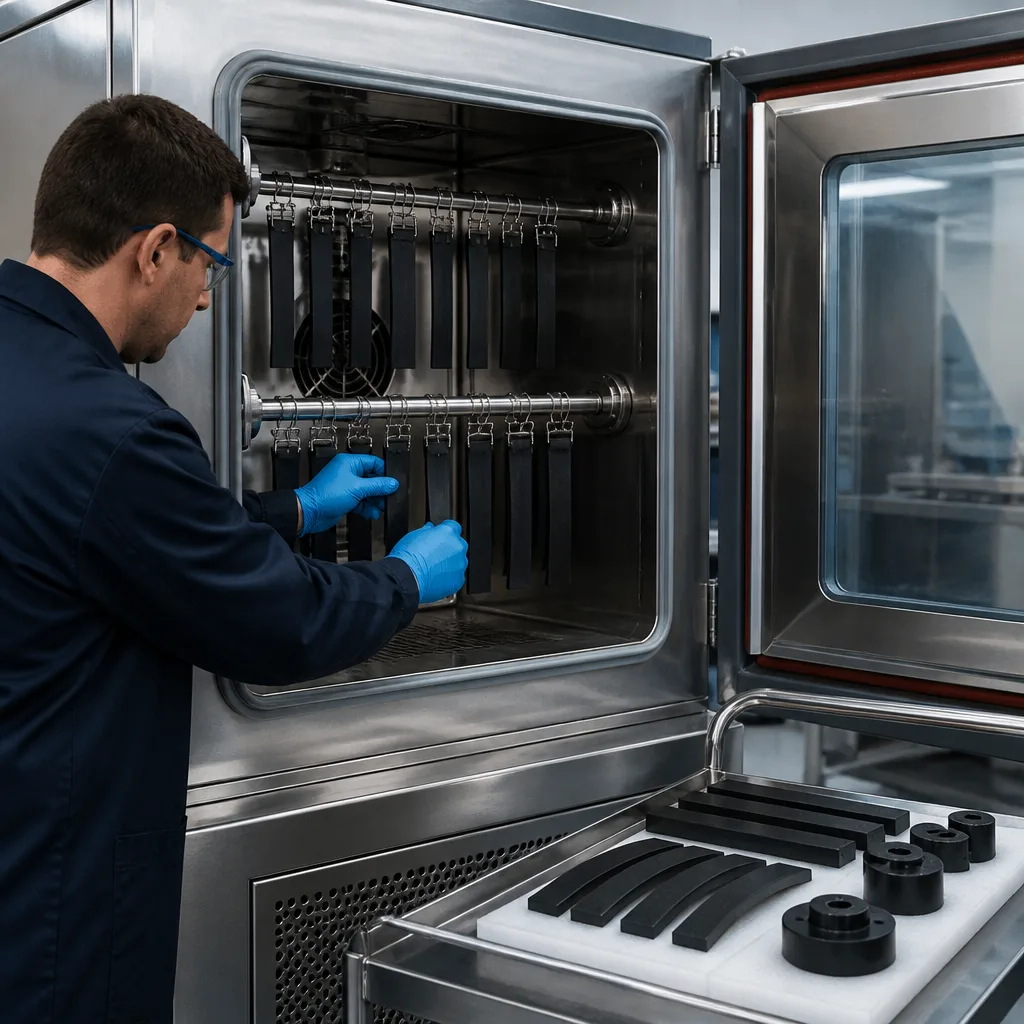
Originally developed by GM Europe (formerly Opel), the GME 60251 standard is widely used to qualify rubber materials for automotive exterior and under-hood applications.
The objectives of the GME 60251 standard are as follows:
Without adequate ozone resistance, rubber components can crack even under relatively low mechanical stress, leading to leaks, noise, reduced sealing performance, and shortened service life.
Although ozone occurs naturally in low concentrations in the atmosphere, it aggressively attacks the double bonds found in many elastomers, especially when under tensile stress. Typical effects include:
Common automotive parts susceptible to ozone attack include:
In principle, according to the GME 60251 standard, rubber samples,
This method accelerates ozone aging to simulate years of natural outdoor exposure.
While exact values depend on the material specification, this standard generally checks for the following:
Different GM material specifications may refer to different exposure conditions or severity levels.
Many General Motors engineering specifications refer to the GME 60251 standard, using exposure conditions coded as follows:
For example, 2J2W is a commonly referenced condition for automotive air seal strips and elastomer profiles. It specifies a defined combination of sample voltage, ozone concentration, temperature, and exposure time to evaluate ozone resistance.
After exposure, the samples are visually inspected in the following aspects:
Acceptance criteria are generally defined not in the GME 60251 standard itself, but in the relevant GM material specification.
This standard is used for many automotive elastomers, including:
Among these, EPDM is widely used because it exhibits excellent resistance to ozone, weathering, and UV rays.
Although developed for General Motors, the GME 60251 standard also applies to suppliers producing the following products:
Test laboratories that support original equipment manufacturers' supplier qualifications frequently list the GME 60251 standard among their elastomer durability capabilities.
The GME 60251 standard is conceptually similar to several international ozone resistance standards, including:
Although the test principles are similar, the GME 60251 standard includes original equipment manufacturer-specific procedures and acceptance requirements adapted to General Motors vehicle applications.
Implementing the GME 60251 standard offers several advantages:
In the automotive development process, tests performed in accordance with the GME 60251 standard support the following:
Engineers typically perform ozone testing along with other environmental durability tests, including UV aging, thermal aging, humidity cycling, and chemical resistance.
In conclusion, the GME 60251 standard is a significant engineering standard for evaluating the ozone resistance of elastomeric materials used in General Motors vehicles. By exposing stretched rubber samples to controlled ozone environments, this standard helps manufacturers identify materials that can maintain sealing performance and structural integrity throughout a vehicle's service life. It is particularly valuable for weather strips, gaskets, and other rubber components exposed to outdoor conditions. The GME 60251 standard provides General Motors-specific testing requirements that support consistent supplier qualification and long-term vehicle durability.
For many years, our organization, with its competent and experienced staff, has been understanding the needs of its clients, providing the advanced testing services they require, and assisting them in the establishment, implementation, and improvement of management systems. Within this framework, we also provide testing services compliant with the GME 60251 standard.
To get an appointment, to get more detailed information or to request an evaluation, you can ask us to fill in our form and reach you.

