

The “ Porsche PPV 4025 Exterior, paintwork - Color inspection - Painted body and components” standard, developed by the Volkswagen automotive company , describes the color inspection procedure for Porsche vehicles. The technical content of the VA.PK.033 standard procedural instruction is included in this test standard.
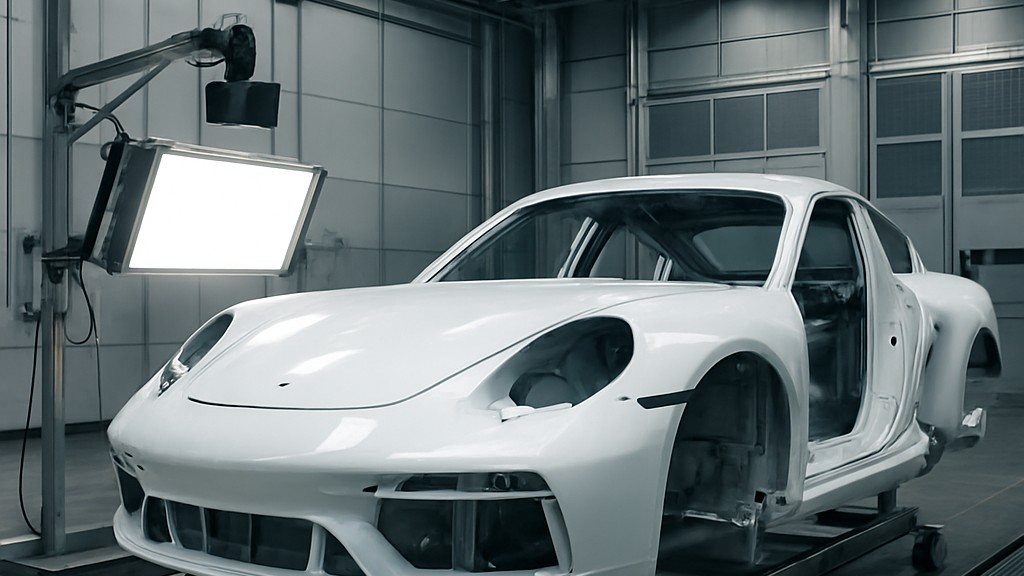
Body and fittings painted in body color (exterior colors) are tested according to this standard. The color impression is influenced by various factors. Therefore, the test parameters for color control must be precisely defined and adhered to at all inspection locations (both inside and outside Porsche AG):
The Porsche AG paint laboratory is responsible for determining the test parameters. The relevant supplier or department at Porsche AG where the color control is performed is responsible for compliance with the test parameters, particularly the use of the correct types of light and observation from different viewing angles. Furthermore, the relevant supplier or department at Porsche AG where the color control is performed is responsible for documenting the results.
For the purposes of this standard, master samples are color samples created in accordance with work instructions AA.PK.O7.030. Samples are back-labeled and marked as master samples in accordance with these work instructions. These serve as color samples for all color checks. Any color samples labeled differently cannot be used for color comparisons.
Colour control during testing is carried out according to the standards VDA 621-409 and DIN EN ISO 3668 by visual comparison of the colour with the relevant master sample.
The table within the standard specifies the lighting to be used during testing. Mixed light should be avoided, meaning that artificially lit inspection stations should be shielded from sunlight or other prohibited light sources. This also ensures that color differences (metamerism) between different light sources are visible to the inspector.
The requirements for all test samples are determined as follows:
Meanwhile, the test officer must be color blind and wear dull gray clothing.
Tests and methods for color comparison include:
The master specimen is placed on the test specimen or test piece. Ensure the master specimen is perfectly flat. For slightly curved specimens, the position can be corrected by gently pressing down. Always observe at a 45-degree angle to the light source, with a distance of 60 cm to 80 cm between the eye and the specimen. Both the top view and the oblique view are evaluated.
The master sample is placed in the body. The master sample must lie completely flat. For slightly curved surfaces, the position can be uniformed by gently pressing it. The edges of the master samples must be burr-free to avoid damaging the vehicle's paint. The angle of incidence cannot be precisely determined because the vehicle is illuminated from different angles due to its shape. Color comparisons are typically performed at a distance of 60 cm (arm's length) from different viewing angles: top view (0 degrees to the surface normal) and oblique view (various angles, preferably 45 degrees and -65 degrees to the surface normal).
The master sample is placed on the component. Care must be taken to ensure that the master sample is positioned at exactly the same angle. For slightly curved samples, the position can be uniformed by gently pressing it. For more curved samples, a definitive color assessment is not possible; only an acceptable overall appearance on the body can be determined. The master sample edges must be burr-free to prevent damage to the paint coating.
Our organization, which has been supporting businesses across all sectors for years through a wide range of testing, measurement, analysis, and evaluation activities, has a strong team of employees who closely follow global developments in science and technology and are constantly improving themselves. In this context, we also provide testing services to businesses in accordance with the "Porsche PPV 4025 Exterior, Paintwork - Color Control - Painted Body and Fittings" standard.
To get an appointment, to get more detailed information or to request an evaluation, you can ask us to fill in our form and reach you.

