

The “GMW 3220 Laminate Bond Strength” standard, developed by General Motors Worldwide (GMW), is an engineering standard used to determine the bond strength of laminated soft furnishing materials. This standard is particularly applicable to automotive interior materials where two or more flexible layers are bonded together, such as coated textiles, synthetic leather, films, foams, and backing materials. It is applicable to coated textiles and plastic roll products used in vehicle interiors.
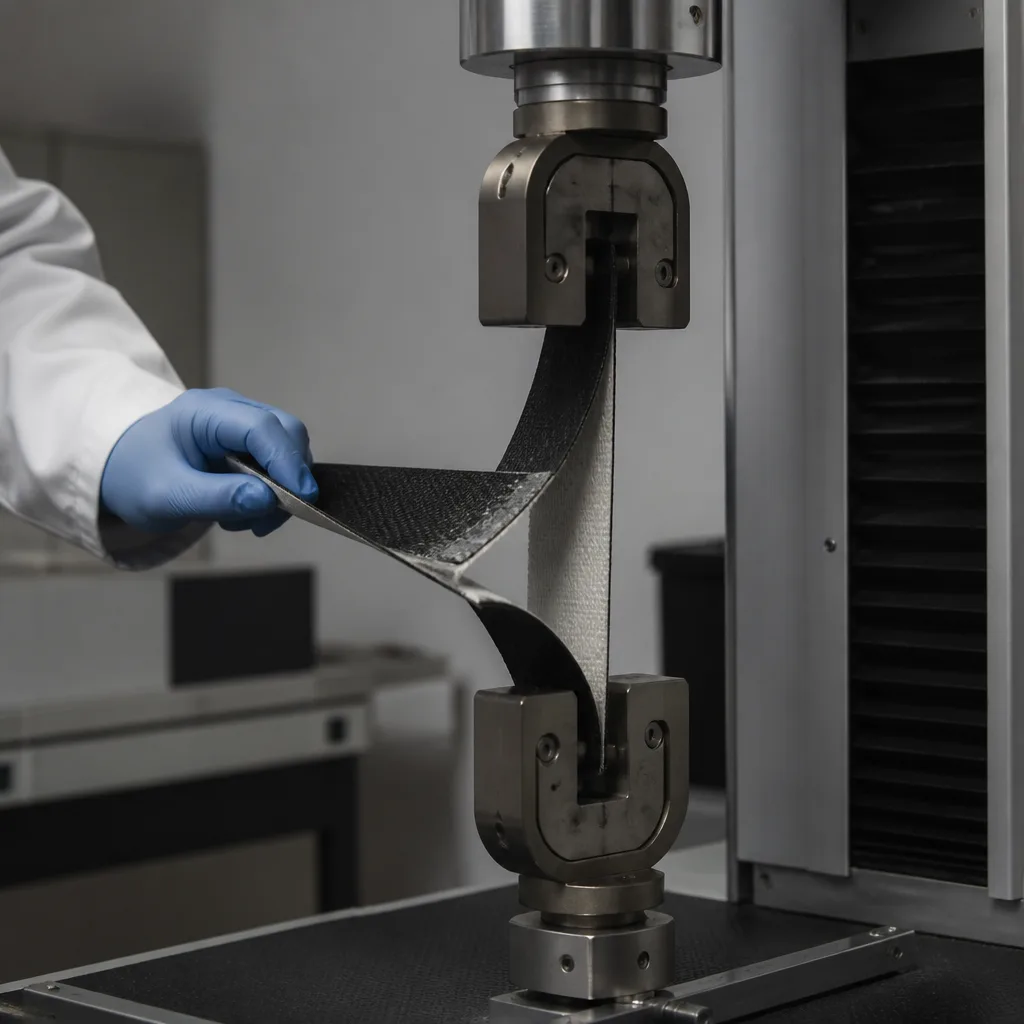
The primary purpose of the GMW 3220 standard is to determine the average force required to physically separate one layer from another in a laminate arrangement. This method is designed for laminated soft flooring materials rather than rigidly glued components. A laminate, for example, may consist of:
The bond between these layers must remain sufficiently strong throughout production, transportation, assembly, and vehicle servicing. The GMW 3220 standard provides a quantitative method for evaluating this characteristic.
The GMW 3220 standard, in principle, uses a constant elongation rate to separate bonded layers of a flexible laminate. During testing, the force required to separate the layers is measured as a function of jaw separation. The resulting force-separation curve is then evaluated to obtain an approximate average laminate bond strength.
In general, the testing process follows these steps:
The exact dimensions of the sample, conditioning, machine settings, separation rate, and evaluation requirements are specified in the GMW 3220 standard.
The key property being measured is laminate adhesion strength, that is, the resistance of the interface between laminated layers to physical separation. This test method helps determine:
The result is generally expressed as a force associated with separation, and appropriate reporting principles are specified by standard and laboratory procedure.
The GMW 3220 standard is particularly important for automotive interior upholstery. Generally applicable to coated textiles and plastic roll products, this standard is classified between adhesion and separation tests. Potential applications include:
However, the exact application depends on the material specification or component requirement to which the GMW 3220 standard is referenced.
A laminate can still have an acceptable appearance even if it has inadequate interlayer adhesion. A weak bond can eventually lead to:
In conclusion, visual inspection alone is insufficient to determine laminate quality. The GMW 3220 standard provides an objective mechanical measurement of the force required to separate the layers. This makes the method useful for material adequacy, supplier quality control, process validation, and failure investigation.
A significant advantage of the described method is that the laminate bond strength can be assessed after the specified exposure or conditioning processes. This standard allows for the evaluation of the separation strength and the durability of the laminate bond under the required exposure conditions. This is important because adhesive interfaces can change significantly after exposure to the following factors:
A material with high initial bond strength may not maintain that strength throughout its expected service life.
A laboratory applying GMW 3220 typically uses a universal tensile testing machine or equivalent tensile device capable of maintaining a controlled, constant elongation rate. Typical equipment includes:
The testing machine must be able to accurately record the changing force as the laminate layers separate.
The force curve is important because laminate separation is not always homogeneous. The measured force can fluctuate due to failures in different regions of the interface. Therefore, the GMW 3220 standard is not based on a single instantaneous peak. The procedure evaluates the separation behavior to obtain an average laminate bond strength.
The results are interpreted as follows:
However, acceptance should always be based on the specific material or component specification, rather than on a general sense of good or bad value.
The GMW 3220 standard belongs to a broader family of automotive adhesion and separation methods. For example, laboratories list it alongside ISO 11339, FLTM BN 121, and Chrysler laminate/bond strength procedures. However, these methods should not be considered automatically interchangeable. Differences may exist in sample preparation, loading configuration, separation rate, conditioning, and result calculation.
In summary, the GMW 3220 standard defines a mechanical testing method used to determine the laminate bonding strength of flexible automotive flooring materials. Its primary purpose is to measure the force required to separate bonded layers, thereby assessing the integrity of the laminate structure.
This test is valuable for automotive manufacturers and suppliers because it provides an objective measurement of interlayer adhesion and can reveal weaknesses that could ultimately lead to separation, peeling, or other interior upholstery failures. Therefore, it is an important quality control and material verification method for laminated soft-touch flooring products.
For many years, our organization, with its competent and experienced staff, has been understanding the needs of its clients, providing the advanced testing services they require, and assisting them in the establishment, implementation, and improvement of management systems. Within this framework, we also provide testing services in accordance with the GMW 3220 standard.
To get an appointment, to get more detailed information or to request an evaluation, you can ask us to fill in our form and reach you.

