

The “GMW 3286 Neutral Salt Spray Corrosion Test” standard, developed by General Motors Worldwide (GMW), is an engineering standard that includes a procedure for evaluating the corrosion resistance of metallic materials, coatings, and finished components through neutral salt spray (NSS) testing. This procedure is designed to provide a controlled and repeatable accelerated corrosion environment for automotive materials and components.
Automotive components are exposed to moisture, road salt, humidity, and other corrosive contaminants during use. These conditions can lead to rust, coating degradation, loss of adhesion, discoloration, and ultimately functional failure. The GMW 3286 standard provides a standardized laboratory method for accelerating chloride-induced corrosion so that the protective performance of a material or coating can be evaluated over a controlled period. Therefore, it is useful for material development, coating qualification, supplier verification, quality control, and corrosion performance comparison.
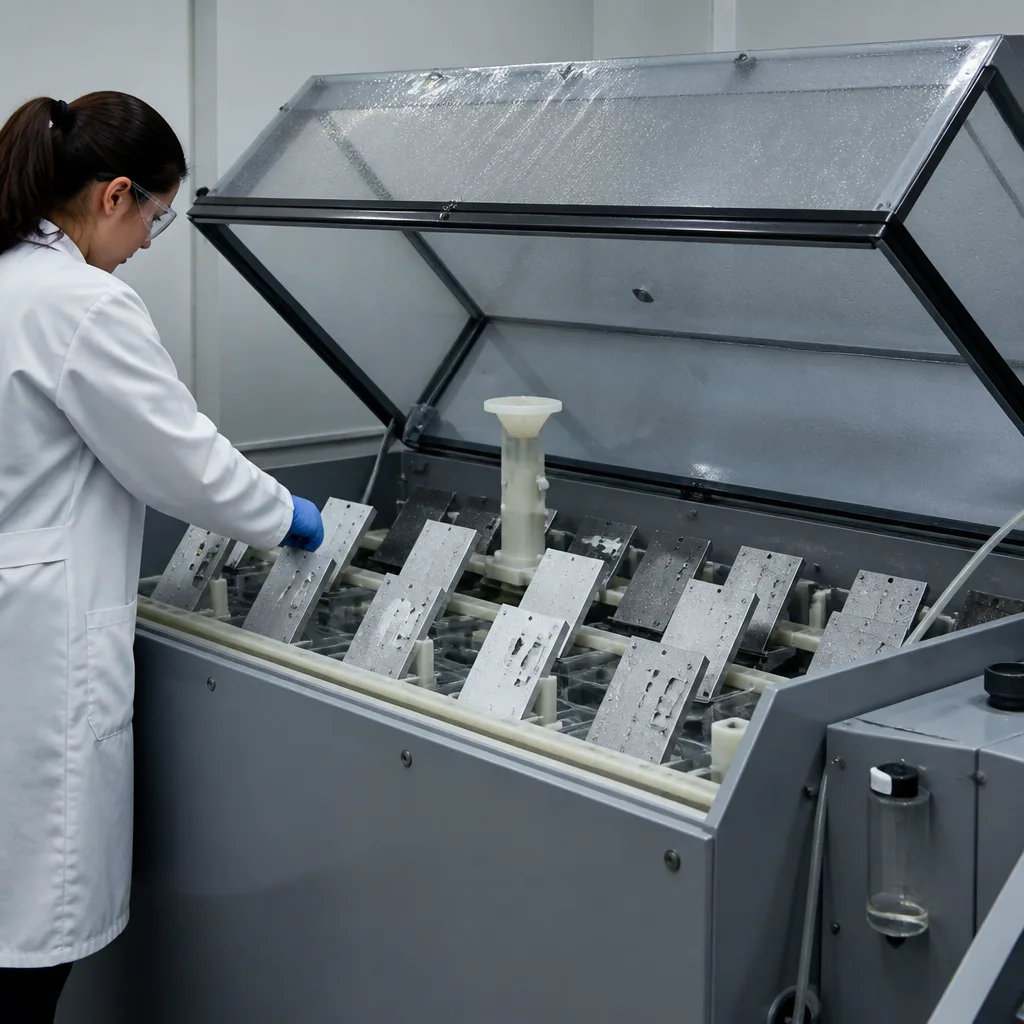
This test method exposes samples to a continuous mist of aqueous sodium chloride solution within a controlled corrosion chamber. The salt solution creates an aggressive chloride-containing atmosphere that accelerates the corrosion of sensitive metallic surfaces. The test sample is typically positioned so that its dominant surface is exposed to the salt mist at an angle of approximately 15 to 30 degrees from the vertical, although other orientations may be used if agreed upon by the responsible parties. Rather than directly reproducing a specific external environment, the test aims to recreate a controlled and reproducible corrosive environment.
The GMW 3286 standard checks various parameters to ensure consistency between tests:
The GMW 3286 standard is applicable to metallic substrates and components, including parts with protective coatings or surface treatments. Examples of automotive applications include:
The exact configuration of the sample, exposure time, and acceptance criteria are generally determined by the relevant component specification, drawing, or engineering requirement.
Following exposure, samples are examined for signs of corrosion and deterioration. Depending on the product requirement, the assessment may include:
GMW 3286 standard specifies the salt spray procedure. Specific acceptance criteria may be defined by the relevant component or material specification.
This standard belongs to a family of neutral salt spray corrosion procedures widely used in the automotive industry. Laboratories often list it alongside ASTM B117, ISO 9227, and JIS Z 2371 standards for salt spray testing. However, these standards should not be considered automatically interchangeable. Even though the basic principle is similar, the specified solution preparation, chamber requirements, sample arrangement, monitoring requirements, exposure time, and evaluation criteria may differ.
The GMW 3286 standard is described as General Motors' successor to the neutral salt spray test described in the older GM 4298P standard.
The GMW 3286 standard is important because corrosion protection is a crucial durability requirement for automotive components. A component that performs correctly when new can experience significant degradation if its metallic substrate or protective coating does not offer sufficient resistance to chloride exposure. This procedure helps suppliers in the following areas:
Both GMW 3286 and ASTM B117 standards utilize salt spray exposure to accelerate corrosion. While ASTM B117 is a commonly used general salt spray application, GMW 3286 is an engineering procedure specific to General Motors. The main differences between these two standards are as follows:
A simplified GMW 3286 test process follows these steps: sample preparation, chamber preparation, salt spray verification, chamber conditioning, sample placement, continuous salt spray exposure, daily monitoring, sample removal, corrosion assessment, and test report.
Before the formal test begins, the chamber and saline solution must meet the necessary operating conditions. Chamber preparation and the establishment of operating conditions must take at least 16 hours before the test starts.
In conclusion, the GMW 3286 standard is particularly valuable in the automotive industry because it helps identify weaknesses in metallic materials and protective surface treatments before they reach long-term vehicle service.
For many years, our organization, with its competent and experienced staff, has been understanding the needs of its clients, providing the advanced testing services they require, and assisting them in the establishment, implementation, and improvement of management systems. Within this framework, we also provide testing services in accordance with the GMW 3286 standard.
To get an appointment, to get more detailed information or to request an evaluation, you can ask us to fill in our form and reach you.

