

Developed by Fiat Chrysler Automobiles (FCA) (now Stellantis), an Italian-American automotive company, the “Fiat 7-M8300 Cellular Polyurethane Filling for Vehicle Seat Cushions and Backrests” standard is an automotive material testing standard used to evaluate cellular polyurethane foam fillings used in vehicle seat cushions and backrests. This specification focuses on the mechanical and durability performance of polyurethane foams that provide seating comfort, support, and long-term dimensional stability in automotive interiors.
Polyurethane foam degrades over time for the following reasons:
The Fiat 7-M8300 standard establishes controlled laboratory methods to verify that the seat foams can withstand these stresses and maintain their appropriate mechanical properties.
This standard is primarily divided into the following test sections:
This procedure is specifically designed for cellular polyurethane padding used in motor vehicle seat cushions and backrests.
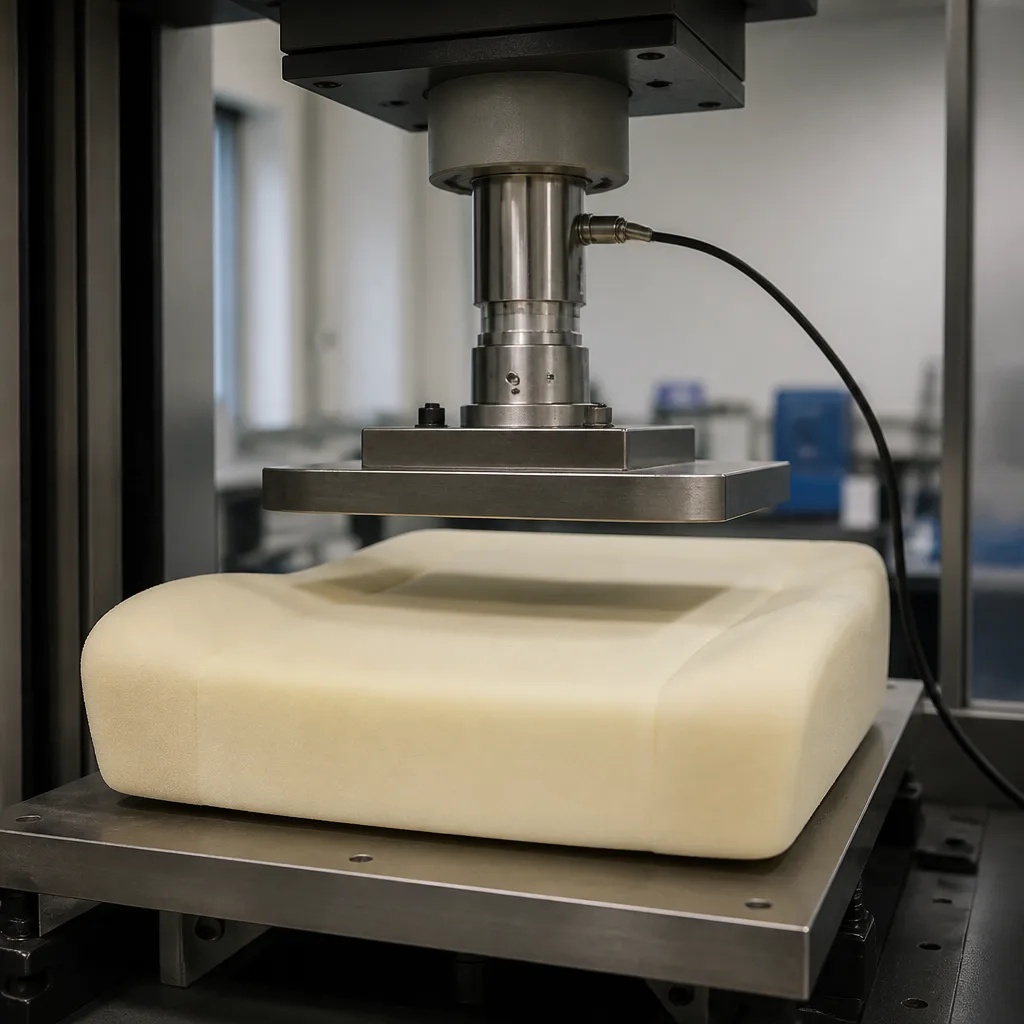
During testing, a foam sample is compressed using a standard-sized plate. The force required to achieve a specified deformation is then measured. Typical compression levels might include:
The resulting force-strain curve shows the following:
Indentation load deflection is important for the following reasons:
Consistent foam firmness is crucial for ergonomic performance.
Indentation load deflection testing ensures that each production batch meets the required specifications.
In principle, when administering the test:
A lower compressive residual deformation value indicates better recovery performance.
Permanent compression deformation is important for the following reasons:
These procedures apply to polyurethane foams used in automotive seat systems.
The aim of the Fiat 7-M8300 standard is to ensure that vehicle seats provide the following:
The following materials are evaluated under the Fiat 7-M8300 standard:
The areas of application of this standard are:
The Fiat 7-M8300 is within the scope of various international foam testing standards, including, for example, ASTM D3574, ISO 2439, and ISO 1856.
The Fiat 7-M8300 standard is necessary because automotive seat foams must maintain their comfort, durability, safety, and dimensional stability throughout the entire lifespan of a vehicle. Without a controlled test specification, the quality of seat cushion materials can vary significantly, leading to premature failure, customer dissatisfaction, and ergonomic issues. This standard provides a consistent method for evaluating the mechanical behavior of polyurethane seat foams used in automotive seat systems.
This standard is considered important for the following reasons:
Without such standards, foam performance varies significantly between suppliers and production batches.
In short, the Fiat 7-M8300 standard is a specific automotive seat foam test specification that focuses on evaluating the following:
This standard helps ensure that the polyurethane seat foam used in Fiat vehicles provides consistent comfort, structural integrity, and durability throughout the vehicle's lifespan. Automotive seat engineering plays a crucial role in supplier qualification and quality assurance.
For many years, our organization, with its competent and experienced staff, has been understanding the needs of its customers, providing the advanced testing services they require, and assisting them in the establishment, implementation, and improvement of management systems. Within this framework, we also provide testing services in accordance with the Fiat 7-M8300 standard.
To get an appointment, to get more detailed information or to request an evaluation, you can ask us to fill in our form and reach you.

