

The GMW 14777 standard, developed by General Motors Worldwide (GMW), describes a test method used to determine the moisture content, water absorption, and thickness swelling of fiberboard, particleboard, cardboard, and similar rigid materials. These properties are particularly important for materials used in automotive components, as exposure to moisture can alter their dimensions, mass, mechanical performance, and appearance.
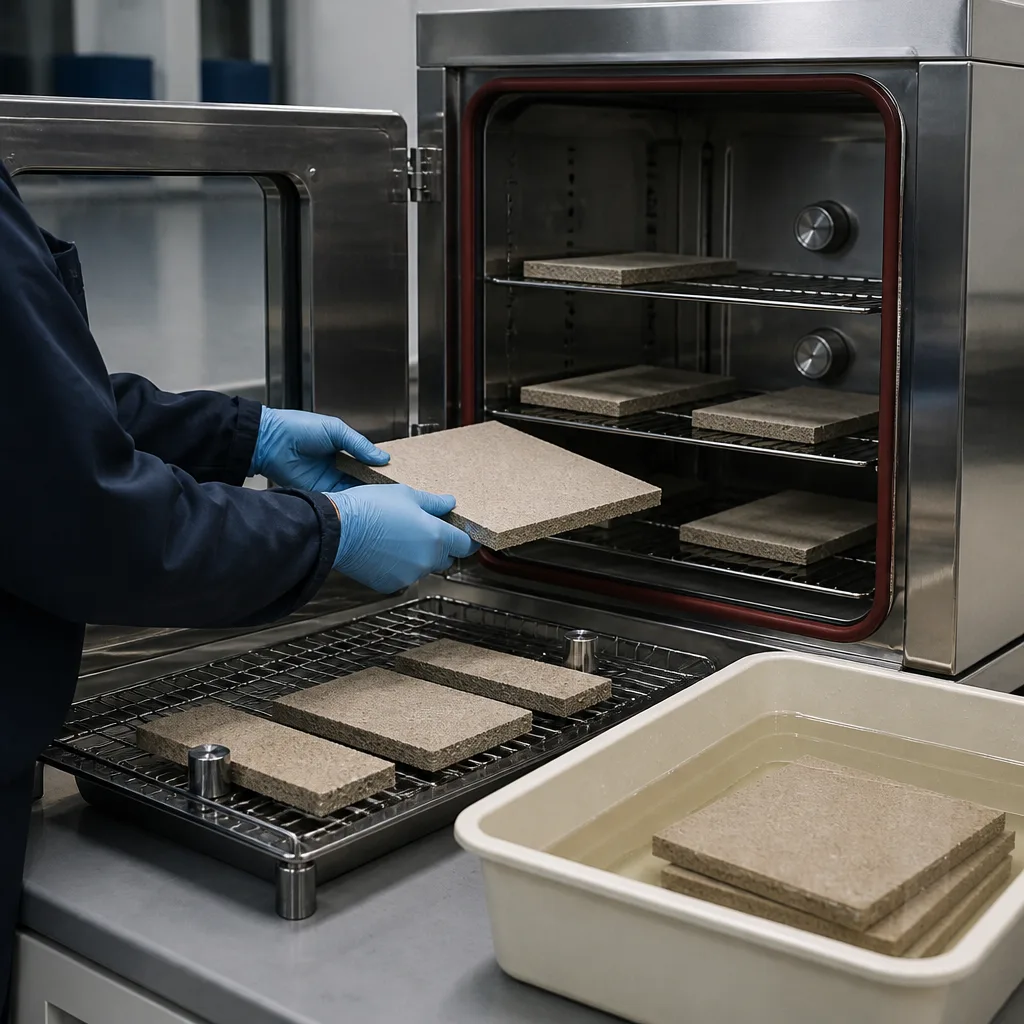
The primary purpose of the GMW 14777 standard is to provide a standardized procedure for measuring the following three moisture-related properties:
This method is applicable to rigid materials such as fiberboard, particleboard, cardboard, and similar materials. These measurements help determine how a material behaves when exposed to water or humid environmental conditions.
Automotive materials can be exposed to moisture during manufacturing, transportation, vehicle operation, cleaning, condensation, and exposure to environmental factors. A material that absorbs excessive water may experience the following:
For internal components, these effects can eventually lead to poor fit, squeaking or rattling, deformation, or premature failure. Therefore, the GMW 14777 standard provides a way to compare materials and determine whether their moisture-related behavior is suitable for their intended automotive application.
Moisture content represents the amount of water already present in the material before the water absorption test. Generally, the sample is weighed in its initial state and then dried under controlled conditions until a stable mass is obtained. A higher moisture content indicates that the material contains more water at the time of testing.
Water absorption measures how much water a material absorbs when exposed to water. The sample is weighed before exposure to water and then subjected to a specified water conditioning process. It is weighed again after exposure. The increase in mass provides an indication of the material's ability to absorb water.
In applications where dimensional stability and resistance to moisture are important, a low water absorption rate is generally desired.
Thickness swelling describes the increase in thickness of a sample after exposure to water. The initial thickness is measured before conditioning, followed by a measurement after the specified water exposure. Thickness increase is particularly important for sheet-like materials because even a relatively small dimensional change can affect the fit and function of an automotive component.
The exact dimensions of the sample, conditioning requirements, exposure time, drying conditions, and measurement details are specified in the GMW 14777 standard, but the test generally follows this sequence: Sample preparation, initial measurements, initial weighing, water exposure, final measurements, drying, final weighing, calculations. Important measurements may include:
The results are then used to calculate the relevant moisture, absorption, and swelling properties.
The GMW 14777 standard specifically covers the following:
Test laboratories also list the method for automotive applications, including components, leather-fiber materials, textiles/yarns, and coated textile/plastic roll products.
This standard may be particularly applicable to rigid or semi-rigid materials integrated into automotive components where moisture exposure can affect dimensional stability. Examples include:
Therefore, the test is part of a broader group of physical property evaluations used for automotive interior materials.
GMW 14777 is one of several General Motors methods that address the performance of rigid sheet materials. For example, GMW 14777 addresses the burst strength of rigid materials such as cardboard and fiberboard, while GMW 14773 addresses the dimensional stability of rigid materials such as fiberboard and cardboard under humid conditions. Together, these tests can provide a broader picture of a material's resistance to environmental and mechanical stresses.
The GMW 14777 standard is important because moisture can significantly affect the performance of sheet-based automotive materials. A material may have adequate strength in a dry state, but behave very differently after absorbing water. This testing helps General Motors and its suppliers in the following areas:
In summary, the GMW 14777 standard test method is a material testing standard focusing on the effects of moisture on rigid sheet-type materials. By measuring moisture content, water absorption, and thickness swelling, this standard provides crucial information about how a material will behave when exposed to water. This is particularly useful for the qualification and quality control of materials used in automotive components that require dimensional stability, durability, and resistance to moisture.
For many years, our organization, with its competent and experienced staff, has been understanding the needs of its clients, providing the advanced testing services they require, and assisting them in the establishment, implementation, and improvement of management systems. Within this framework, we also provide testing services in accordance with the GMW 14777 standard.
To get an appointment, to get more detailed information or to request an evaluation, you can ask us to fill in our form and reach you.

